Even the smallest ecosystems, like ponds, are feeling the pressures of global biodiversity loss, with human-driven fragmentation posing a significant threat.
These often-overlooked waterbodies are vital to ecological balance, housing diverse microbial communities that play crucial roles in ecosystem functioning. While the effects of habitat fragmentation on larger organisms are widely recognized, the impact on microorganisms such as bacteria and algae remains less understood.
A recent study published in Global Change Biology by researchers from the HUN-REN Centre for Ecological Research in Hungary sheds new light on how the loss of connectivity between ponds disrupts microbial biodiversity, revealing profound consequences for both the tiny organisms and their broader ecosystems.
Katalin Mázsa | Hun-Ren Ökológiai Kutatóközpont – In the midst of the ongoing global biodiversity crisis, even the smallest habitats like ponds demand our attention. Fragmentation of these habitats – driven by human activities like urbanization, agriculture, and land-use changes – poses a significant threat to biodiversity.
Often overlooked in conservation efforts, ponds serve as vital ecological hotspots, supporting diverse species and sustaining essential ecosystem processes. These waterbodies are home to various microbial communities that, despite their tiny size play an indispensable role in ecosystem functioning, acting as primary producers, decomposers, and links in food webs.
While the impacts of habitat fragmentation on large organisms like mammals and birds are well-documented, the effects on microscopic organisms, including bacteria, algae, and other unicellular eukaryotes remain poorly understood.
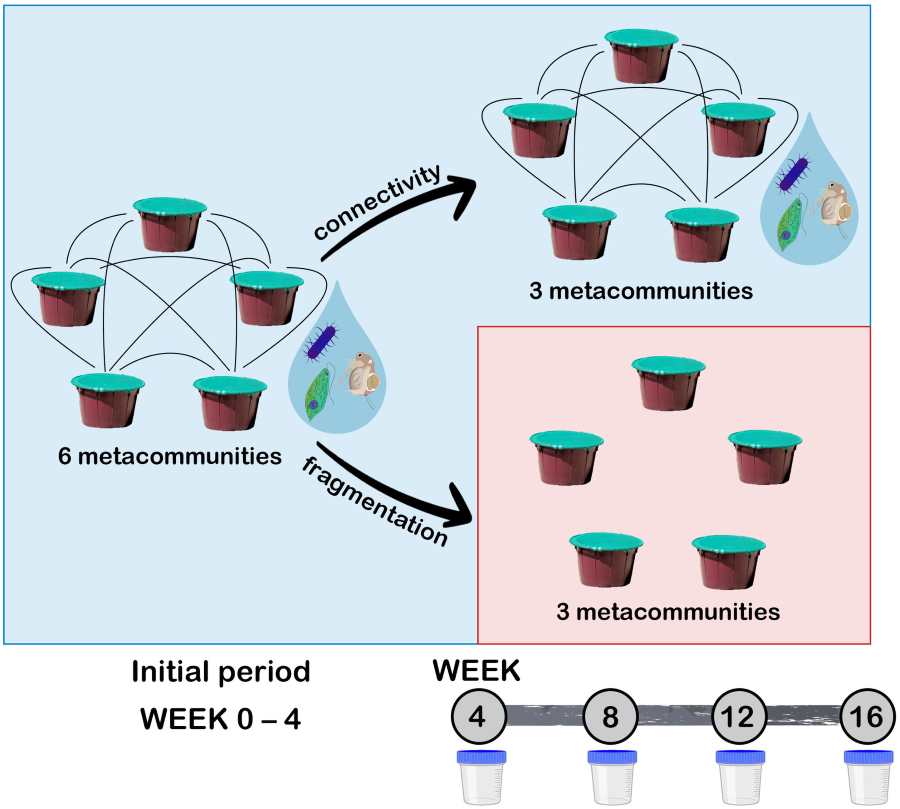
A recent study carried out by researchers from HUN-REN Centre for Ecological Research in Hungary explored the effects of connectivity loss within pond networks. Using an outdoor experimental setup of artificial ponds (mesocosms), the researchers simulated fragmentation by terminating the movement of water and organisms between habitats in half of the pond networks while maintaining dispersal in the other half.
By controlling for factors like habitat size and environmental conditions, and focusing solely on connectivity loss, the study provided an insight into the direct impacts of fragmentation on biodiversity.
“Our findings were particularly striking for unicellular microeukaryotes. Connectivity loss led to significant declines in their diversity at both local and regional levels, highlighting that fragmentation can directly drive biodiversity loss, even under controlled circumstances,” explains Dr. Beáta Szabó, the first author of the study.
“Both rare and abundant species were impacted, suggesting that fragmentation represents a widespread and severe threat to microbial biodiversity. In contrast, prokaryotes appeared more resilient, though we observed signs of a potential “extinction debt,” where biodiversity loss may emerge over longer timescales.”
Beyond biodiversity, the study also highlighted how connectivity loss disrupts trophic interactions. Zooplankton grazers, which interact closely with microbial communities, experienced reduced biomass in fragmented habitats, further exacerbating the decline in diversity and community evenness of microeukaryotes.
These findings highlight the interdependence of organism groups within ecosystems and the cascading impacts that habitat fragmentation can have on biodiversity and ecosystem functioning.
“Our study clearly demonstrates that habitat fragmentation – specifically the loss of connectivity – can have serious and far-reaching consequences for biodiversity. Even when habitat size or environmental conditions remain constant, simply disrupting the dispersal of individuals between habitats can trigger significant declines in microbial diversity,” summarizes Dr Zsófia Horváth, the senior author of the study and head of the Biodiversity and Metacommunity Ecology Research Group at Institute of Aquatic Ecology, HUN-REN Centre for Ecological Research.
“Conservation efforts must not only focus on preventing habitat destruction, particularly in vulnerable ecosystems like pond networks, but also prioritize maintaining and restoring connectivity between habitats to protect the ecosystems and species that rely on them. This is especially crucial for microbes, which, despite their small size, have enormous ecological significance.”
Journal Reference:
Beáta Szabó, Máté Váczy-Földi, Csaba F. Vad, Károly Pálffy, Thu-Hương Huỳnh, Péter Dobosy, Ádám Fierpasz, Zsuzsanna Márton, Tamás Felföldi, Zsófia Horváth, ‘Connectivity Loss in Experimental Pond Networks Leads to Biodiversity Loss in Microbial Metacommunities’, Global Change Biology 30 (12) e70001 (2024). DOI: 10.1111/gcb.70001
Article Source:
Press Release/Material by HUN-REN Centre for Ecological Research (Hun-Ren Ökológiai Kutatóközpont)
Featured image: Outdoor experimental setup of artificial ponds (mesocosms) used for studying how aquatic microbes are affected by the effects of connectivity loss within habitat networks. Credit: Zsófia Horváth