Sumary:
What if carbon dioxide, a major greenhouse gas, could be converted into a useful fuel source – quickly, efficiently, and at scale?
Researchers from Tohoku University, Hokkaido University, and AZUL Energy, Inc. have developed a spray-growth method that does just that. Their technique forms crystalline layers of cobalt phthalocyanine (CoPc) directly onto carbon paper electrodes in only 15 minutes, bypassing the traditional 24-hour fabrication process. This streamlined approach doesn’t just save time – it delivers record-setting performance in the electrochemical reduction of CO₂ to carbon monoxide (CO), a key intermediate for synthetic fuels.
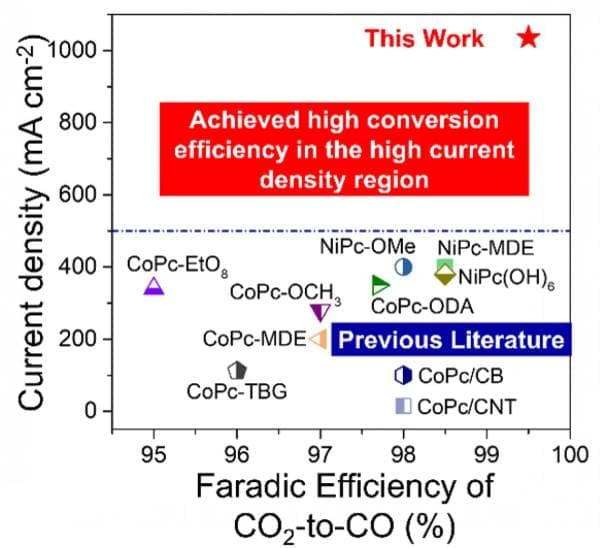
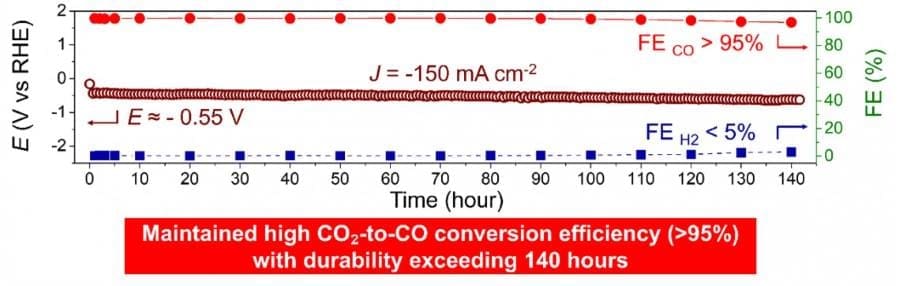
The study, published in Advanced Science, reports that the spray-grown CoPc electrode maintains over 90% selectivity for CO production across a wide voltage range and achieves an unprecedented CO current density of −1034 mA cm-2. It also shows remarkable long-term stability, operating continuously for 144 hours at a current density of −150 mA cm-2. Detailed analysis revealed that the electrode’s crystalline structure and surface charge transfer properties enable more efficient electron movement and improve the adsorption of key reaction intermediates.
By simplifying production and exceeding industrial benchmarks, this spray-growth method offers a practical route toward scaling up CO₂ utilization and opens the door for broader use of phthalocyanine-based catalysts in clean energy technologies.

— Press Release —
Turning Pollution into Fuel with Record-Breaking CO₂-to-CO Conversion Rates
What if we could transform harmful pollution into a helpful energy source? As we strive towards carbon neutrality, researching energy innovations that reduce pollution is crucial. Researchers at Tohoku University, Hokkaido University, and AZUL Energy, Inc. developed a streamlined process for converting carbon dioxide (CO₂) into carbon monoxide (CO) – a key precursor for synthetic fuels. Their method achieved record-breaking efficiency, cutting down the required time from 24 hours to just 15 minutes.
“CO₂-to-CO conversion is currently a hot topic to address climate change, but the conventional techniques had major pitfalls that we wanted to address,” remarks Liu Tengyi (WPI-AIMR at Tohoku University). “The materials were expensive, unstable, had limited selectivity, and took a long time to prepare. It just wouldn’t be feasible to use them in an actual industrial setting.”
With industrial standards in mind, the researchers selected various phthalocyanines (Pc) expected to improve performance [metal-free (H2Pc), iron (FePc), cobalt (CoPc), nickel (NiPc), and copper (CuPc)]. These were sprayed onto gas diffusion electrodes to directly form crystalline layers of the phthalocyanines on the electrode surface. Ultimately, CoPc – a low-cost pigment and metal complex – showed the highest efficiency in converting CO₂ to CO.
This graffiti-like method of simply spraying the catalyst on a surface reduces the typical processing time down to a mere 15 minutes. Conventional methods required a tedious process of mixing conductive carbon and binders, drying, and heat treatment over 24 hours. Furthermore, under a current density of −150 mA cm-2, the new system maintained stable performance for 144 hours. Using the DigCat Database (the largest experimental electrocatalysis database to date), the researchers confirmed that their catalyst surpassed all previously reported Pc-based catalysts.
“Not only is this the best Pc-based catalyst for producing CO to date, but it successfully exceeds the industrial standard thresholds for its reaction rate and stability,” remarks Liu. “It’s the first ever to make the cut.”
Read also: Innovative catalyst layering unlocks new potential in sustainable fuel production
To investigate the reasons behind this high performance, the team conducted structural analysis using synchrotron radiation at the NanoTerasu facility, along with theoretical calculations. The results suggested that the crystallization led to densely packed molecules, which facilitated efficient electron transfer to the surface. These findings highlight that direct crystallization is an effective strategy for fabricating metal complex-based catalyst electrodes for CO₂ electroreduction.
The gas diffusion electrode fabrication method developed in this study, along with the CO₂ electrolysis technology, offers a promising pathway for synthesizing carbon monoxide (CO), an important intermediate for synthetic fuels, from CO₂ with high efficiency using low-cost pigment-based catalysts. This approach addresses one of the key bottlenecks in synthetic fuel production by improving energy efficiency and reducing costs associated with CO₂ utilization. As such, it holds great potential as a next-generation technology for Carbon Dioxide Capture and Utilization (CCU).
Journal Reference:
T. Liu, D. Zhang, Y. Hirai, K. Ito, K. Ishibashi, N. Todoroki, Y. Matsuo, J. Yoshida, S. Ono, H. Li, H. Yabu, ‘Surface Charge Transfer Enhanced Cobalt-Phthalocyanine Crystals for Efficient CO₂-to-CO Electroreduction with Large Current Density Exceeding 1000 mA cm−2‘, Advanced Science online, 2501459 (2025). DOI: 10.1002/advs.202501459
Article Source:
Press Release/Material by Tohoku University
Featured image credit: Malte Reimold | Pixabay