

Summary:
Even as global climate policy struggles to remain at the forefront of political agendas, a large majority of people across the world back comprehensive international measures to combat climate change.
A study published in Nature Human Behaviour and co-authored by the Potsdam Institute for Climate Impact Research (PIK) shows widespread public support for policies that combine climate mitigation with global redistribution. The research team surveyed over 40,000 people in 20 countries, including the U.S., Japan, and major EU nations, and found strong approval for a global carbon pricing scheme that funds equal per capita transfers – what they call the Global Climate Scheme (GCS).
A second round of surveys among 8,000 respondents in the U.S., France, Germany, Spain, and the UK confirmed this support, even when participants understood that wealthier countries would contribute more. Using robust methods such as list experiments and conjoint analyses, the researchers found that support for such policies is sincere and stable. “This study is not about current sentiment, but about deep-seated attitudes,” said co-author Linus Mattauch. The results challenge the idea that ambitious global action lacks a social mandate, and suggest the public may be more ready for international climate cooperation than political discourse assumes.
Encouraging findings on public acceptance of global climate policy
Even though the topic seems to have slipped down the political agenda, comprehensive measures to combat global heating enjoy widespread public support around the world. The study co-authored by the Potsdam Institute for Climate Impact Research (PIK) now takes a scientific look at the acceptance of global climate policies. The research team draws on surveys that it initiated around the globe specifically for this purpose. It shows that there is strong and genuine support for international carbon pricing, per capita reimbursement of revenues, and thus redistribution to poorer countries.
“This study is not about current sentiment, but about deep-seated attitudes,” explains co-author Linus Mattauch, head of PIK’s Societal Transition and Well-being research group. “That’s why we test the robustness of questionnaire responses by a wide variety of methods – in other words, we check whether they will hold up over time. We were pleasantly surprised by the results. Politicians should not be too afraid of citizens when pushing ahead with global climate protection.”
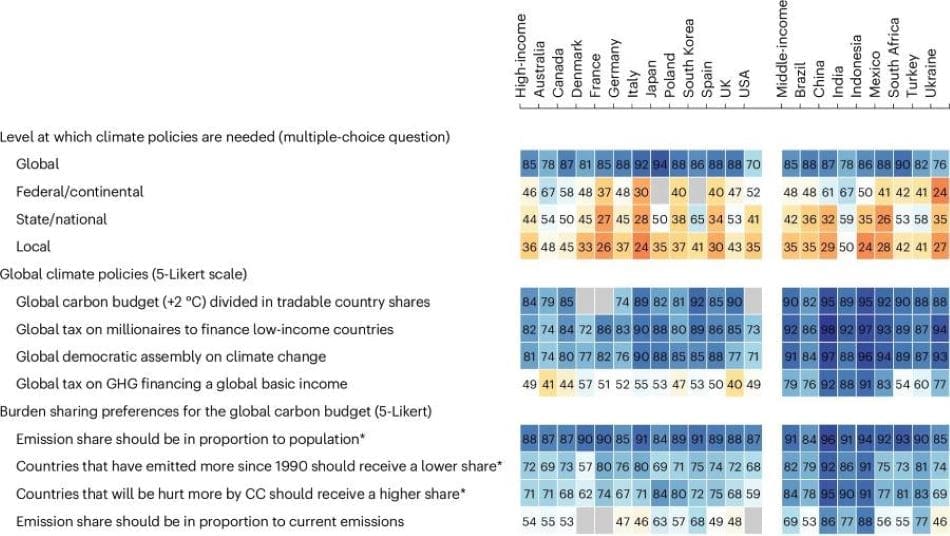
The encouraging findings are based on two scientifically rigorous representative surveys conducted in 2021 and 2023: the first among around 41,000 people in 20 countries accounting for almost three-quarters of all carbon emissions, and the second among 8,000 people in the US and the EU. The 20-country survey shows support for climate policy at the global level, ranging from 70 percent (US) to 94 percent (Japan). And there is similarly high support, in principle, for an ambitious global carbon pricing scheme, in which the remaining global emissions budget (in line with the 2-degree limit) is divided according to population, with countries receiving emission rights that they can trade.
List experiment and conjoint analyses
A finding from the US–EU survey goes even further: the questionnaire specified a concrete timeline for pricing, with 90 dollars per tonne of CO2 in 2030, and a per capita reimbursement of 30 dollars per month for every adult worldwide. This would be a substantial financial inflow to the Global South, where per capita carbon emissions are relatively low and where 30 dollars has more purchasing power than in the wealthy Global North. Even though they understood that their own country would occur a financial loss under these conditions, three-quarters of respondents in the EU, and more than half in the US, expressed support for this idea.
To test whether these were genuinely held convictions, the research team used a list experiment, for example: it “hid” the proposal among other ideas so that it would not be perceived as socially desirable and selected for that reason alone. It also linked the answer to an “action” – namely signing a fictitious petition to the government. The experts also used conjoint analysis, commonly used in market research, in which they broke down the “product” in the questionnaire (i.e., global carbon pricing with redistribution) into its constituent features and compared it with alternatives. Asking respondents to rank various measures, and probing the pros and cons of the actual proposal, also helped to verify the seriousness of the responses.
Willingness to pay the Global South
The reference point of the study – global carbon pricing with redistribution – is considered a long-term goal at best. Indeed, the only concrete plans currently on the table are “climate clubs” involving several countries, or climate agreements (“Just Energy Transition Partnerships”) between industrialised countries and individual nations in the Global South. Regardless of the specific model, however, public acceptance will be a critical issue. The research team is confident that people in the wealthy Global North are willing to pay for climate protection in poorer countries.
“Against this backdrop, the question is why the international community is not making faster progress,” says Adrien Fabre from the French research centre CIRED, the lead author of the study. “How misunderstandings and misperceptions arise in public discourse, and what role interest groups play is yet unclear. Perhaps the boundaries of what is considered realistic are shifting. Our work could contribute to this.”
Journal Reference:
Fabre, A., Douenne, T. & Mattauch, L., ‘Majority support for global redistributive and climate policies’, Nature Human Behaviour (2025). DOI: 10.1038/s41562-025-02175-9
Article Source:
Press Release/Material by Potsdam Institute for Climate Impact Research (PIK)
Featured image credit: Tope J. Asokere | Pexels