Switzerland’s Gries Glacier, nestled in the canton of Valais, is melting at an alarming pace as climate change accelerates the loss of alpine ice. The 5.4 km-long glacier, once a key subject for scientific study, has retreated by about 800 metres between 2000 and 2023 and lost around six metres in ice thickness in just a few months during the summer of 2025.
“This is a dying glacier,” said Matthias Huss, Director of Glacier Monitoring Switzerland (GLAMOS). He explained that despite heavy snowfall in mid-April 2025, the combination of two dry years in 2022 and 2023 and a particularly warm summer in 2025 worsened the situation. “We would need much more snow to counteract the effect of the very warm summers. And this summer of 2025, again, was much too warm,” he said.
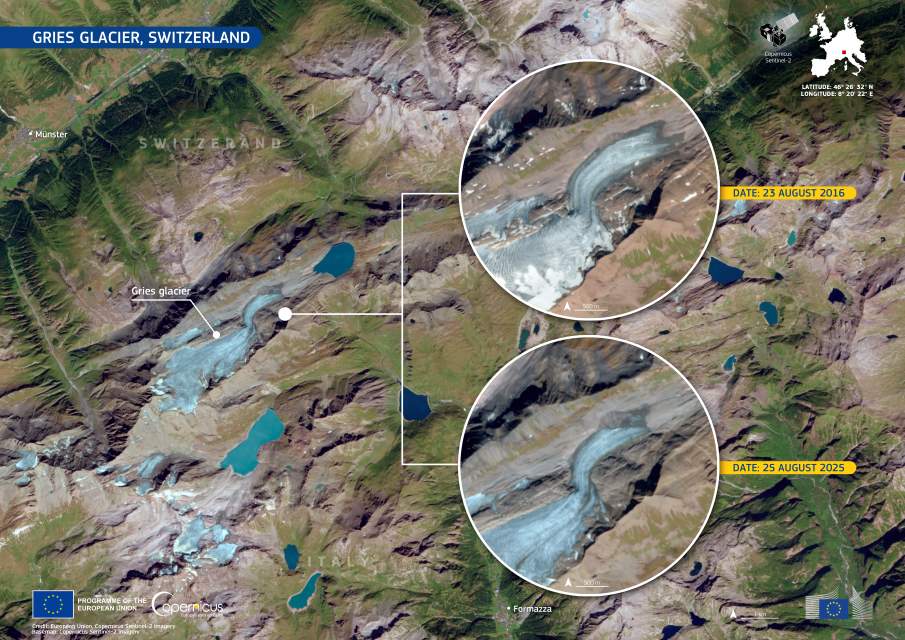
The Copernicus Sentinel-2 image shows the retreat of the glacier over the past nine years, comparing conditions on 23 August 2016 and 25 August 2025. The open data collected by the Sentinel-2 satellites, with their high spatial and temporal resolution, provide valuable insights into glacial dynamics and long-term environmental change.
Today, the Gries Glacier is 3.2 km shorter than it was in 1880, with an average ice thickness of just 57 metres. According to Huss, its lower parts could vanish within five years, while the upper sections around 3,000 metres may persist for another 40 to 50 years.
Across Switzerland, about one hundred glaciers have disappeared between 2016 and 2022, according to GLAMOS. The World Meteorological Organization recently reported that every glaciated region on Earth has continued to lose ice for the third consecutive year, reflecting the global scale of the ongoing melt.
Featured image credit: European Union, Copernicus Sentinel-2 imagery