Sydney is Australia’s largest city and one of the world’s most recognisable urban centres, known for its harbour setting, cultural landmarks and proximity to both ocean and mountains. The city’s population has surpassed five million and continues to grow, making Sydney a focal point for urban sustainability and climate adaptation in the Asia-Pacific region.
Captured by a Copernicus Sentinel-2 satellite on 21 September 2025, the image offers a clear view of Sydney’s coastal layout and surrounding terrain.
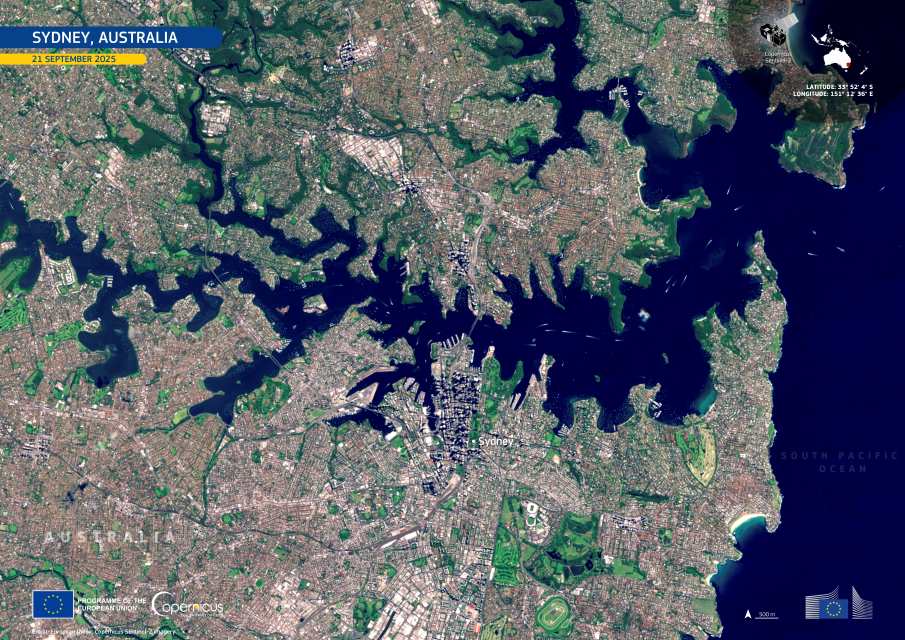
With the Pacific Ocean to the east and the Blue Mountains to the west, Sydney faces increasing environmental pressures linked to climate change. Rising sea levels threaten low-lying coastal suburbs and harbour infrastructure, while inland areas such as Western Sydney experience more frequent and intense heatwaves. Mean sea surface temperatures off New South Wales have increased by about 0.14 to 0.2 °C per decade since the 1950s, adding pressure to marine ecosystems and coastal defences.
To respond, the City of Sydney has introduced an environmental strategy that targets net-zero emissions in its operations and supports large-scale tree planting to expand canopy cover. Urban greening projects, stormwater improvements and renewable energy investments form part of a broader effort to build resilience and protect biodiversity in and around the metropolitan area.
Sydney also hosted the 2025 International Astronautical Congress, held from 29 September to 3 October, underscoring the city’s continuing role as a global meeting place for innovation and science.
Featured image credit: European Union, Copernicus Sentinel-2 imagery