In northern Patagonia, Argentina, the Neuquén and Agrio rivers carve narrow green corridors through a largely arid landscape. Captured by the Copernicus Sentinel-2 mission on 6 September 2025, this false-colour image reveals the contrast between the dry terrain and the thriving vegetation sustained by these two rivers.
The Neuquén River flows southwards, joined by the Agrio River before their waters feed into a reservoir near the town of Añelo. The red tones in the image indicate areas of vegetation, showing how life clusters along the riverbanks in an otherwise inhospitable region. These riparian zones support small-scale agriculture, livestock grazing, and wildlife, providing essential resources for local communities.
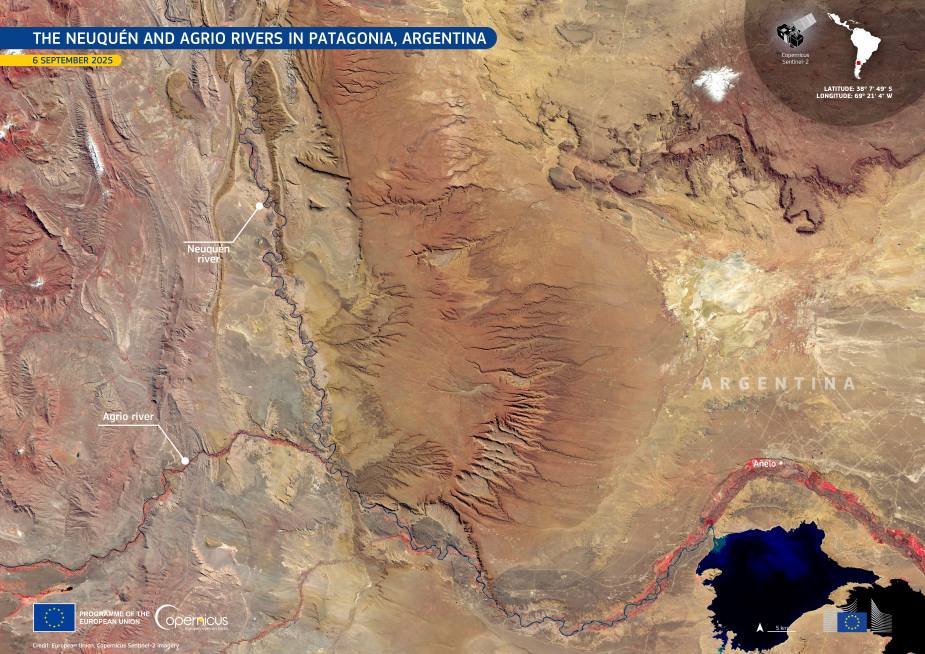
The Neuquén Basin, visible in the image, is one of Argentina’s key geological regions, known for its fossil-rich formations and energy resources. Beyond its economic significance, the basin’s rivers play a vital ecological role by maintaining biodiversity and soil stability in a dry and windy environment.
Climate variations influence the flow of both rivers, affecting vegetation growth and water availability. Changes in rainfall patterns and higher evaporation rates could intensify water stress, making careful management of the rivers and reservoirs increasingly important for local livelihoods.
The false-colour technique used in this Sentinel-2 image enhances near-infrared light reflected by vegetation, turning plant-covered areas bright red. This allows scientists to monitor plant health, water availability, and land-use changes over time. In the Neuquén and Agrio river valleys, it highlights the fragile balance between water, life, and the surrounding Patagonian desert.
Featured image credit: European Union, Copernicus Sentinel-2 imagery