Manila, Philippines | AFP
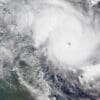
More than 150,000 people took shelter in coastal provinces of the Philippines on Monday as powerful Typhoon Kalmaegi made landfall in a region hit by some of the country’s deadliest storms.
The typhoon, with winds of 150 kilometres (93 miles) per hour and gusts of up to 205 kph, made first contact in Dinagat Islands province, part of the Visayas island chain, before 11 pm (15:00 GMT), the national weather service said.
Barely an hour earlier, 34-year-old Miriam Vargas sat in the darkness with her two children after the storm knocked out their electricity.
“As of now, there is strong rain and winds starting. We’re sitting on the stairs and praying while trying to gauge the typhoon’s strength,” the single mother told AFP from Dinagat.
“The wind is whistling and there are sounds of things falling. The electricity went out about an hour ago, and we cannot see anything.”
Roel Montesa, a disaster official on Leyte Island, said earlier that evacuations were “ongoing in Palo and Tanauan,” naming two of the towns hardest hit by storm surges in 2013, when Super Typhoon Haiyan killed more than 6,000 people there.
Thousands of residents have also been evacuated since Sunday on neighbouring Samar island, where three-metre (10-foot) surges are predicted, according to civil defence official Randy Nicart.
“Some local governments are resorting to forced evacuations,” he said.
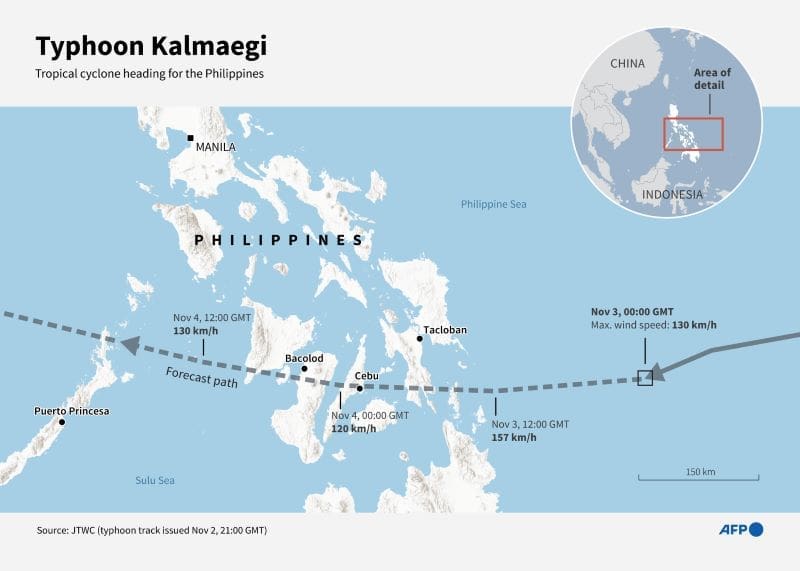
More storms expected
As of 8 pm, “close to 156,000 individuals” had been preemptively evacuated, Office of Civil Defence deputy administrator Rafaelito Alejandro told a press briefing.
The Philippines is hit by an average of 20 storms and typhoons each year, routinely striking disaster-prone areas where millions live in poverty.
With Kalmaegi, the archipelago country has already reached that average, state weather service specialist Charmaine Varilla told AFP, adding that at least “three to five more” storms could be expected by December’s end.
Just south of Leyte, in Dinagat Islands province, governor Nilo Demerey said 10,000 to 15,000 people had been pre-emptively moved to safer areas.
Disaster official Joy Conales said residents of Dinagat’s Loreto town were told to evacuate to higher ground.
The town has a one-storey-tall dike intended to protect its centre from big waves.
Scientists warn that storms are becoming more powerful due to human-driven climate change.
Varilla said that higher numbers of cyclones typically accompany La Niña, a naturally occurring climate pattern that cools surface temperatures in the central and eastern equatorial Pacific Ocean.
The Philippines was hit by two major storms in September, including Super Typhoon Ragasa, which toppled trees and tore the roofs off buildings, and killed 14 people in neighbouring Taiwan.
cgm-cwl/ami
Article Source:
Press Release/Material by Cecil Morella | AFP
Featured image credit: AFP