The Gulf of Morbihan in Brittany forms one of France’s most complex coastal environments, shaped by dozens of small islands, narrow inlets and sheltered bays that create a varied marine landscape. As part of the Natura 2000 network and recognised as a Ramsar wetland, it plays a central role in supporting wintering waterbirds. Between 70,000 and 80,000 birds are counted each January, largely ducks and waders, and the gulf often becomes a crucial refuge during severe cold spells when numbers rise sharply.
During winter, the gulf hosts 25,000 to 35,000 waders, representing 5 to 10 % of the French coastline’s total. Several species reach or surpass international importance thresholds, including Pied avocet (Avocette élégante), Common ringed plover (Grand gravelot), Dunlin (Bécasseau variable), and Black-tailed godwit (Barge à queue noire). Around 35,000 ducks and coots use the site during the colder months, and species such as Brent goose (Bernache cravant), Common shelduck (Tadorne de Belon), Northern pintail (Canard pilet) and Northern shoveler (Canard souchet) also reach internationally significant levels.
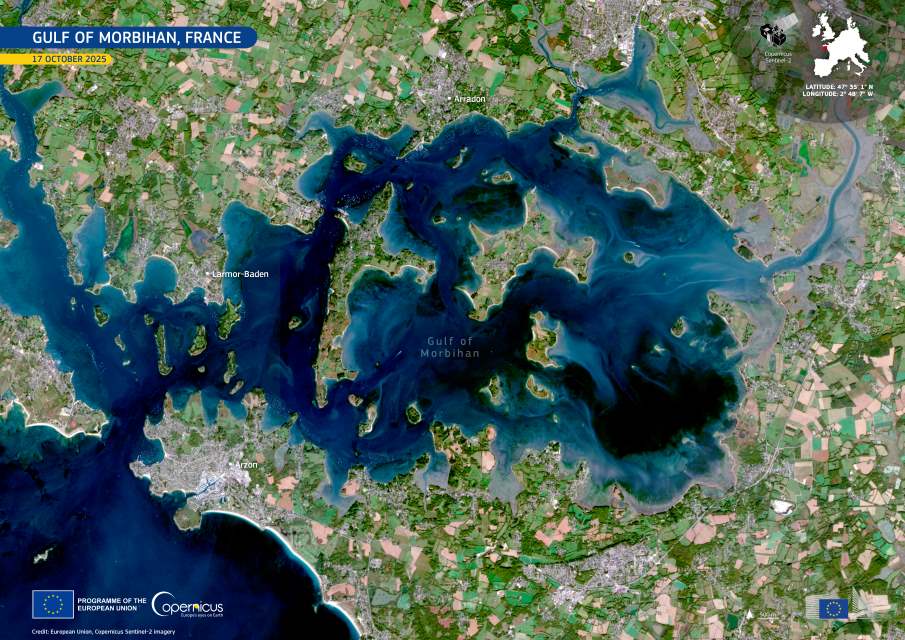
A Copernicus Sentinel-2 image acquired on 17 October 2025 shows the gulf’s intricate outline. Deep blue waters fill the tidal channels at high tide, while bright green vegetation outlines the surrounding coastal habitats that form this shifting landscape.
The gulf is an important migration stopover for Eurasian spoonbill (Spatule blanche), representing 2 to 5 % of the west-European population. The coastal area around Larmor-Baden supports a significant share of the Breton and Irish populations of Dougall’s tern (Sterne de Dougall) during late summer. Twelve species exceed the level of international importance, including Brent goose (Bernache cravant), Red-breasted merganser (Harle huppé), Common shelduck (Tadorne de Belon), Pied avocet (Avocette élégante), Eurasian wigeon (Canard siffleur), Common ringed plover (Grand gravelot), Gadwall (Canard chipeau), Grey plover (Pluvier argenté), Northern pintail (Canard pilet), Dunlin (Bécasseau variable), Northern shoveler (Canard souchet) and Black-necked grebe (Grèbe à cou noir).
The 2008 extension of the protected zone incorporated key high-tide roosts around Locmariaquer, Saint-Philibert and the island of Méaban, areas used by Little egret (Aigrette garzette), Brent goose (Bernache cravant), Common ringed plover (Grand gravelot), Redshank (Chevalier gambette) and Grey plover (Pluvier argenté). Méaban is also a major breeding site for European herring gull (Goéland marin), Lesser black-backed gull (Goéland brun) and Great cormorant (Cormoran huppé).
Copernicus missions, including Sentinel-2, provide frequent and high-resolution observations that help track coastal change, monitor habitats and support long-term conservation efforts in dynamic environments like the Gulf of Morbihan.
Featured image credit: European Union, Copernicus Sentinel-2 imagery