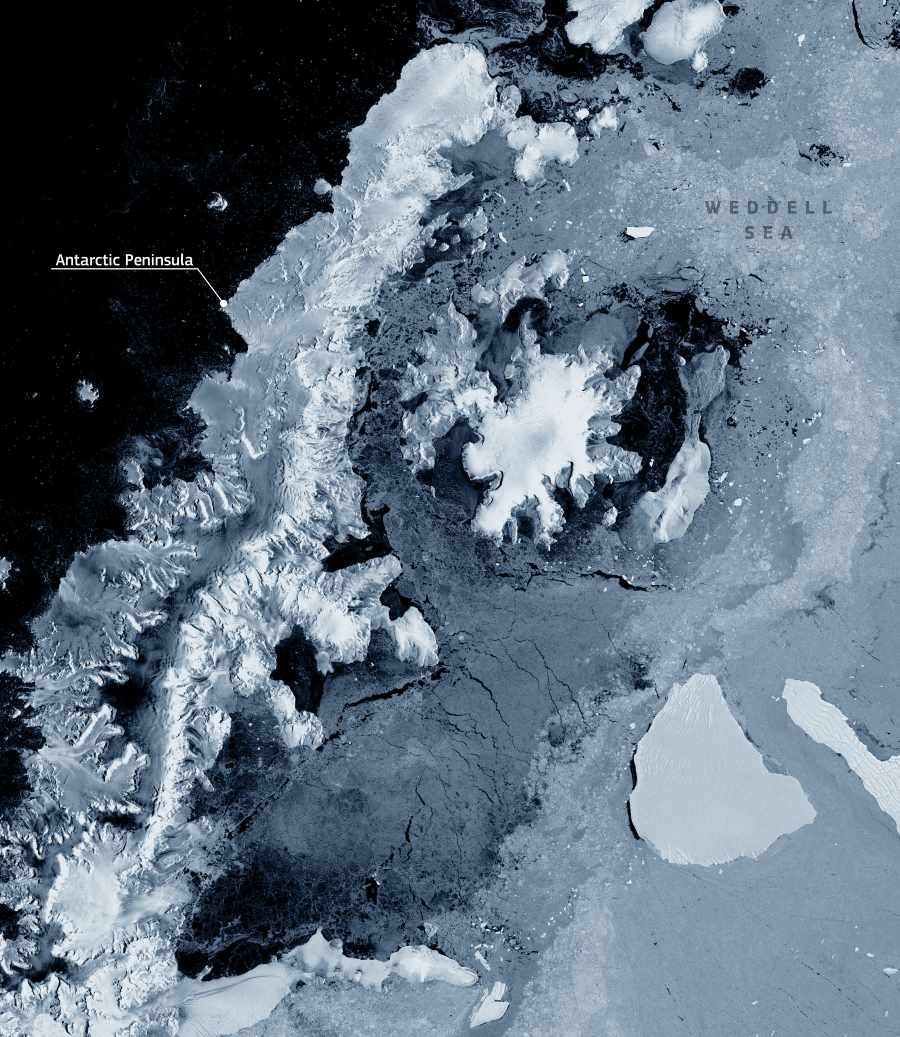
Graham Land, the northern section of the Antarctic Peninsula, forms one of the fastest-warming parts of the continent. Its steep mountain chain and the outlet glaciers that descend toward the Weddell Sea create a boundary where grounded ice, floating shelves, and open water meet. These shifts influence circulation patterns in the Southern Ocean and support ecosystems built around krill, including seals, penguins, and seabirds.
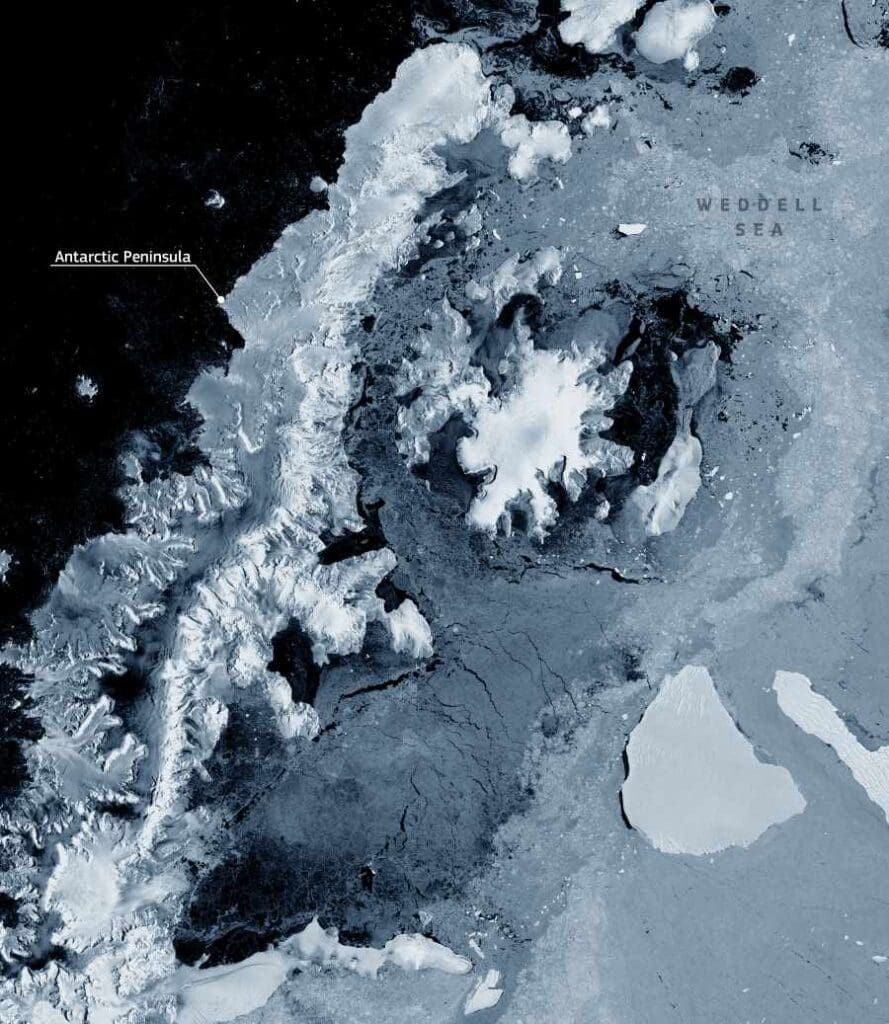
The Copernicus Sentinel-1 image acquired on 21 November 2025 provides a radar view of this transition zone. Variations in backscatter reveal grounded ice with strong reflections, fragmented sea ice with uneven textures, and darker areas of open ocean. These contrasts make structural changes easier to trace, including zones where ice begins to thin or where flow patterns alter as glaciers approach the coast.
A recent study published in Communications Earth & Environment used observations from Sentinel-1 and Sentinel-2 to examine Rusalka and Hoek Glaciers on the western Antarctic Peninsula from 1990 to 2025. The analysis combined grounding-line and calving-front positions with records of sea ice, surface elevation, and flow velocity. Rusalka retreated and accelerated rapidly after 2017 when warm deep water entered a trough that slopes downward beneath the glacier, enabling ocean heat to move inland. Hoek remained stable, supported by an upward-sloping bed and a small floating ice shelf at its front, with summers of higher sea-ice concentration linked to reduced forward motion.
Copernicus data form the foundation for this kind of long-term monitoring, providing consistent observations that allow researchers to assess how ocean temperature, bed shape, and sea-ice conditions influence glacier behaviour in Graham Land. These datasets continue to support climate science by documenting changes across Antarctica with the spatial and temporal coverage needed to understand long-term trends.
Journal Reference:
Dong, Y., Floricioiu, D., Krieger, L. et al., ‘Atmosphere-ocean driven glacial changes in West Graham Land, Antarctic Peninsula’, Communications Earth & Environment 6, 979 (2025). DOI: 10.1038/s43247-025-02939-1
Article Source: Copernicus Services | European Union
Featured image credit: European Union, Copernicus Sentinel-1 imagery