The Image of the day shows the wildfire extent on New Caledonia’s Isle of Pines, where a large fire that began on 30 November 2025 has continued to affect one of the Pacific region’s most distinctive island ecosystems. The island is part of the French overseas territory of New Caledonia and is known for its tropical forests, coastal wetlands, and species found nowhere else.
Civil security services report that the wildfire advanced toward the town of Vao at a speed close to 100 metres per hour in its early stages. Heavy and rapidly shifting winds contributed to the spread, and the absence of firefighters on the island made initial containment difficult. By early December, authorities had identified three main fires. France Info reported on 7 December that burned areas could reach 3,000 hectares by the evening of the same day, with an active fire line stretching roughly five kilometres.
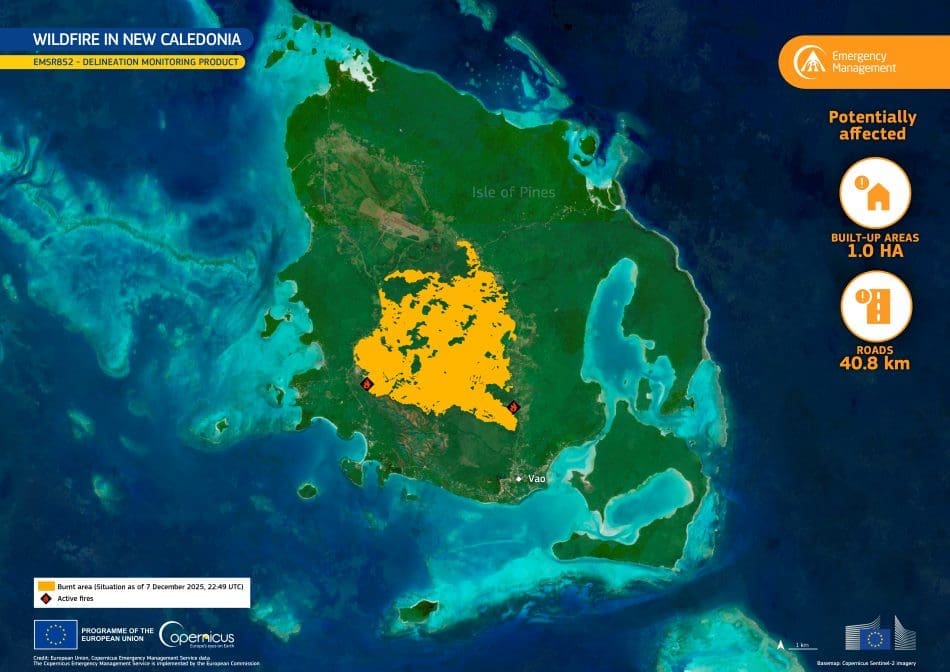
This Copernicus Emergency Management Service image provides a clear view of the situation on 7 December 2025 at 22:49 UTC, with the affected area shown in orange. The mapped burn extent covers 1,856.7 hectares of land as well as 1.0 hectare of built-up zones and 40.8 kilometres of roads. These maps support local authorities as they monitor how the wildfire spreads and plan access to areas that remain difficult to reach.
Copernicus EMS was activated on 7 December at 15:40 UTC following a request from the French Centre Opérationnel de Gestion Interministériel de Crises. The first product for activation EMSR852 was delivered on 8 December at 02:11 UTC, around eleven hours after activation. As of 9 December, remotely sensed analysis estimates that more than 1,900 hectares have burned and almost 50 buildings have been affected, with no active fire visible in the most recent imagery.
Featured image credit: European Union, Copernicus Emergency Management Service