International Mountain Day offers a moment to reflect on the role that mountain regions play in sustaining life far beyond their summits. The retreating glaciers of the Hoher Dachstein massif speak directly to this theme, showing how a changing climate is reshaping water supplies that nearly 2 billion people depend on for daily needs, livelihoods and cultural traditions. Glaciers hold around 70 percent of the world’s freshwater, and their rapid loss signals risks that extend from agriculture to clean energy and long-term water security.
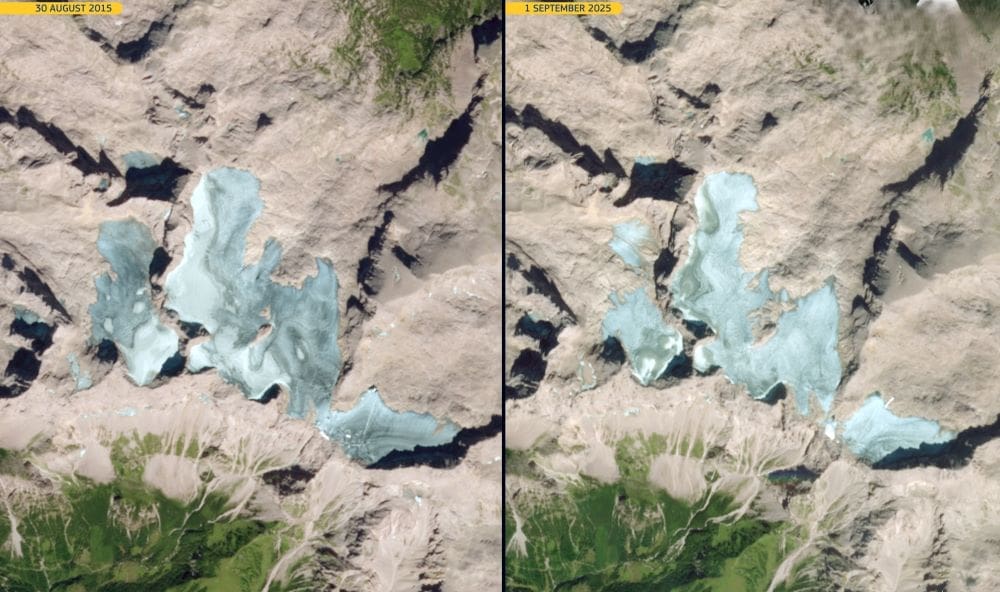
Copernicus Sentinel-2 images from 1 September 2025 and 30 August 2015 reveal a marked reduction in ice cover across the Dachstein’s glaciers, illustrating one of the most emblematic examples of glacier retreat in the Northern Alps. Such comparisons offer clear visual evidence of the accelerating pace of ice loss.
The United Nations notes that five of the past six years have seen the quickest glacier retreat on record. More than 600 glaciers have already disappeared, and many more face the same fate if temperatures continue to rise. As glaciers melt and permafrost thaws, the risks increase for communities living downstream, with greater potential for floods, glacier lake outburst floods, landslides and erosion. Today more than 15 million people worldwide are highly vulnerable to flooding from glacier lakes.
Mountains host 15 percent of the global population and support about half of the world’s biodiversity hotspots. They provide freshwater to half of humanity and support agriculture, clean energy and essential medicines. Yet they are threatened by climate change, overuse and pollution. Steep terrain can magnify the impacts of land clearing, causing erosion and degrading water quality, while more than 311 million rural mountain residents live in areas affected by ongoing land degradation.
International Mountain Day, observed since 2003 through the Food and Agriculture Organization, aims to build awareness of these pressures and encourage cooperation that supports mountain communities. The Dachstein images offer a clear reminder of what is at stake as glaciers continue to retreat.
Featured image credit: European Union, Copernicus Sentinel-2 imagery