Along Mexico’s Pacific shoreline, the Marismas Nacionales region forms one of the country’s most extensive coastal wetland systems. Stretching across parts of Nayarit and Sinaloa, the area is defined by a dense network of brackish lagoons, tidal channels, estuaries, and mangrove forests shaped by river inflows and coastal processes. Its ecological importance has led to multiple layers of protection and international recognition, including designation as a Ramsar wetland of international importance.
At the heart of this landscape lies a vast mosaic of mangroves and interconnected water bodies, including well-known features such as the Agua Brava lagoon and the El Chumbeño estuary along the Nayarit coast. Together, these wetlands support fisheries, protect shorelines, and provide habitat for a wide range of species adapted to fluctuating salinity and seasonal flooding.
This false-colour image was acquired on 25 November 2025 by one of the Copernicus Sentinel-2 satellites. In this rendering, healthy vegetation appears in deep red tones, clearly outlining the extent and continuity of mangrove forests along the coastal zone. The image highlights how mangroves trace lagoon margins and tidal channels, revealing the structure of the wetland system from space and offering a snapshot of vegetation condition at the onset of the dry season.
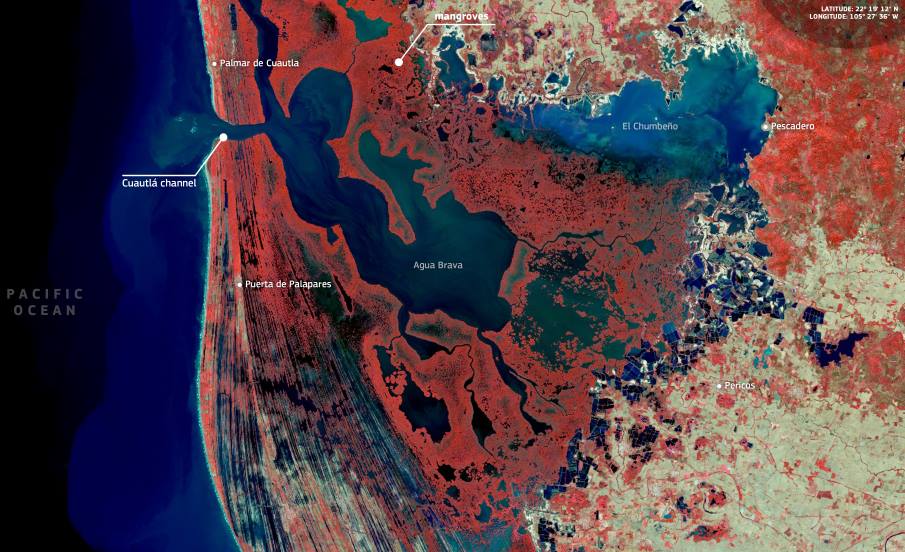
Marismas Nacionales is recognised under the Ramsar Convention as a wetland of international importance, covering a broad network of coastal lagoons, mangroves, swamps, and saltmarshes along Mexico’s Pacific coast. Within this wider system, the Marismas Nacionales Biosphere Reserve focuses on the northern coast of Nayarit, protecting an extensive mosaic of wetlands that form one of the country’s most important mangrove regions.
The wetlands are also notable for their biodiversity. At least 60 species of nationally or internationally endangered vertebrates have been recorded within the Ramsar site, including 51 endemic species. Birds are particularly prominent, with 36 endemic bird species associated with the wetlands, making the region an important area for breeding, feeding, and migration along the Pacific flyway.
Human activity has long been intertwined with the wetlands. Traditional fishing remains widespread, alongside cattle ranching and small-scale animal husbandry. Local communities also harvest fruit, seeds, and palm leaves, which are used in handicrafts and roof thatching. At the same time, parts of the wetland network have been altered, with some creeks converted into large prawn farms, reflecting ongoing economic pressures on the coastal landscape.
Open data from Copernicus Sentinel-2 plays an important role in documenting these dynamics. Satellite observations support the monitoring of mangrove extent, land cover change, and wetland health, providing information used in conservation planning, climate adaptation strategies, and territorial governance initiatives. In a region where ecosystems, livelihoods, and climate resilience are closely linked, such observations offer a consistent way to track change across one of Mexico’s most complex coastal environments.
Featured image credit: European Union, Copernicus Sentinel-2 imagery