Rising from the eastern Mediterranean, Cyprus sits at the crossroads of Europe, Asia, and the Middle East. The island’s position has shaped its history for millennia, but it has also left a clear imprint on its landscapes. Mountains, plains, and a long, indented coastline combine to form a compact yet varied geography that supports a wide range of natural environments.
Although Cyprus has a predominantly semi-arid climate, its ecosystems are far from uniform. The Troodos Mountains dominate the southwest of the island and host some of its most extensive forested areas, where higher elevations receive more rainfall and cooler temperatures. These uplands contrast with the broad central plain, known as the Mesaoria, where agriculture has long depended on careful water management. Along the coast, salt lakes, wetlands, and lagoons provide seasonal refuge for migratory birds moving between Africa and Europe, while also supporting several endemic plant and animal species.
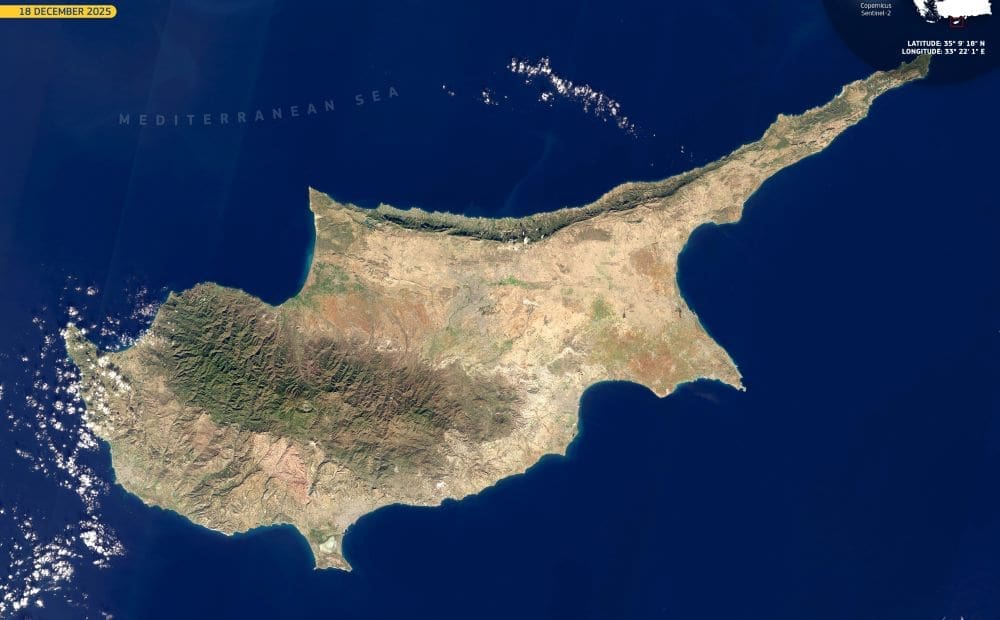
Cyprus is visible in this image acquired by one of the Copernicus Sentinel-2 satellites on 18 December 2025. The surrounding sea appears in deep blue tones, while vegetation is visible in shades of green, contrasting with drier brown and ochre areas of the central plains. The capital city, Nicosia, can be seen near the centre of the island, marking the political and administrative heart of the country.
Beyond its environmental diversity, Cyprus also plays a role in European governance. On 1 January 2026, the country assumed the Presidency of the Council of the European Union for the first half of the year. The rotating presidency involves coordinating meetings, shaping legislative discussions, and representing the Council in negotiations with other EU institutions. Cyprus’s term places renewed attention on the eastern Mediterranean region and its strategic, environmental, and economic links with the wider European Union.
Featured image credit: European Union, Copernicus Sentinel-2 imagery