The Szczecin Lagoon, where the Oder River meets the Baltic Sea, forms a broad and shallow expanse of water shared by Germany and Poland. Separated from the open Baltic by the islands of Usedom and Wolin, the lagoon acts as a transition zone between river and sea, shaped by freshwater inflow, wind-driven circulation, and seasonal temperature shifts.
In winter, this low-lying coastal landscape can change rapidly. Prolonged cold spells allow ice to spread across the lagoon’s surface, while snow settles over reed beds, wetlands, and surrounding farmland. These conditions temporarily alter habitats and limit navigation, but they also reveal the lagoon’s structure with unusual clarity.
The lagoon and its surroundings appear covered with snow and ice in this Copernicus Sentinel-2 false-colour image acquired on 7 January 2026. Snow shows up in bright white tones, while vegetation appears in deep reds, outlining the extensive reed belts and wetland margins that characterise the lagoon’s shoreline near Świnoujście in Poland and Ueckermünde in Germany.
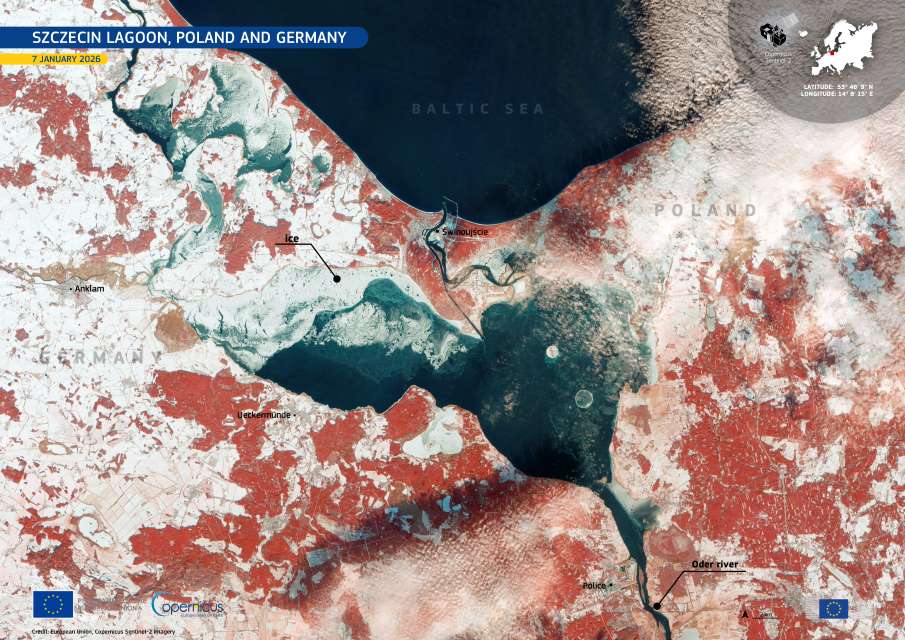
Ecologically, the Szczecin Lagoon is closely linked to the wider Oder Delta. The river’s floodplains upstream – including the Unteres Odertal near Schwedt, designated as a Ramsar wetland – influence water quality and sediment dynamics downstream. Together, these connected systems support fish reproduction, provide feeding and resting areas for migratory birds, and buffer the southern Baltic coast from nutrient loads and flooding.
The lagoon also sits at the centre of growing environmental concern. Pollution from agriculture and industry, increased shipping traffic, and rising temperatures have placed long-term stress on its waters. The mass fish mortality event in the Oder basin in 2022 highlighted how disturbances upstream can quickly propagate into the lagoon, affecting biodiversity across borders.
Copernicus satellite data plays an important role in observing these dynamics. By tracking ice cover, vegetation patterns, and changes in land use, satellite imagery helps authorities and researchers in Germany and Poland monitor the lagoon as a single, interconnected system – an essential step for managing a shared landscape whose winter stillness masks both ecological richness and fragility.
Featured image credit: European Union, Copernicus Sentinel-2 imagery