Flooding in Albania followed several days of persistent rainfall in early January 2026, pushing rivers beyond their banks and inundating low-lying areas across the country’s central and western regions. The floods affected a wide geographic area, with impacts reported along major river corridors and in cities such as Fier and Berat, where agricultural land was submerged and transport and local services were disrupted.
Emergency conditions developed as rainfall continued from 6 January, part of a broader period of severe winter weather across the western Balkans that also brought snow, power cuts, and transport closures. In Albania, emergency services evacuated residents from flooded homes, particularly in southwestern areas near Fier and Vlora, after the Vjosa River rose to more than 9 metres. One fatality was reported in Durrës on 8 January, while dozens of people were moved to safety as water levels continued to rise.
In response to the situation, the Copernicus Emergency Management Service was activated on 9 January 2026 under Rapid Mapping activation EMSR856, following a request from Albania’s National Civil Protection Agency via the Emergency Response Coordination Centre. The service was tasked with assessing flood extent and potential damage to support emergency response and situational awareness.
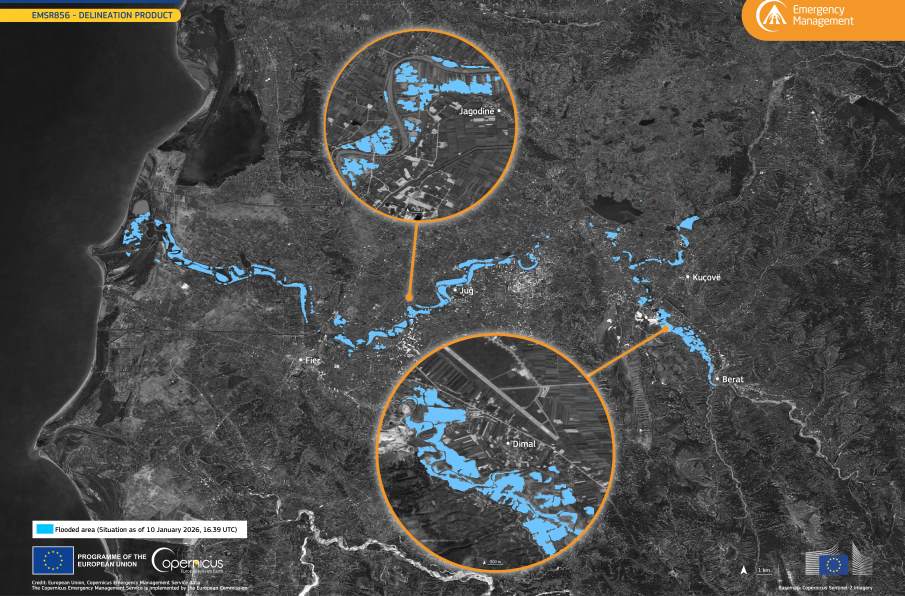
The image shows flooded areas in parts of Albania as of 10 January 2026, derived from Copernicus Emergency Management Service delineation products, with inundated zones highlighted in cyan to indicate areas covered by water.
Analysis based on 17 remotely sensed images estimated that approximately 12,350 people, 1,918 buildings, and 438.8 km of roads may have been affected across 13 areas of interest. The first mapping product was delivered on the evening of 9 January, around 11 hours after activation, focusing initially on Balldren before additional locations were assessed as the activation continued.
Flood warnings at the highest national level were issued across multiple Albanian regions, including Shkodër, Durrës, Tiranë, Fier, and Vlorë. Heavy rainfall also affected neighbouring Montenegro, where flooded homes, damaged roads, and traffic disruptions were reported in several municipalities.
By mid-January, the Copernicus activation remained ongoing, providing updated mapping to assist national authorities as response and recovery efforts continued across the affected areas.
Featured image credit: European Union, Copernicus Emergency Management Service