Smoke has become a familiar presence over parts of Argentine Patagonia this January, as multiple wildfires continue to burn across forested and shrubland areas in the country’s south. Among the hardest-hit regions is the province of Chubut, where fire crews have been battling advancing flames near rural communities and environmentally sensitive areas. The blazes are part of a wider emergency affecting southern Argentina, with fires also reported in Santa Cruz and Neuquén provinces.
Authorities say dry vegetation, sustained heat, and strong winds have contributed to the rapid spread of the fires, complicating containment efforts on the ground. More than 15,000 hectares have burned across Patagonia since the start of the month, according to local officials, forcing the evacuation of over 3,000 residents and tourists from areas considered at risk. Emergency teams have focused on protecting homes, infrastructure, and key transport routes, while monitoring how shifting wind conditions could alter fire behaviour.
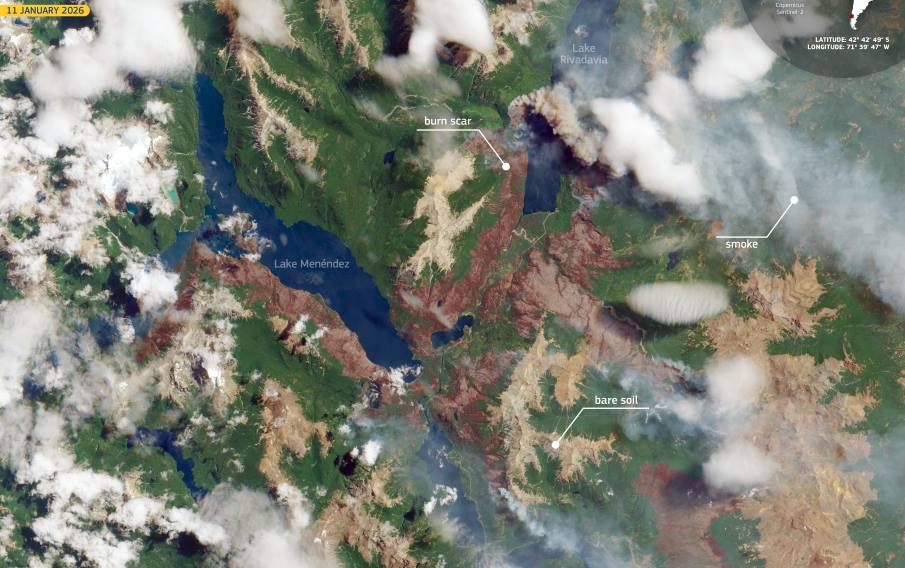
This image, acquired on 11 January 2026 by one of the Copernicus Sentinel-2 satellites, shows an active wildfire burning in Argentina’s Chubut province. In the scene, healthy vegetation appears in green, while burned areas are visible as dark brown and reddish patches. Cream-coloured areas indicate exposed soil, and smoke plumes can be seen drifting eastwards, reflecting the prevailing wind conditions reported by emergency services.
Authorities in Chile have also been dealing with a severe wildfire emergency at home, with President Gabriel Boric declaring a state of catastrophe in parts of the country after deadly fires swept through central and southern regions during an intense summer heatwave. While Chilean crews are stretched by domestic operations, the government confirmed that firefighters from the southern Palena area crossed into Argentina to assist with blazes in Patagonia, following coordination between authorities in both countries. Officials described the deployment as a targeted act of cooperation, carried out while monitoring fire behaviour on both sides of the Andes amid extreme conditions affecting the region.
Satellite observations from Copernicus Sentinel-2 play a central role in wildfire monitoring across remote regions such as Patagonia. The data allows authorities to map burn scars, follow the progression of active fires, and assess environmental impacts after the flames subside. As firefighting operations continue in Chubut and neighbouring provinces, satellite imagery remains a critical tool for understanding how these large-scale fires are reshaping the Patagonian landscape.
Featured image credit: European Union, Copernicus Sentinel-2 imagery