A powerful winter cold outbreak affected eastern Canada in late January 2026, driving temperatures far below seasonal averages across Ontario, Quebec, Nova Scotia, and Newfoundland and Labrador. As cold, dry continental air spread eastward, it moved over the relatively warmer waters of the Atlantic Ocean, creating conditions favourable for organised atmospheric convection.
The resulting instability in the lowest layers of the atmosphere allowed air motions to arrange into long, parallel structures aligned with the prevailing wind. Instead of producing scattered cloud fields, the convection became organised into narrow bands of rising and sinking air, a configuration commonly associated with wintertime cold-air outbreaks over open water.
These formations are known as cloud streets, or horizontal convective rolls. They develop within the planetary boundary layer when unstable surface air is capped by a more stable layer above, limiting vertical growth while promoting horizontal organisation. Rising air cools and condenses to form clouds, while adjacent sinking air suppresses cloud formation, producing the characteristic striped appearance.
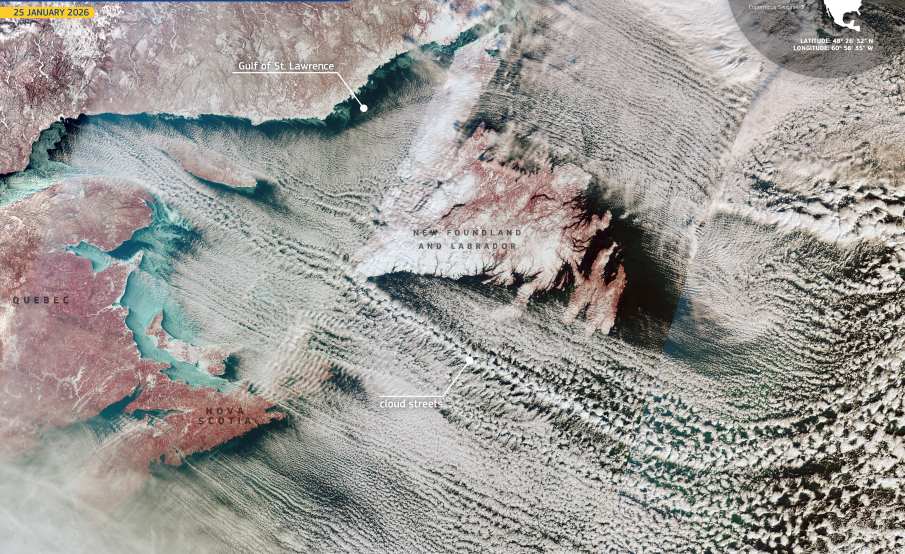
This Copernicus Sentinel-3 image, acquired on 25 January 2026, shows cloud streets extending from the Gulf of St. Lawrence into the Atlantic Ocean along Canada’s east coast.
Cloud streets can stretch for hundreds of kilometres and remain remarkably uniform when wind speed and direction are consistent. They play an important role in transporting heat, moisture, and momentum between the ocean surface and the lower atmosphere, influencing surface heat loss and downstream weather development.
Data from the Copernicus programme support the monitoring of extreme winter events by providing continuous observations of cloud structures, surface temperatures, and atmospheric conditions. These observations assist weather forecasting and help authorities assess potential impacts on transport networks, energy systems, and ecosystems during prolonged cold spells.
Featured image credit: European Union, Copernicus Sentinel-3 imagery