Green ice on Lake Lipno turned one of the Czech Republic’s most familiar winter landscapes into something rarely seen. The reservoir, the largest in the country, lies on the upper course of the Vltava River near the Austrian border and is surrounded by the forests of the Bohemian Forest region. In winter, its surface often freezes, but during December 2025 the ice took on an unexpected green colour that stood out clearly against the surrounding snow and dark water.
Field observations confirmed that the unusual colouration was linked to a dense concentration of cyanobacteria trapped beneath thin, transparent ice. Cyanobacterial blooms are typically associated with warmer months, yet in this case the biomass persisted into early winter, remaining close to the surface as freezing conditions set in. Calm weather, limited wind mixing, and sufficient light allowed the organisms to survive longer than usual.
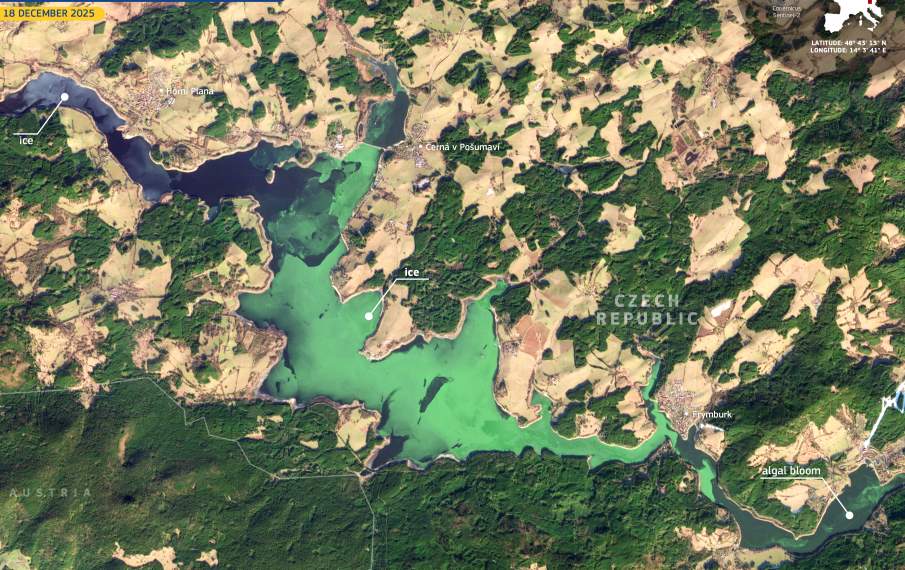
Captured on 18 December 2025 by a Copernicus Sentinel-2 satellite, the scene reveals sharp contrasts across the frozen reservoir. A broad green zone dominates the centre, where cyanobacteria became locked into newly formed ice. Elsewhere, conditions differ markedly: ice in the north-west appears lighter and largely unaffected, while open water in the south-east traces an ongoing bloom following the reservoir’s elongated shape.
Researchers identified Woronichinia naegeliana as the dominant species present. The bloom remained visible until snowfall reduced light penetration, limiting photosynthesis and eventually bringing the phenomenon to an end. During a brief warm period before Christmas, partial melting and refreezing created circular clear patches above darker aggregates, adding to the striking surface patterns.
Copernicus satellite data play a growing role in tracking algal blooms across Europe, supporting assessments of their extent and duration. Such observations help water managers monitor changing conditions, evaluate ecological risks, and issue timely public information when water quality is affected.
Featured image credit: European Union, Copernicus Sentinel-2 imagery