

Summary:
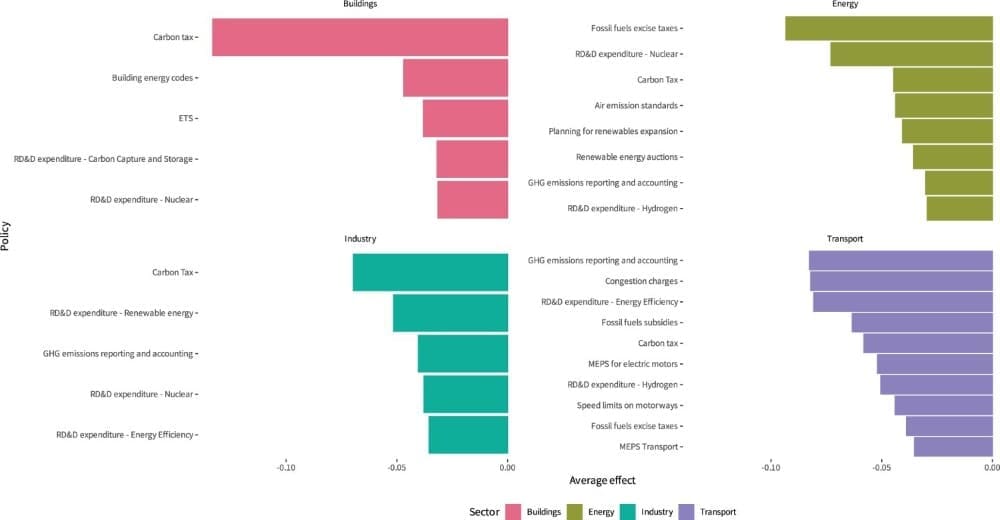
Carbon pricing, taxation, and sustained investment in renewable energy and research are among the most effective tools governments can use to cut CO₂ emissions, according to a new peer-reviewed study published in Climate Policy. The research assesses climate policies across 40 countries over a 32-year period, from 1990 to 2022, examining 1,737 individual measures spanning carbon pricing, energy, transport, and research sectors.
Rather than searching for a single best policy, the authors analyse how expanding policy mixes perform over time. Using a novel methodological approach that explicitly models multiple climate policy parameters and applies Bayesian priors, the study identifies which measures consistently reduce emissions under different national conditions. Countries such as Sweden and Norway, which have implemented broad and diverse policy portfolios, are shown to benefit most from layered approaches rather than reliance on one instrument.
The analysis also points to substantial untapped potential in countries including Australia, Canada, and Japan, particularly through higher fossil fuel excise taxes. Summarising the findings, lead author Dr Yves Steinebach says: “As governments expand their climate policy efforts, evaluating effectiveness has become increasingly challenging due to the growing number of coexisting policies. Our findings help decision-makers identify which climate policies are most likely to be effective in their national context.”
— Press Release —
To reduce CO₂ emissions, policy on carbon pricing, taxation and investment in renewable energy is key
A new peer-reviewed study evaluating climate policies in 40 countries over a 32-year period finds that carbon pricing and taxation – combined with investments in renewable energy and research – are among the most effective tools governments can use to reduce CO₂ emissions.
Drawing on successful examples such as Sweden and Norway, which have implemented a broad mix of climate policies at varying levels of stringency, the authors conclude that countries benefit most from a comprehensive and diverse policy toolkit rather than reliance on a single measure.
The research team – comprising experts from the University of Barcelona, the University of Lausanne, LMU Munich, and the University of Oslo – emphasizes that effective climate action does not depend on identifying one “optimal” policy. Instead, policy effectiveness emerges from the implementation of multiple measures over time.
Published in Climate Policy, the study provides a country-specific assessment of where additional climate action could deliver the greatest emissions reductions. It evaluates the effectiveness of individual climate policies during periods of sustained policy expansion, using a novel methodological approach that explicitly models multiple climate policy parameters simultaneously.
The analysis highlights countries such as Australia, Canada, and Japan as having substantial potential to strengthen their climate performance by increasing fossil fuel excise taxes.
In addition, the paper:
- identifies a set of core climate policy measures that consistently strengthen climate ambition across different national policy mixes, offering practical guidance for policymakers; and
- introduces a new methodological toolkit that enables more comprehensive evaluation of climate policies and can be applied to other policy areas experiencing rapid expansion.
Summarizing the findings, lead author Dr Yves Steinebach, from the Department of Political Science at the University of Oslo, says: “As governments expand their climate policy efforts, evaluating effectiveness has become increasingly challenging due to the growing number of coexisting policies. Our findings help decision-makers identify which climate policies are most likely to be effective in their national context.”
Commenting on the significance of the study, Dr Pieter Pauw, Editor-in-Chief of Climate Policy, adds: “The need for effective climate policies is growing, as is their complexity. This paper offers a rigorous analysis and timely insights that can help countries curb carbon dioxide emissions more effectively.”
Journal Reference:
Fernández-i-Marín, X., Hinterleitner, M., Knill, C., & Steinebach, Y., ‘Effective climate policies for ‘all seasons’: novel evidence from 40 countries’, Climate Policy 1–14 (2026). DOI: 10.1080/14693062.2025.2598684
Article Source:
Press Release/Material by Taylor & Francis Group
Featured image credit: creativeart | Freepik