Successive Atlantic storms left little time for recovery across parts of Spain and Portugal in early February 2026. After flooding and coastal impacts linked to Storm Kristin in late January, a new and more expansive system – Storm Leonardo – moved east across the North Atlantic, bringing renewed rainfall, strong winds, and widespread disruption as it approached the Iberian Peninsula.
Leonardo developed as an intense extratropical storm, with a broad circulation and multiple active fronts extending across hundreds of kilometres of ocean. By the time it reached southwestern Europe, river basins were already under strain, increasing flood risks in low-lying and coastal areas.
In Portugal, authorities placed the Tagus River basin on red alert as water levels rose sharply following days of heavy rain. Evacuations were ordered in vulnerable areas, and emergency services were deployed as flooding intensified. A 70-year-old man died on 4 February after his car was swept away near a flooded dam, while dozens of people were rescued during operations along swollen waterways.
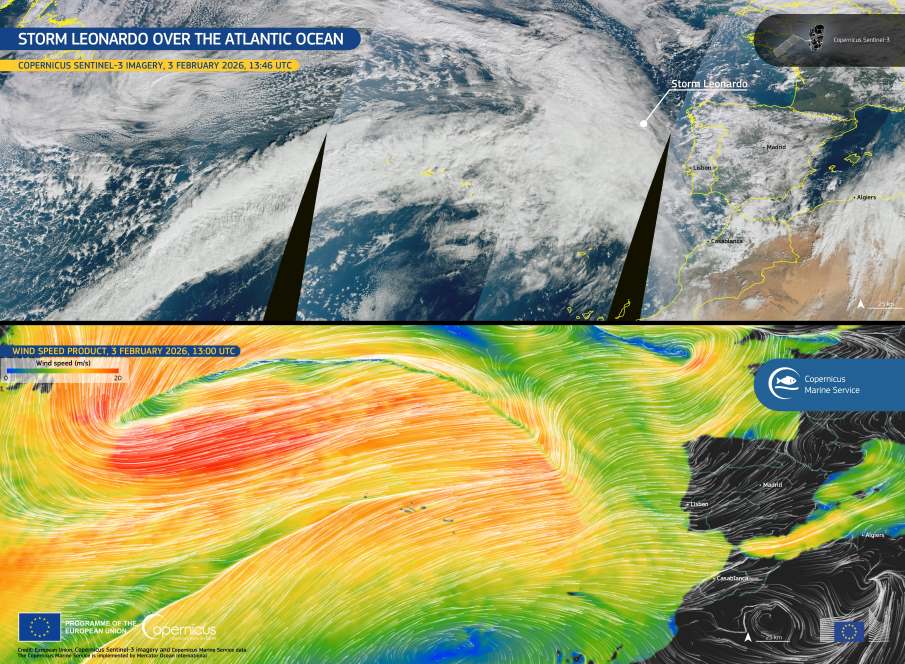
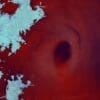
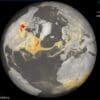
The image shows Storm Leonardo reaching the Iberian Peninsula (top), observed by one of the Copernicus Sentinel-3 satellites on 3 February 2026. At the same time, a data visualisation (bottom) derived from the Copernicus Marine Service wind speed product reveals a broad zone of stronger winds over the open Atlantic, indicating the movement of large air masses toward Europe.
In Spain, the storm caused extensive damage across Andalusia. The town of Grazalema in Cádiz province was completely evacuated after more than 800 litres of rain per square metre fell within a week. Flooded streets, landslides in elevated areas, and widespread transport disruption were reported. Rail services were largely suspended, more than 150 roads were closed, and flights were diverted or cancelled at Málaga-Costa del Sol Airport due to strong winds. Emergency teams continue to search for a woman swept away by river currents in Sayalonga, Málaga.
The Copernicus Emergency Management Service Rapid Mapping was activated under EMSR864 to support flood extent mapping in affected regions of Portugal. As Leonardo began to weaken, meteorologists warned that impacts could persist, with Storm Marta already approaching from the Atlantic, raising concerns of further rainfall in areas still recovering from consecutive storms.
Featured image credit: European Union, Copernicus Sentinel-3 imagery and Copernicus Marine Service Data