

Summary:
A new guideline published in CMAJ (Canadian Medical Association Journal) provides practical recommendations to reduce the environmental impact of operating rooms, which are among the most energy-intensive areas in hospitals. Canada’s health care system is responsible for about 4.6% of national greenhouse gas emissions and approximately 200,000 tonnes of other pollutants, with operating rooms contributing a significant share through high energy use and waste generation.
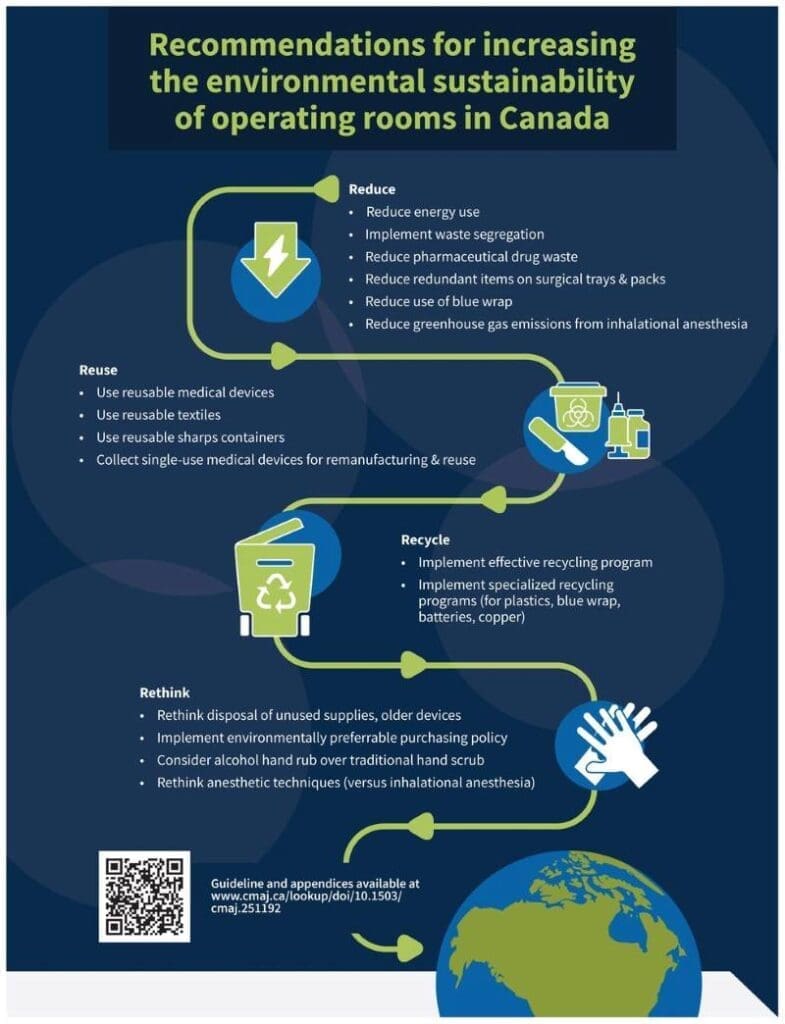
Developed by the Best Practice in Surgery Group at the University of Toronto, the updated guideline outlines 21 evidence-informed recommendations grouped into four areas: reduce, reuse, recycle, and rethink. Measures include improving waste segregation, lowering pharmaceutical waste, reducing the number of instruments in surgical trays, cutting unnecessary energy use, and limiting emissions from inhalational anesthesia. The guideline also encourages replacing disposable items with reusable alternatives, expanding traditional and specialized recycling programs, and reconsidering procurement and donation practices.
The authors note that adopting these recommendations can reduce environmental harm while often delivering financial benefits and maintaining patient safety and quality of care.
— Press Release —
How to ‘green’ operating rooms: new guideline advises reduce, reuse, recycle, and rethink
Reduce, reuse, recycle, and rethink can be applied in Canadian operating rooms (ORs) to increase environmental sustainability, advises a new guideline published in CMAJ.
As the Canadian health care system produces almost 5% of the country’s greenhouse gas emissions and 200 000 tonnes of other pollutants, many generated in ORs, it makes sense to focus on reducing these harms.
An evidence-based guideline that updates guidance from 2020 outlines 21 recommendations that include reducing energy use by turning off lights and heating in ORs when not in use, using reusable surgical devices and gowns, developing recycling programs, and rethinking disposal of unused supplies and older devices.
“Adopting these recommendations will generally confer both environmental and financial benefits, and will often also benefit the people providing and receiving care,” writes Dr. Sarah Ward, an orthopedic surgeon at St. Michael’s Hospital at Unity Health Toronto and assistant professor, University of Toronto, Toronto, Ontario, with coauthors.
A multidisciplinary team of clinicians, administrators, environmental specialists, and patient partners developed the guideline, with funding from the Department of Surgery and Collaborative Centre for Climate, Health & Sustainable Care, University of Toronto.
“Successful implementation will require tailored strategies, and not all recommendations will be feasible for every hospital. Barriers to implementation of these recommendations exist, including limited resources (financial, time, and personnel), staff buy-in, site-specific restrictions (e.g., access to reusable sharps containers, portable nitrous oxide canisters) and administrative restrictions (e.g., OR occupancy sensors, current purchase agreements, space restrictions),” write the authors.
The guideline team hopes that hospitals and surgical departments will act on the recommendations.
“Given the large environmental impact of ORs and the danger to human health represented by climate change and other global ecological challenges, we urge those involved in providing surgical care to review this guideline carefully and adopt as many recommendations as are feasible within their own organizations,” they conclude.
Journal Reference:
Jamie Goldman, Emily A. Pearsall, Kathy Liu, Charmaine De Castro, Nam Le, Syed A. Abbass, Reeba Philip, Laura L. Donahoe, Yasir Khalid, Ashlie Nadler, Alexander D. Vincent, Martin Van Der Vyver, Husein Moloo, Sean McKellar, Karen Devon, Fiona A. Miller and Sarah E. Ward, ‘Increasing the environmental sustainability of operating rooms in Canada: an evidence-informed guideline for policy’, CMAJ 198 (5): E159-E170 (2026). DOI: 10.1503/cmaj.251192
Article Source:
Press Release/Material by Canadian Medical Association Journal (CMAJ)
Featured image credit: stefamerpik | Freepik