
Summary:
Accurately predicting how a wheat variety will perform in a specific location remains a major challenge for plant breeding, especially as growing conditions become more diverse under climate change. A new study by researchers at the Leibniz Institute of Plant Genetics and Crop Plant Research (IPK) shows how artificial intelligence and large-scale datasets can substantially improve these predictions by focusing on interactions between genotype and environment.
The team analysed grain yield data from 13,285 winter wheat genotypes, including lines and hybrids, tested across 31 sites in Central Europe between 2010 and 2022. These field data were combined with genomic information covering around 10,000 genetic markers and detailed environmental variables such as daily temperature and precipitation. Using this integrated dataset, the researchers compared traditional statistical models with machine learning and deep learning approaches.
By explicitly modelling genotype × environment interactions, the best-performing models improved predictions of environment-specific performance of new hybrids by up to 23 percent. Selecting varieties based on local adaptation rather than average performance also delivered measurable yield gains in the field. The study was published in Genome Biology and points to new ways of identifying high-performing wheat varieties tailored to specific growing conditions.
— Press Release —
IPK research team improves predictions for ‘tailor-made’ wheat
Climate change and evolving growing conditions present new challenges for breeding. It is important to take local environmental conditions into account. An international team led by the IPK Leibniz Institute of Plant Genetics and Crop Plant Research has used AI and big data to develop a method of determining which winter wheat varieties are best suited to specific locations.
The study’s results have been published in the journal Genome Biology.
The interaction between genotype and environmental conditions is crucial for a plant’s performance and yield. For instance, a wheat variety may produce a high yield in one location but perform poorly in another with distinct environmental conditions. Therefore, the environment affects the performance of the genotype. Given the increasing diversification of cultivation environments, it is crucial, in the context of climate change, to provide varieties tailored to specific local conditions. The research team, therefore, focused on modelling the interactions between genotype and environment as precisely as possible. This is essential for accurately predicting yields in specific locations.
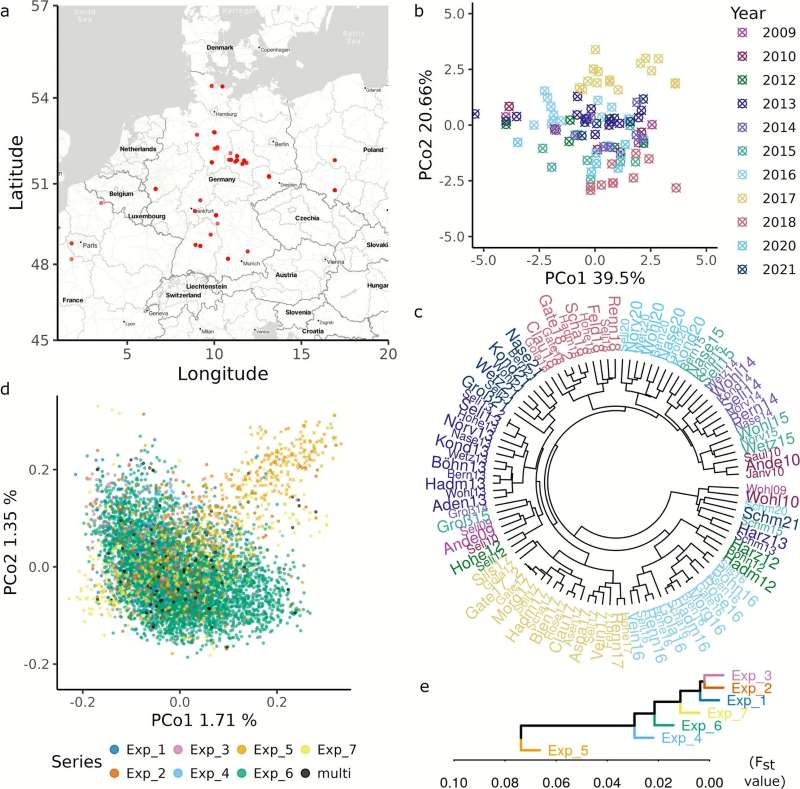
First, the scientists analysed large amounts of data on winter wheat. Grain yield data from over 13,200 genotypes (lines and hybrids) grown and tested at 31 locations in Central Europe between 2010 and 2022 were collected for this purpose. This phenotypic data was then combined with genomic data (approximately 10,000 genetic markers) and environmental information, such as daily temperature and precipitation. The researchers built and compared different prediction models, including statistical and deep learning approaches. They used the best model to forecast wheat line performance across 117 environments and to identify varieties suited to specific conditions.
“Our study shows that interactions between genes and environmental conditions are key to significantly improving yield forecasts,” explains Abhishek Gogna, the study’s first author. By considering how genotype and environment interact, the research team was able to predict how new hybrids would perform in specific environments with greater accuracy, achieving improvements as high as 23 percent. This can be compared to buying a new suit: instead of a standard size that fits most people on average (traditional prediction), you get a suit that is tailored exactly to your body shape (environmentally adapted prediction).
Furthermore, by selecting the top ten per cent of environmentally adapted genotypes for each specific environment, an additional yield increase of almost four quintals per hectare was achieved compared to winter wheat varieties selected solely for average performance. “This additional yield is equivalent to the success of up to twelve years of conventional breeding progress in Germany,” says Prof. Dr. Jochen Reif, head of the ‘Breeding Research’ department at the IPK. “This demonstrates the enormous, previously hidden yield potential of breeding programmes.”
The study’s practical relevance is also emphasised by KWS SAAT SE & Co. KGaA’s participation.
Journal Reference:
Gogna, A., Kamali, B., Wimmer, V. et al., ‘Predicting enviromically adapted varieties with big data’, Genome Biology 27, 3 (2026). DOI: 10.1186/s13059-025-03914-x
Article Source:
Press Release/Material by Leibniz Institute of Plant Genetics and Crop Plant Research (IPK)
Featured image credit: pvproductions | Freepik