Paris, France | AFP | Muser NewsDesk
Human-driven climate change intensified rainfall that triggered the Spain’s deadliest natural disaster in a generation when flash floods hit the Valencia region in 2024, a new study showed on Tuesday.
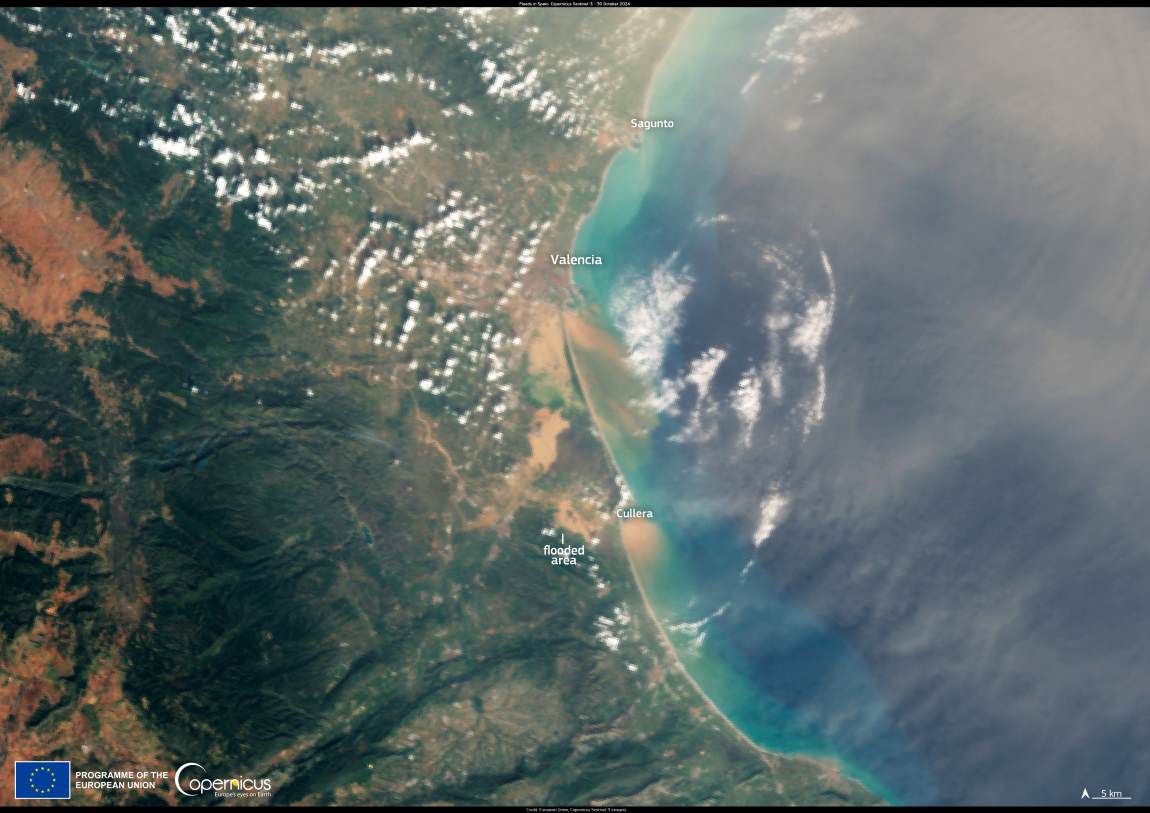
More than 230 people died and thousands of homes were damaged in the Mediterranean region when a year’s worth of rain fell in just a few hours on October 29, 2024.
Warming amplified the six-hour rainfall rate in the eastern region by 21 percent compared to conditions in 19th-century preindustrial times, according to the study published in the journal Nature Communications.
The area affected by extreme rainfall was 55 percent larger than what it would have been before industrialisation, according to the paper.
“Human-induced climate change worsened the storm by significantly increasing the atmospheric moisture, driven by the anomalously warm sea surface temperatures in the Mediterranean,” Carlos Calvo-Sancho, the study’s lead author, told AFP.
“A lesson from our study is that human-induced climate change not only intensifies the peak rainfall rates but also drastically expands the geographical footprint of these storms,” said Calvo-Sancho, a postdoctoral researcher at Spain’s Desertification Research Centre.
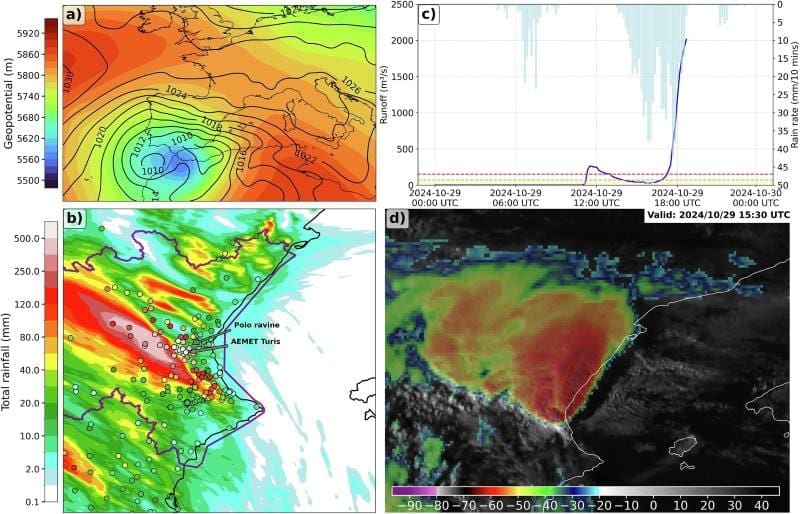
The researchers ran the storm through a high-resolution simulation — once in today’s climate and once in a preindustrial planet — to measure the impact of warming.
The analysis showed increases in water vapour in the atmosphere due to higher sea surface temperatures in the Mediterranean Sea and the North Atlantic Ocean.
Increasingly vulnerable
The last three years have been the hottest on record, according to climate monitors, with all-time high sea surface temperatures in the Mediterranean in 2024.
“The findings presented in this regional study are consistent with broader evidence that human-induced climate change is intensifying the global hydrological cycle,” the authors wrote.
“The results support the idea that such localised increases in flash-flood events may be part of a wider global trend,” they said.
The researchers said the results highlight “an immediate need” for western Mediterranean cities to adapt to climate risks.
“The primary takeaway for people in Mediterranean cities is that the catastrophic events witnessed in Valencia highlight a profound and growing vulnerability to extreme precipitation in the region,” Calvo-Sancho said.
“The extreme rainfall scenarios that climate models have been projecting for the future are no longer just distant warnings, they are already becoming a reality today,” he said.
lt/gil
© Agence France-Presse
Journal Reference:
Calvo-Sancho, C., Díaz-Fernández, J., González-Alemán, J.J. et al., ‘Human-induced climate change amplification on storm dynamics in Valencia’s 2024 catastrophic flash flood’, Nature Communications 17, 1492 (2026). DOI: 10.1038/s41467-026-68929-9
Article Source:
Press Release/Material by AFP
Featured image credit: European Union, Copernicus Sentinel-3 imagery