Piton de la Fournaise rises from the east-southeastern tip of Réunion Island, a French territory in the western Indian Ocean shaped by successive volcanic episodes. The basaltic shield volcano, about 500,000 years old, is built on the flank of the older Piton des Neiges and ranks among the most active volcanoes in the world. Its broad profile was formed by repeated outpourings of fluid basaltic lava, and most eruptions occur within the Enclos Fouqué caldera, a natural depression that helps contain lava flows away from inhabited areas.
The volcano lies within the UNESCO World Heritage site ‘Pitons, cirques and remparts of Réunion Island‘, inscribed in 2010. The protected area covers roughly 40 % of the island and includes dramatic volcanic peaks, steep escarpments known as remparts and deep erosion-carved cirques. The landscape reflects both volcanic construction and long-term tropical erosion, creating one of the most striking reliefs in the Indian Ocean.
After a period of relative calm, activity resumed on 18 January 2026. A seismic crisis beneath the summit preceded the opening of fissures inside the Enclos Fouqué. Lava fountains and flows remained confined within the caldera, and surface effusion ceased within days. Monitoring networks continued to record shallow volcano-tectonic earthquakes and ground inflation in the following weeks, indicating renewed pressurisation of the shallow magma reservoir.
On 13 February at 10:06 local time, a second effusive eruption began on the south–south-east flank inside the caldera. Lava flows descended the Grandes Pentes, and authorities activated ORSEC Alert 2–1, closing access to the Enclos Fouqué. No populated areas were directly threatened.
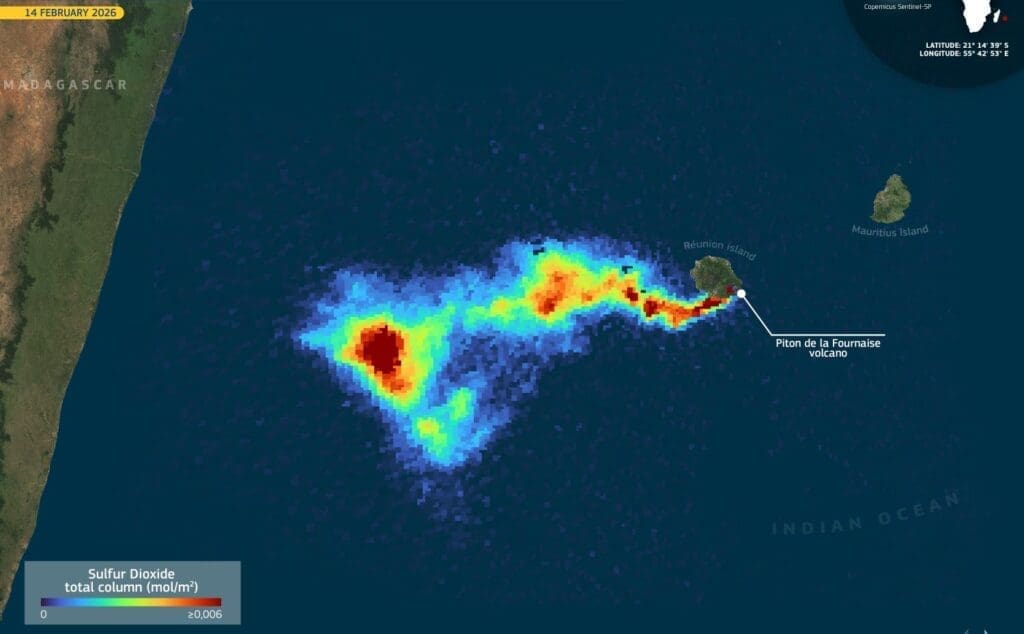
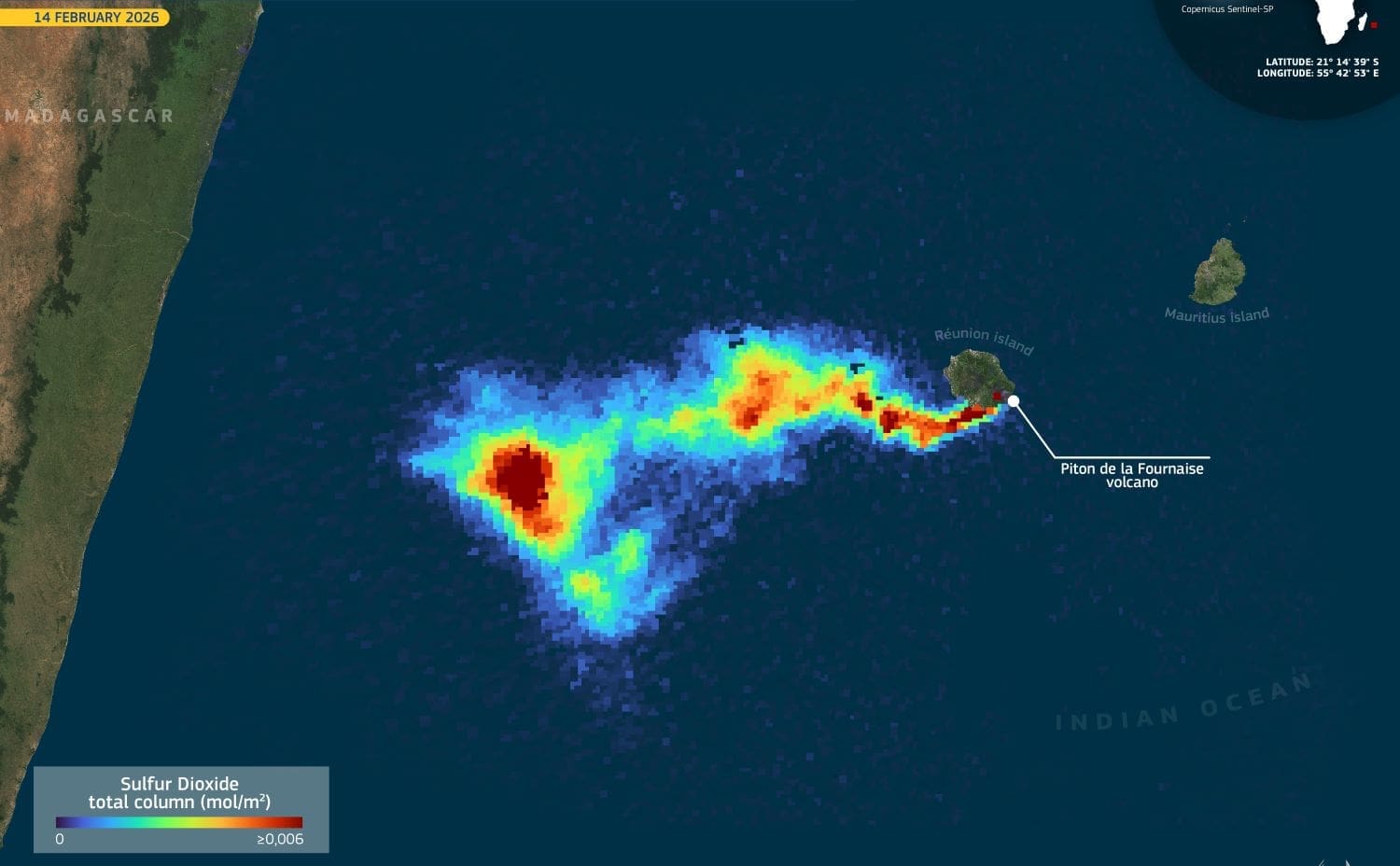
The following day, 14 February 2026, the TROPOMI instrument aboard the Copernicus Sentinel-5P satellite detected a plume of sulfur dioxide (SO₂) rising from the eruption site. The plume extended more than 550 km westward across the Indian Ocean toward Madagascar, illustrating how volcanic gases can disperse rapidly under prevailing winds.
The Copernicus Sentinel-5P image of Réunion Island shows elevated sulfur dioxide concentrations stretching far beyond the island’s coastline. Sentinel-5P, launched on 13 October 2017 as part of the European Union’s Copernicus Earth observation programme, is dedicated to monitoring atmospheric composition with high spatial and temporal resolution. Its single instrument, TROPOMI – the TROPOspheric Monitoring Instrument – measures key atmospheric trace gases including sulfur dioxide, nitrogen dioxide, ozone, carbon monoxide and methane, along with aerosols and cloud properties. The mission supports the monitoring of air quality, the ozone layer, ultraviolet radiation and climate-related variables on a global scale.
Sulfur dioxide is one of the principal gases emitted during volcanic eruptions and a direct indicator of magma degassing. By quantifying SO₂ in the atmosphere, Sentinel-5P enables scientists to assess the scale of an eruption and track how emissions spread over regional and international airspace. Such data are used in aviation advisories, air quality assessments and environmental management worldwide.
At Piton de la Fournaise, where eruptions are frequent but often short-lived, satellite observations complement ground-based seismic and deformation monitoring, providing a broader view of each event and its atmospheric footprint.
Featured image credit: European Union, Copernicus Sentinel-5P imagery