Rainfall in northeastern Morocco has reshaped the landscape in just one year, as satellite images show a shift from severe drought to widespread vegetation following an intense winter season.
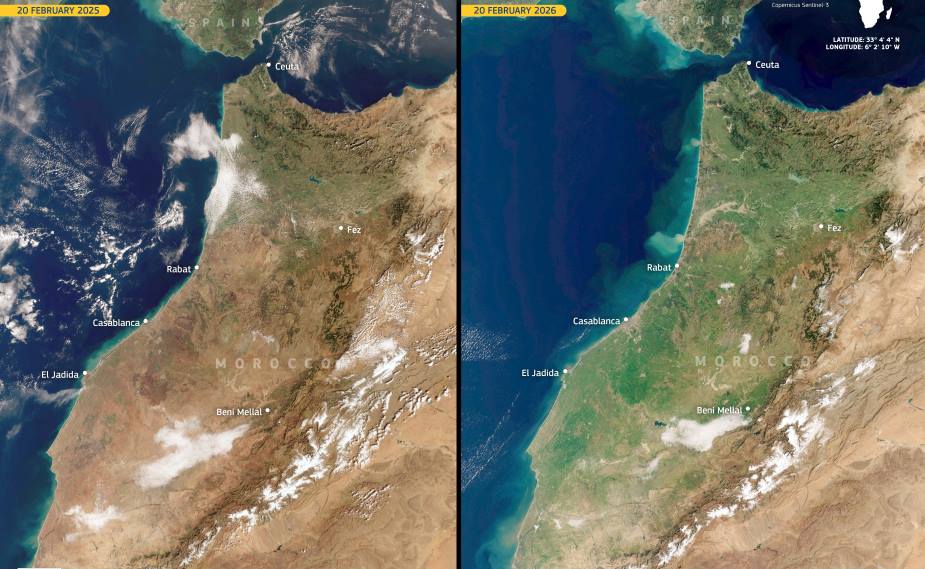
In mid-February 2025, the region was marked by sparse plant cover and dry terrain after prolonged drought. Vegetation appeared limited, with large areas showing the pale tones typical of water stress. One year later, the same area presents a markedly different picture.
These Copernicus Sentinel-3 images illustrate the contrast. The image on the left, acquired on 20 February 2025, shows widespread drought conditions across northeastern Morocco. In the image on the right, acquired on 20 February 2026, the landscape appears in shades of green after two months of sustained rainfall, indicating extensive vegetation growth during the winter season.
The improvement is also reflected in national water reserves. As of 20 February 2026, Morocco’s available water resources reached 11.8 billion cubic metres, an increase of around 155% compared with the 4.644 billion cubic metres recorded at the same time in 2025. Reservoir storage rose to 70.7% of total dam capacity, up from 27.5% a year earlier.
Several major basins reported substantial gains. Loukkos approached full capacity, while Bouregreg and Sebou both exceeded 90%. Within the Sebou basin, the Al Wahda Dam held more than 3.2 billion cubic metres, securing supplies for agricultural areas and urban centres. In the Rabat-Casablanca corridor, the Sidi Mohamed Ben Abdellah Dam reached close to 95%.
Other regions showed improvement, including Tensift and the Guir-Ziz-Rheris basin, which surpassed 60%. In the southeast, the Hassan Addakhil Dam climbed to 78%. However, disparities remain. The Oum Er-Rabia basin stood at 46.3%, and Sous-Massa at 54.5%, with some dams, such as Youssef Ben Tachfine, below half capacity. Draa-Oued Noun continued to face the greatest pressure, despite gains compared with last year.
Short-term inflows also increased reservoir levels. Between 17 and 18 February, the Al Massira Dam gained more than 21 million cubic metres, while the Mohammed V Dam added over 5.5 million cubic metres. The Sidi Mohamed Ben Abdellah Dam rose by more than 2.2 million cubic metres over the same period.
Copernicus satellite data provide consistent observations to monitor vegetation recovery and reservoir levels, supporting national water management and drought assessment efforts as Morocco navigates ongoing climate variability.
Featured image credit: European Union, Copernicus Sentinel-3 imagery