
Explore the latest insights from top science journals in the Muser Press roundup (February 25, 2026), featuring impactful research on climate change challenges.
In brief:
— Press Release —
Methane’s missing emissions: The underestimated impact of small sources
Methane is a potent greenhouse gas, with an impact estimated as 80 times that of CO₂. Although efforts are being made to reduce the contribution of big polluters to methane in Japan, new research from Osaka Metropolitan University suggests that smaller sources are vastly underestimated in the Osaka metropolitan area.
The discovery was made by an international collaborative research team led by Associate Professor Masahito Ueyama of the Graduate School of Agriculture who used a tower for high-altitude readings and a bike for ground-level readings of methane and ethane. Instead of spot checks, the measurements were continuous and integrated over the city center, giving a more complete overview of their output.
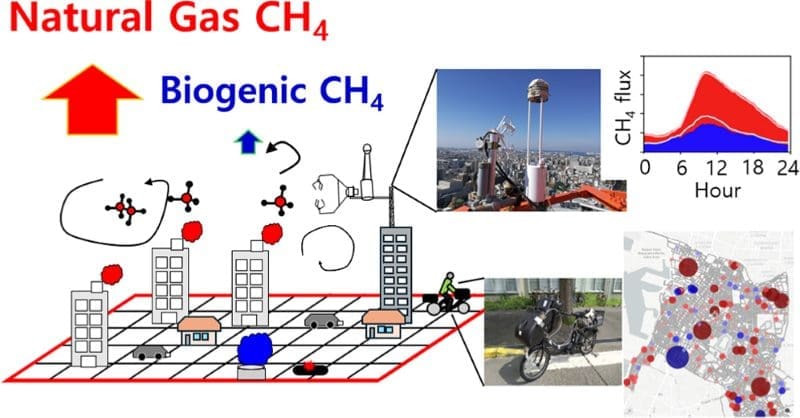
When the researchers compared their findings with government inventories, they found large differences. As well as the well-known large emitters of greenhouse gases, especially chemical and industrial plants, they found unaccounted emissions from numerous small sources, including restaurants, commercial facilities, and private residences.
Because emissions were higher on weekdays, followed a clear day–night pattern, and included ethane – a gas linked to human activity – the researchers concluded that people, not natural processes, were the main source. Even so, methane produced by biological processes was also underestimated, probably due to small but widespread sources, like sewage manholes and the production of fermented foods common in Japanese cuisine.
Ultimately, the study highlights hidden sources of methane that could be fixed with technology and policy. “By clarifying the existence of methane emissions originating from city gas that had previously been overlooked, our research is expected to aid in identifying these unaccounted emission sources within urban areas,” Professor Ueyama explained.
“This research establishes a method for real-time monitoring of methane emissions by source, which is expected to be utilized in assessments evaluating the effectiveness of emission reduction measures,” he added. He believes that the group’s technique is useful for separating human fossil fuel leakage from biological emissions. “Going forward, it is hoped that this approach will be expanded to other cities and utilized for methane emission management and policy formulation in a wider range of urban areas.”
The findings were published in Environmental Science & Technology.
Journal Reference:
Masahito Ueyama, Akira Nakaoka, Taku Umezawa, Yukio Terao, and Mark Lunt, ‘Natural Gas and Biogenic CH4 Emissions from an Urban Center, Sakai, Japan, Based on Simultaneous Measurements of CH4 and C2H6 fluxes Based on the Eddy Covariance Method’, Environmental Science & Technology 59 (48), 25877-25888 (2025). DOI: 10.1021/acs.est.5c09629
Article Source:
Press Release/Material by Osaka Metropolitan University (OMU)
— Press Release —
More trees where they matter, please
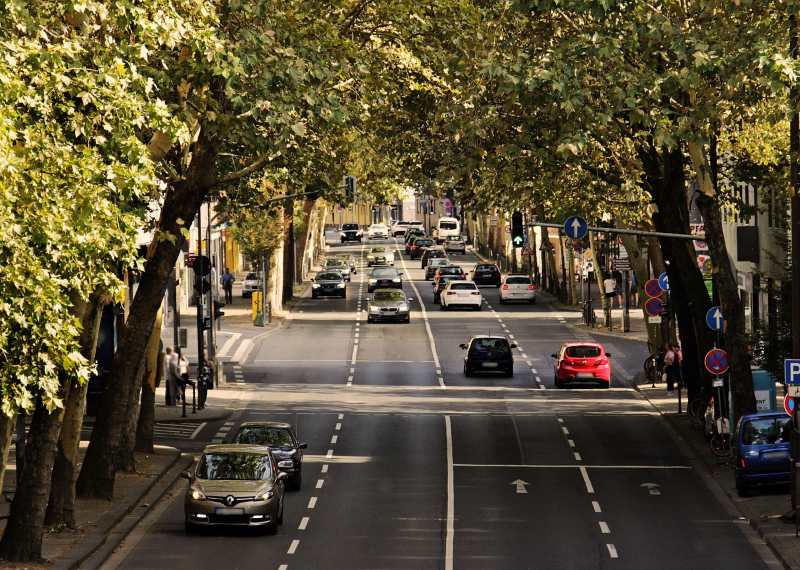
One of the best forms of heat relief is pretty simple: trees. In cities, as studies have documented, more tree cover lowers surface temperatures and heat-related health risks.
However, as a new study led by MIT researchers shows, the amount of tree cover varies widely within cities, and is generally connected to wealth levels. After examining a cross-section of cities on four continents at different latitudes, the research finds a consistent link between wealth and neighborhood tree abundance within a city, with better-off residents usually enjoying much more shade on nearby sidewalks.
“Shade is the easiest way to counter warm weather,” says Fabio Duarte, an MIT urban studies scholar and co-author of a new paper detailing the study’s results. “Strictly by looking at which areas are shaded, we can tell where rich people and poor people live.”
That disparity is evident within a range of cities, and is present whether a city contains a large amount of tree cover overall or just a little. Either way, there are more trees in wealthier spots.
“When we compare the most well-shaded city in our study, Stockholm, with the worst-shaded, Belem in northern Brazil, we still see marked inequality,” says Duarte, the associate director of MIT’s Senseable City Lab in the Department of Urban Studies and Planning (DUSP). “Even though the most-shaded parts of Belem are less shaded than the least-shaded parts of Stockholm, shade inequality in Stockholm is greater. Rich people in Stockholm have much better shade provision as pedestrians than we see in poor areas of Stockholm.”
The paper, ‘Global patterns of pedestrian shade inequality’, is published in Nature Communications.
The authors are Xinyue Gu of Hong Kong Polytechnic University; Lukas Beuster, a research fellow at the Amsterdam Institute for Advanced Metropolitan Solutions and MIT’s Senseable City Lab; Xintao Liu, an associate professor at Hong Kong Polytechnic University; Eveline van Leeuwen, scientific director at the Amsterdam Institute for Advanced Metropolitan Solutions; Titus Venverloo, who leads the MIT Senseable City Amsterdam lab; and Duarte, who is also a lecturer in DUSP.
From Stockholm to Sydney
To conduct the study, the researchers used satellite data from multiple sources, along with urban mapping programs and granular economic data about the cities they examined. There are nine cities in the study: Amsterdam, Barcelona, Belem, Boston, Hong Kong, Milan, Rio de Janeiro, Stockholm, and Sydney. Those places are intended to create a cross-section of cities with different characteristics, including latitude, wealth levels, urban form, and more.
The scholars looked at the amount of shade available on city sidewalks on summer solstice day, as well as the hottest recorded day each year from 1991 to 2020. They then created a scale, ranging from 0 to 1, to rate the amount of shade available on sidewalks, both citywide and within neighborhoods.
“We focused on sidewalks because they are a major conduit of urban activity, even on hot summer days,” Gu says. “Adding tree cover for sidewalks is one crucial way cities can pursue heat-reduction measures.”
Duarte adds: “When it comes to those who are not protected by air conditioning, they are also using the city, walking, taking buses, and anybody who takes a bus is walking or biking to or from bus stops. They are using sidewalks as the main infrastructure.”
The cities in the study offer very different levels of tree coverage. On the 0-to-1 scale the researchers developed, much of Stockholm falls in the 0.6-0.9 range, with some neighborhoods being over 0.9. By contrast, large swaths of Rio de Janeiro are under the 0.1 mark. Much of Boston ranges from 0.15 to 0.4, with a few neighborhoods reaching 0.45 on the scale.
The overall pattern of disparities, however, is very consistent, and includes the more affluent cities. The bottom 20 percent of neighborhoods in Stockholm, in terms of shade coverage, are rated at 0.58 on the scale, while the top 20 percent of Belem neighborhoods rate at 0.37; Stockholm has a greater disparity between most-covered and least-covered. To be sure, there is variety within many cities: Milan and Barcelona have some lower-income neighborhoods with abundant shade, for instance. But the aggregate trend is clear. Amsterdam, another well-off place on average, has a distinct pattern of less shade in lower-income areas.
“In rich cities like Amsterdam, even though it’s relatively well-shaded, the disparity is still very high,” Beuster says. “For us the most surprising point was not that in poor cities and more unequal societies the disparity would be notable – that was expected. What was unexpected was how the disparity still happens and is sometimes more pronounced in rich countries.”
“Follow transit”
If the tree-shade disparity issue is quite persistent, then it raises the matter of what to do about it. The researchers have a basic answer: Add trees in areas with public transit, which generate a lot of pedestrian mileage.
“In each city, from Sydney to Rio to Amsterdam, there are people who, regardless of the weather, need to walk,” Duarte says. “And it’s those people who also take public transportation. Therefore, link a tree-planting scheme to a public transportation network. And secondly, they are also the medium-and low-income part of the population. So the action deriving from this result is quite clear: If you need to increase your tree coverage and don’t know where, follow transit. If you follow transit, you will have the right shading.”
Indeed, one takeaway from the study is to think of trees not just as a nice-to-have part of urban aesthetics, but in functional terms.
“Planners and city officials should think about tree placement at least partly in terms of the heat-mitigating effect they have,” Beuster says.
“It’s not just about planting trees,” Duarte observes. “It’s about providing shade by planting trees. If you remove a tree that’s providing shade in a pedestrian area and you plant two other trees in a park, you are still removing part of the public function of the tree.”
He adds: “With increasing temperatures, providing shade is an essential public amenity. Along with providing transportation, I think providing shade in pedestrian spaces should almost be a public right.”
***
The Amsterdam Institute for Advanced Metropolitan Solutions and all members of the MIT Senseable City Consortium (including FAE Technology, Dubai Foundation, Sondotécnica, Seoul AI Foundation, Arnold Ventures, Sidara, Toyota, Abu Dhabi’s Department of Municipal Transportation, A2A, UnipolTech, Consiglio per la Ricerca in Agricoltura e l’Analisi dell’Economia Agraria, Hospital Israelita Albert Einstein, KACST, KAIST, and the cities of Laval, Amsterdam, and Rio de Janeiro) supported the research.
Journal Reference:
Gu, X., Beuster, L., Liu, X. et al., ‘Global patterns of inequality in pedestrian shade provision’, Nature Communications (2026). DOI: 10.1038/s41467-026-69190-w
Article Source:
Press Release/Material by Peter Dizikes, MIT News | Massachusetts Institute of Technology (MIT)
— Press Release —
Rewetting peatlands could unlock more effective carbon removal using biochar
Scientists are proposing a new way to boost the climate benefits of biochar by pairing it with peatland restoration. A new study suggests that applying biochar to rewetted peatlands could dramatically improve long term carbon storage while making biochar production more efficient and scalable.
Biochar, a charcoal like material made by heating biomass in low oxygen conditions, is widely recognized as a promising carbon dioxide removal technology. When added to soil, it can store carbon for decades or centuries. However, the stability of biochar varies depending on how it is produced and where it is applied. Current climate programs often favor highly stable biochars produced at high temperatures, but this approach reduces carbon yield and increases pressure on limited biomass resources.
The new research explores whether rewetted peatlands could provide an alternative solution. When peatlands are drained for agriculture, they release large amounts of greenhouse gases. Restoring water levels slows decomposition and helps prevent carbon loss. The researchers found that these waterlogged conditions could also slow the breakdown of biochar, allowing more of its carbon to remain stored over time.
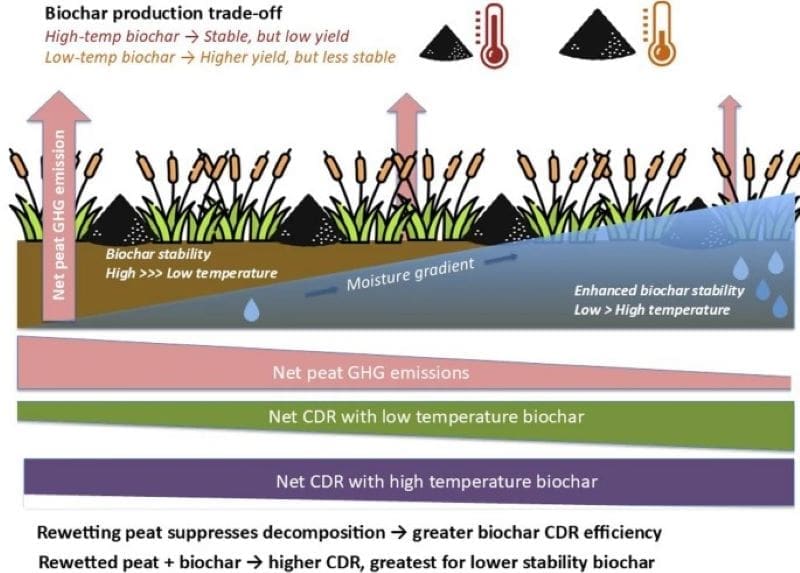
“Our findings suggest that where biochar is applied may be just as important as how it is produced,” said the study’s lead author. “Rewetted peatlands create naturally low oxygen environments that suppress microbial activity, which helps biochar persist for longer.”
Using biogeochemical modeling approaches, the team estimated how biochar would behave in saturated peat compared with typical agricultural soils. Over a 100 year period, rewetted peatlands increased carbon retention by about 5 percent for highly stable biochars and up to 40 percent for lower stability biochars. In practical terms, this means biochars that are cheaper and easier to produce could become viable for long term carbon removal if applied in the right environment.
The results also challenge a common assumption in climate policy. Many carbon markets prioritize biochar with the highest stability, assuming it offers the best carbon storage potential. The study shows that this focus may overlook an important tradeoff. Lower temperature biochars often retain more carbon during production, so when combined with peatland rewetting they may deliver greater overall carbon removal efficiency.
“This work suggests we should think about biochar deployment as part of a system rather than a single technology,” the researchers noted. “By integrating it with peatland restoration, we may be able to remove more carbon using fewer resources.”
The authors emphasize that challenges remain. Rewetting peatlands can increase methane emissions in some cases, and large scale biochar application would require new monitoring and regulatory frameworks. Long term land management commitments would also be necessary to ensure carbon remains stored.
Despite these uncertainties, the researchers argue that combining biochar with peatland restoration could significantly enhance global climate mitigation strategies. International climate plans already include large scale peatland rewetting as a nature based solution. Adding biochar to these projects could help maximize their carbon removal potential while improving the efficiency of biomass use.
The study concludes that reconsidering how and where biochar is used could open new pathways for scalable carbon dioxide removal. If supported by updated carbon market rules and careful environmental safeguards, this integrated approach could play an important role in helping countries reach net zero emissions targets.
Journal Reference:
Rhymes, J.M., McNamara, N.P., Jones, D.L. et al., ‘Harnessing peatland rewetting for effective biochar-based carbon dioxide removal’, Biochar 8, 16 (2026). DOI: 10.1007/s42773-025-00524-5
Article Source:
Press Release/Material by Biochar Editorial Office | Shenyang Agricultural University (SYAU)
— Press Release —
Peatland lakes in the Congo Basin release carbon that is thousands of years old
The vast swamps and peatlands of the tropics play an important role in the global carbon cycle and consequently in the global climate. The Amazon basin, the Congo basin, and the tropical wetlands of Southeast Asia accumulate carbon in the form of dead, undecomposed plant material, storing around 100 gigatonnes of carbon in the process.
One of the largest and most important of these tropical carbon stores is situated in the Congo Basin in the heart of Africa, home to the mighty Congo River and its numerous tributaries. Although the swamps and peatlands of the Congo Basin cover only 0.3 per cent of the Earth’s land surface, they hold one third of the carbon stored in tropical peatlands.
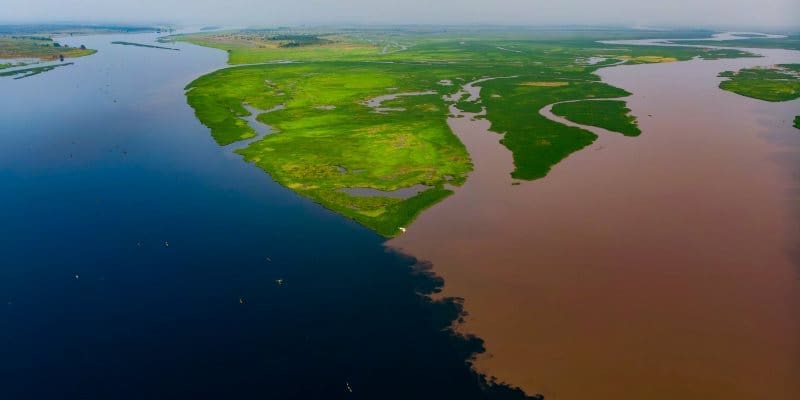
Just how great the impact of these peat ecosystems is on the global carbon cycle and climate has hardly been researched, partly because the central Congo Basin remains difficult to access. Boats and pirogues are often the only means of transport for reaching the remote swamps and lakes.
Research uncovers surprises
A research team headed by ETH Zurich has taken a closer look at the Congo Basin in the last decade. In the process, the researchers uncovered several surprises, such as one of the darkest blackwater rivers in the world, the Ruki River (ETH News reported).
In the latest study, which has just been published in the journal Nature Geoscience, the researchers once again focused on water that has been darkened by the leaching of plant debris: Africa’s largest blackwater lake, Lac Mai Ndombe, and its smaller neighbour, Lac Tumba – and they once again met with a surprise.
More than four times the size of Lake Constance, the water of Lake Mai Ndombe resembles black tea. The lake is surrounded by extensive swamp forests and virtually untouched lowland rainforest growing on thick peat. Organic matter washed out of decaying plant and soil material from the surrounding swamp and lowland rainforests colours the lake water dark brown.
Ancient carbon released
Now, researchers have shown that large amounts of carbon in the form of CO₂ are emitted into the atmosphere by way of the two lakes.
Contrary to the researchers’ expectations, however, only some of the carbon is from recently produced plant matter. Up to 40 per cent of the carbon stems from peat that has accumulated in the surrounding ecosystems over thousands of years. This is shown by age determinations (radiocarbon dating) of the CO₂ dissolved in the lake water.
“We were surprised to find that ancient carbon is being released via the lake,” explains lead author Travis Drake, a scientist in the Sustainable Agroecosystem (SAE) group led by ETH Professor Johan Six. “The carbon reservoir has a leak, so to speak, from which ancient carbon is escaping,” adds co-author Matti Barthel, research technician in SAE.
Just how is the carbon released?
Until now, research assumed that carbon stored in the peat of the Congo Basin remained bound for a very long time and was only released under certain conditions, such as prolonged droughts.
It remains unclear just how the carbon is mobilised from the undecomposed plant material. The pathways by which the carbon enters the lake water are also still unknown.
Consequently, it is crucial for researchers to find out whether the release of old carbon indicates a destabilising turning point or a natural state of equilibrium that is balanced by new peat deposits.
Is there a risk of the peatlands drying up?
The release of old carbon could indicate a larger problem, namely that environmental changes triggered by climate change are leading to a chain reaction.
If the climate becomes drier, for example, more carbon could be mobilised because the peat dries out more often and for longer periods of time, allowing oxygen to penetrate deeper the peat layers. This promotes the decomposition of once-stable organic matter by microorganisms, with consequences for the global climate as more CO₂ from this huge carbon store is released into the atmosphere.
“Our results help to improve global climate models, because tropical lakes and wetlands have been underrepresented in these models so far,” as Six stated.
Water levels have a massive influence on degassing
In addition to investigating the age and origin of the degassed CO₂, the researchers also examined emissions of two other important greenhouse gases from Lake Mai Ndombe, namely nitrous oxide and methane.
In this parallel study, which was published on the ESS Open Archive, the researchers found that water levels, for example, have a strong influence on the volume of methane escaping into the atmosphere.
The higher the water level of the lake, the more effectively microorganisms break down methane. If the water levels are low(er), as is usual during the dry season, methane is broken down less effectively and escapes from the lake in larger quantities.
“Our fear is that climate change will also upset this balance. If droughts become longer and more intense, the blackwater lakes in this region could become significant sources of methane that impact on the global climate,” says ETH Professor Jordon Hemingway. “At present we do not know when the tipping point will be reached.”
Changes in land use could prove to be serious
But it is not only climate change that could affect the balance. Changes in land use could incur even more serious consequences. According to estimates, the population of the Democratic Republic of Congo is set to triple by 2050. In order to gain arable land, more forest land will be cleared in future.
Deforestation, in turn, promotes drought, which could keep lake levels permanently low. “We all know the analogy whereby forests are the green lungs of the Earth,” says Barthel. “They are not only responsible for gas exchange like our lungs, however, but they also evaporate water through their leaves, thereby enriching the atmosphere with water vapour. This promotes cloud formation and precipitation, which in turn feeds rivers and lakes.”
The results help to clarify the role of tropical peatlands and blackwater lakes in global climate change. The research is also vital for developing strategies to reduce greenhouse gases and protect wetlands in the Congo Basin and around the equator belt.
***
These studies were conducted as part of the TropSEDs project led by ETH Zurich and funded by the Swiss National Science Foundation, in collaboration with scientists from the University of Louvain in Belgium and the Democratic Republic of Congo.
Journal Reference:
Drake, T.W., Hemingway, J.D., Barthel, M. et al., ‘Millennial-aged peat carbon outgassed by large humic lakes in the Congo Basin’, Nature Geoscience (2026). DOI: 10.1038/s41561-026-01924-3
Article Source:
Press Release/Material by Peter Rüegg | ETH Zurich
Featured image credit: Freepik (AI Gen.)