Rising from the frozen expanse of West Antarctica, Vinson Massif stands within the Sentinel Range of the Ellsworth Mountains as the continent’s highest mountain block. Its summit reaches 4,892 metres above sea level. Unlike a single sharp peak, the massif extends roughly 21 kilometres in length and 13 kilometres in width, forming a broad elevated feature of plateaus, steep ridgelines and exposed rock shaped by persistent polar winds and extreme cold.
The mountain was first surveyed in 1957 during the International Geophysical Year and later named after U.S. Congressman Carl Vinson, who supported Antarctic research programmes. Its isolation remains one of its defining characteristics. Even in summer, when daylight lasts around the clock, average temperatures hover near –29 °C. Access is limited to ski-equipped aircraft capable of landing on blue-ice runways near the range.
The massif is visible in this Copernicus Sentinel-2 image acquired on 7 February 2026. From orbit, glaciers descending from its slopes are marked by crevasse fields that trace the slow movement of ice. Variations in tone distinguish compacted snow from exposed rock and wind-scoured surfaces, while shadows accentuate the relief carved into the mountains over geological time.
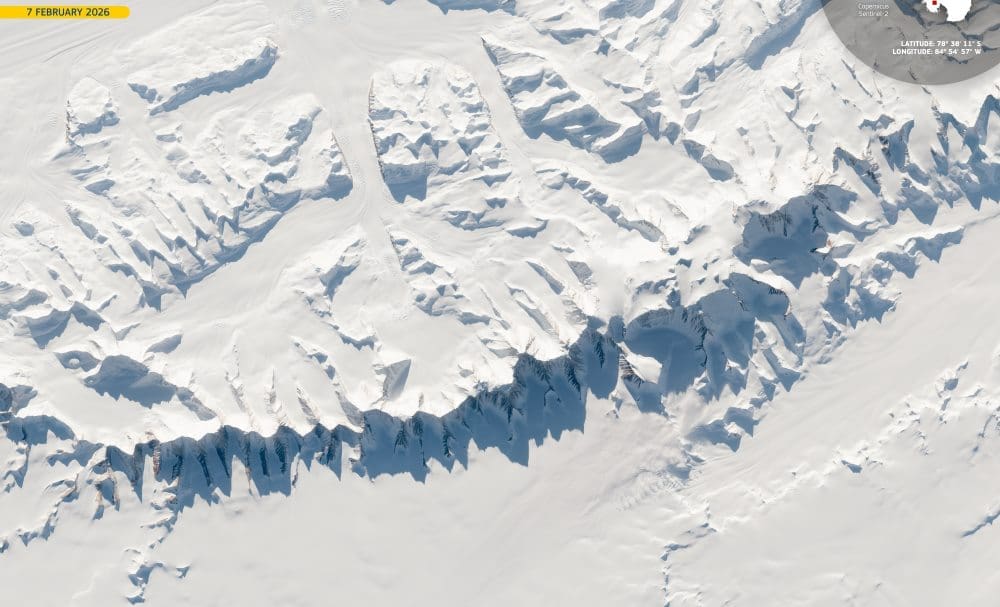
Beyond its elevation, Vinson Massif forms part of the interior West Antarctic ice system. Glaciers flowing from the Sentinel Range connect to broader drainage networks that extend toward the Ronne Ice Shelf. Although this sector is not among the fastest-changing coastal regions, repeated satellite observations allow scientists to document surface structure, accumulation patterns and glacier flow across high-elevation zones. Combined with radar measurements of ice velocity and elevation, these data contribute to wider assessments of Antarctic ice mass balance.
Copernicus Sentinel-2 data support the monitoring of glacier movement and changes in ice surface conditions. Combined with radar observations from Sentinel-1, the imagery helps scientists analyse glacier dynamics and assess longer-term trends in parts of Antarctica where satellite records provide the most consistent means of observation.
Featured image credit: European Union, Copernicus Sentinel-2 imagery