Summary:
Climate scientists are challenging a recent US Department of Energy climate report, arguing it misrepresents established evidence of human-driven global warming. In a new analysis published in the journal AGU Advances, Prof Benjamin Santer of the University of East Anglia and colleagues from MIT, Colorado State University and the University of Washington state that the DOE report is “demonstrably incorrect” in its assessment of changes in the vertical structure of atmospheric temperature.
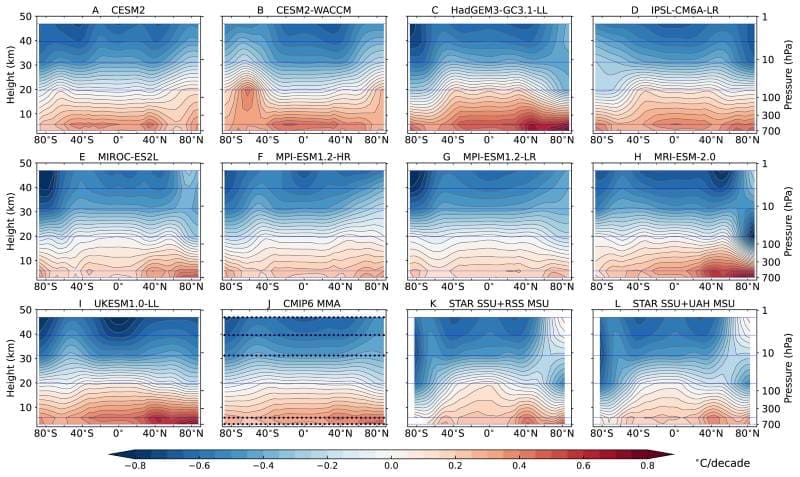
For decades, researchers have identified a distinct “fingerprint” of human influence on climate: warming in the troposphere, the lowest layer of the atmosphere, alongside cooling in the stratosphere above. This pattern is primarily driven by rising concentrations of CO₂ and other greenhouse gases, with additional effects from past ozone depletion. According to the authors, satellite observations closely match climate model simulations of these human-caused changes.
The dispute follows the DOE report’s citation in efforts to reverse the 2009 EPA endangerment finding, which underpins US greenhouse gas regulations. The scientists argue the report should not be used to inform legal or regulatory decisions, and say it fails to accurately reflect the scientific evidence.
— Press Release —
DOE climate report ‘demonstrably incorrect’, say leading scientists in new analysis
Prof Benjamin Santer, an Honorary Professor at the University of East Anglia (UEA), was among the first scientists to identify a human ‘fingerprint’ on Earth’s climate, with his research contributing to the historic 1995 report from the Intergovernmental Panel on Climate Change (IPCC). This concluded for the first time that there was sufficient evidence to suggest a “discernible human influence” on global climate.
However, in July 2025 a claim to the contrary was made in a report of the US Department of Energy (DOE) citing Prof Santer’s research as evidence. This was on the same day the US Environmental Protection Agency (EPA) released a proposal to reverse the so-called 2009 ‘endangerment finding’ – a ruling that gave it the legal authority to regulate emissions of greenhouse gases, for example from vehicles, power plants and other industrial sources.
Earlier this month the Trump administration went ahead with its plan to revoke the ruling, a move that prompted concerns about the impact on human health and efforts to reduce emissions. There were also concerns it could open the door to end other environmental regulations in the US.
In a new analysis published this week in the journal AGU Advances, Prof Santer and fellow climate scientists Prof Susan Solomon from the Massachusetts Institute of Technology (MIT), Prof David Thompson from UEA and Colorado State University, and Prof Qiang Fu of the University of Washington, reiterate the role of humans on climate warming and warn the DOE report should not inform legal decisions on the scientific basis of regulations such as the endangerment finding.
“We view it both important and with precedent to rebut an incorrect scientific claim made in the DOE report,” said Prof Santer, of UEA’s Climatic Research Unit. “Setting the record straight in the peer-reviewed literature is particularly important when demonstrably incorrect scientific claims are made in official government reports.
“Changes in the vertical structure of atmospheric temperature are an important ‘fingerprint’ of human effects on global climate. These changes are mainly driven by human caused increases in atmospheric levels of CO₂ and other greenhouse gases.
“Key features of this fingerprint are warming of the troposphere, the lowest layer of the atmosphere, and cooling of the stratosphere, the layer above the troposphere. Satellite observations of this distinctive fingerprint are in agreement with current state-of-the-art climate model estimates of human-caused temperature changes.
“This indisputable fingerprint of human effects on climate has been predicted for over 50 years by both simple and more sophisticated climate models, and is identifiable in satellite temperature data.
“The claim to the contrary made in the US DoE review of climate science is factually incorrect. As our analysis clearly illustrates, the DOE report is not a reliable source of information on the vertical structure of changes in atmospheric temperature, which is a key piece of evidence for human effects on global climate.”
Scientific concerns have also been raised regarding other aspects of the treatment of climate change detection and attribution in the DOE report, which was referenced 16 times in last year’s EPA proposal.
Following a lawsuit alleging failure of the DOE to follow proper Federal Advisory Committee procedures, the author team of the DOE report was dissolved in early September.
However, the authors highlight that the DOE report itself has not been retracted or corrected.
Prof Santer said: “The report is still available on the DOE website and is still being publicly referenced by DOE Secretary Wright as a credible source of information on climate science. It is not.”
Journal Reference:
Santer, B. D., Solomon, S., Thompson, D. W. J., & Fu, Q., ‘Modeled and observed stratospheric temperature changes: Implications for fingerprint studies’, AGU Advances 7, 2: e2025AV002196 (2026). DOI: 10.1029/2025AV002196
Article Source:
Press Release/Material by University of East Anglia (UEA)
Featured image credit: Ale Alvarez | Unsplash