Seagrass meadows spread quietly beneath shallow coastal waters, forming underwater prairies that rank among the most productive ecosystems on Earth. Unlike seaweed, seagrasses are flowering plants with roots, stems and leaves. They grow in soft sediments along coastlines on every continent except Antarctica, binding the seabed together while creating shelter and feeding grounds for marine life.
Although seagrass covers only about 0.1% of the ocean floor, its ecological role is far greater than its size suggests. Meadows provide habitat for thousands of species, including commercially important fish, seahorses and endangered sea turtles. Juvenile fish use the dense blades as nursery grounds, reducing exposure to predators. Seagrass also traps sediments and filters nutrients, helping to maintain water clarity and stabilise shorelines.
These ecosystems are among the ocean’s most effective natural carbon sinks. Through photosynthesis, seagrass captures carbon dioxide and stores it in plant tissue and in the sediments below, sometimes for centuries. For this reason, seagrass meadows are grouped with mangroves and salt marshes as part of the world’s blue carbon systems.
Yet their decline has been documented for decades. Seagrasses have been shrinking globally since the 1930s, and the most recent census estimates that around 7% of this marine habitat is being lost each year. According to the International Union for Conservation of Nature, 21% of seagrass species are classified as Near Threatened, Vulnerable or Endangered on its Red List of Threatened Species. Coastal development, pollution, dredging, destructive fishing and rising sea temperatures all contribute to the loss.
World Seagrass Day, observed each year on 1 March, was established by the United Nations General Assembly in 2022 to raise awareness of these trends and promote conservation and restoration. The day places seagrass within wider discussions on climate change, biodiversity and sustainable coastal management.
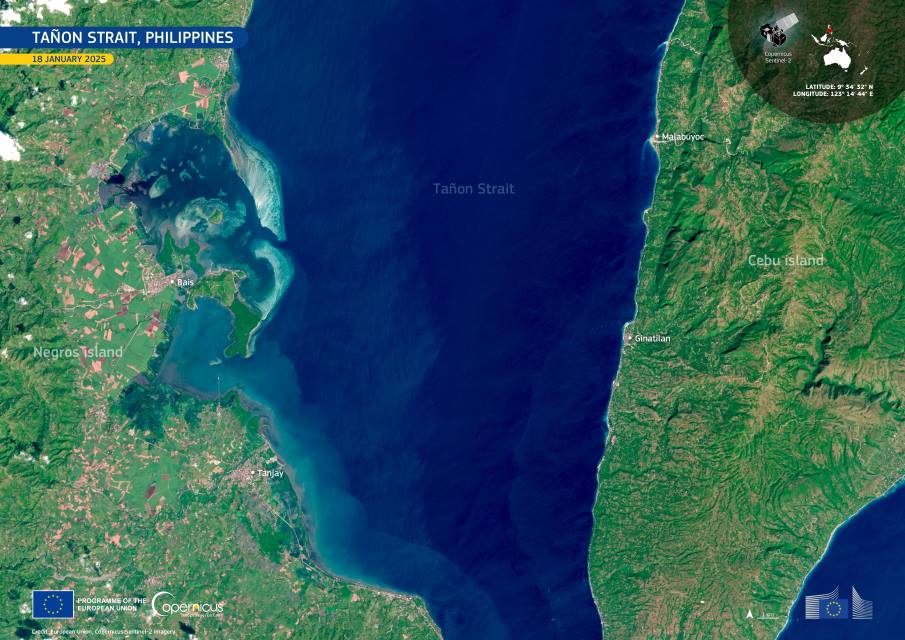
The Tañon Strait in the central Philippines offers one example of where these ecosystems remain significant. Located between Negros Island and Cebu Island, the strait forms part of the Tañon Strait Protected Seascape. It supports seagrass meadows alongside coral reefs and mangroves, creating a connected marine landscape that sustains fisheries and coastal communities.
The image, acquired on 18 January 2025 by one of the Copernicus Sentinel-2 satellites, shows the southern section of the strait. Shallow waters appear in turquoise, deeper areas in dark blue, and vegetation on the surrounding islands in bright green. Individual seagrass beds are not directly visible at this scale, but satellite data allow scientists to map and monitor coastal habitats over time.
By tracking changes in water colour, sediment plumes and shoreline patterns, Copernicus imagery supports long-term observation of marine environments such as Tañon Strait. As World Seagrass Day draws attention to the state of these underwater meadows, space-based monitoring provides a broader view of the coastal zones where they grow and where protection efforts remain essential.
Featured image credit: European Union, Copernicus Sentinel-2 imagery