Storm Regina, a low-pressure system named by the Portuguese Institute for Sea and Atmosphere (IPMA) on 1 March, developed over the eastern Atlantic near the Canary Islands before moving toward northwest Africa. By around 3 March 2026 it had approached the Moroccan coast, where its circulation began drawing large amounts of Saharan dust into the atmosphere, setting the stage for a plume that would later move toward Europe.
Dust plume reaches Europe
As the system evolved, strong southerly winds lifted mineral particles from the Sahara and transported them northwards. The air flow carried the dust across the Mediterranean and into southern and western Europe, where hazy skies were reported in several countries. Air-quality monitoring stations also recorded elevated concentrations of airborne particles as the plume spread across the region.
A key concern during such events is the rise in PM₁₀ – airborne particles with a diameter of 10 micrometres or less. These coarse particles, commonly associated with desert dust, can be inhaled and may affect the respiratory system. The European Union sets a daily limit value of 50 µg/m³ for PM₁₀ concentrations, which should not be exceeded more than 35 times in a year. During the dust episode, some areas approached or temporarily exceeded this threshold, prompting national weather and health services in several countries to advise vulnerable groups – including people with respiratory conditions – to limit prolonged outdoor exposure.
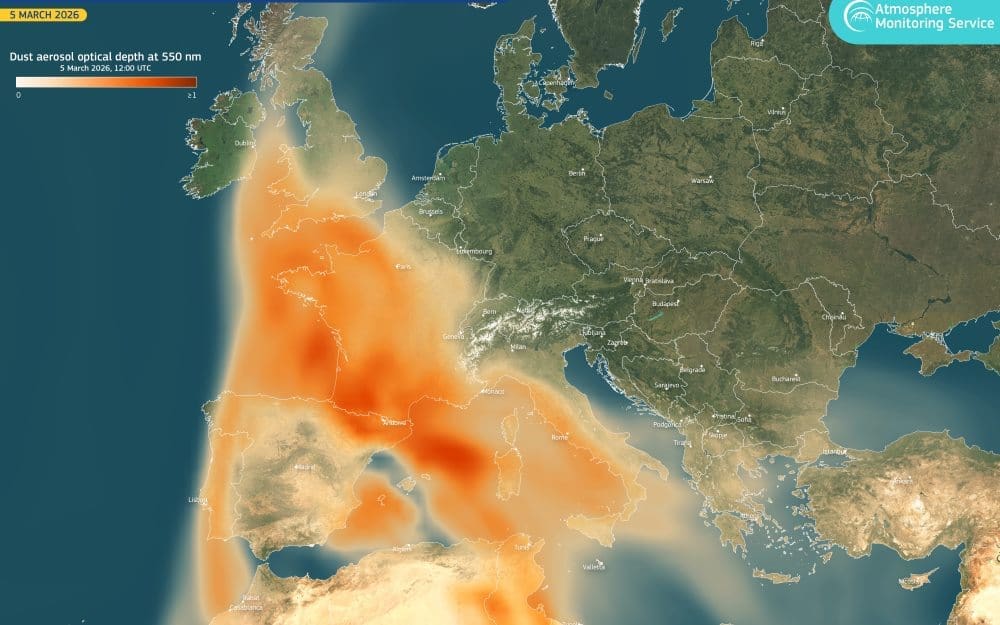
This visualisation, based on Copernicus Atmosphere Monitoring Service (CAMS) data from 5 March 2026 at 12:00 UTC, illustrates a large plume of Saharan dust spreading from the North African coast across much of Europe. The dust cloud extends over Portugal, Spain, Italy and France, with traces reaching as far north as the United Kingdom. Forecasts at the time indicated that the plume would continue moving further north in the following days, potentially reaching parts of Scandinavia.
Air quality and health impacts
The health effects of particulate matter are well documented. Episodes of desert dust can raise concentrations of PM₁₀ – airborne particles small enough to be inhaled – and several studies have linked such events to increases in respiratory symptoms and hospital visits, particularly among vulnerable groups. Researchers note that mineral dust is a natural source of particulate matter, but high concentrations can still affect air quality and human health.
CAMS provides consistent, quality-controlled information on atmospheric composition, including air pollution, solar energy, greenhouse gases and climate forcing worldwide. Part of the European Union’s Copernicus Earth observation programme, the service combines satellite observations with advanced atmospheric models to monitor and forecast the state of the atmosphere.
Featured image credit: European Union, Copernicus Atmosphere Monitoring Service Data