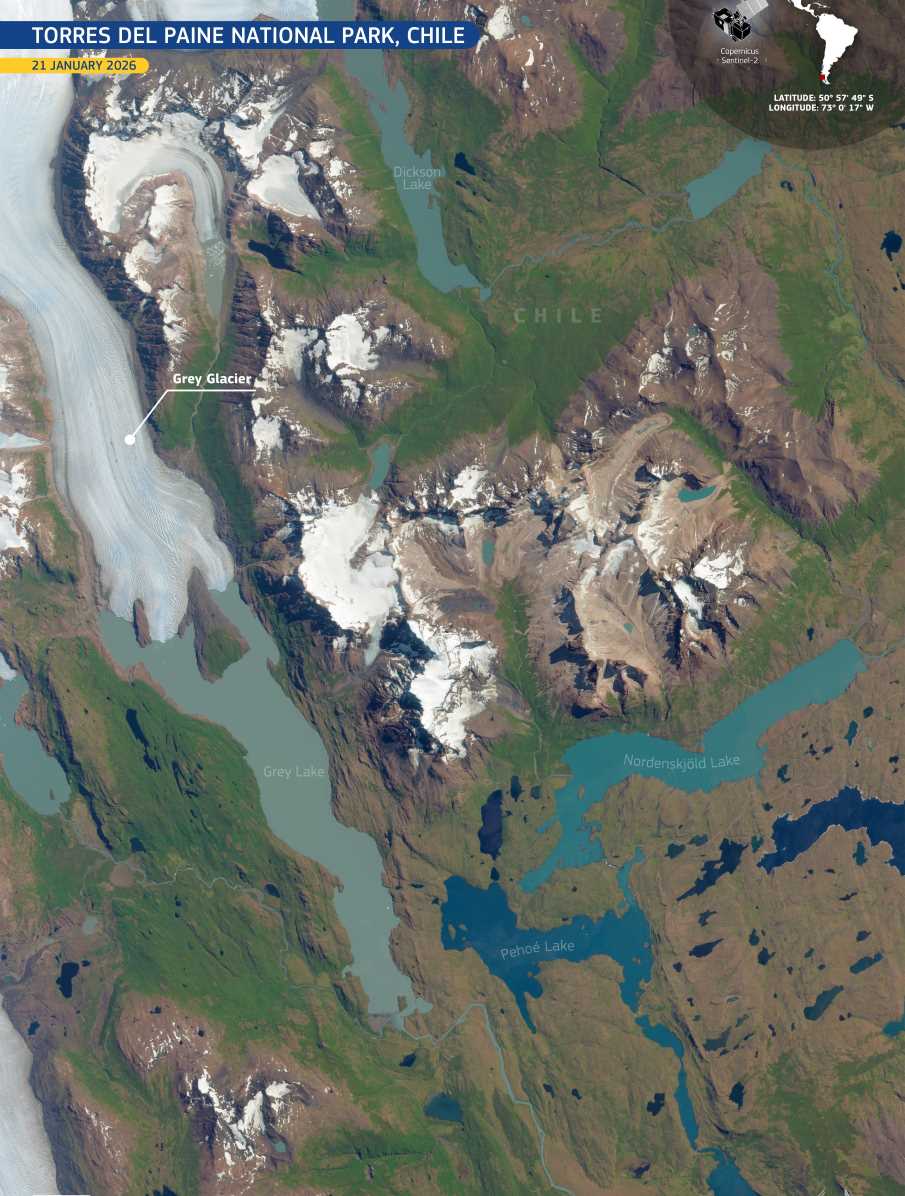
Torres del Paine National Park, in southern Chilean Patagonia, is one of South America’s most recognisable protected landscapes, bringing together mountains, glaciers, rivers, lakes, grasslands and forest within a UNESCO biosphere reserve designated in 1978. The park is known for landmarks such as the Paine massif, the Cuernos del Paine and Grey Glacier, all set between the Andes and the Patagonian steppe.
Seen from orbit in midsummer, the landscape shows clear contrasts between ice, water, vegetation and bare rock. In this Sentinel-2 view, Grey Glacier appears in bright white tones against darker terrain, while lakes within the park show vivid turquoise and blue colours. Across the surrounding steppe, vegetation forms broad green areas that contrast with the brown and grey mountain ridges of the reserve. The image presents Torres del Paine not as a single landmark, but as an interconnected mountain, glacier and lake system shaped by snow, ice and meltwater.
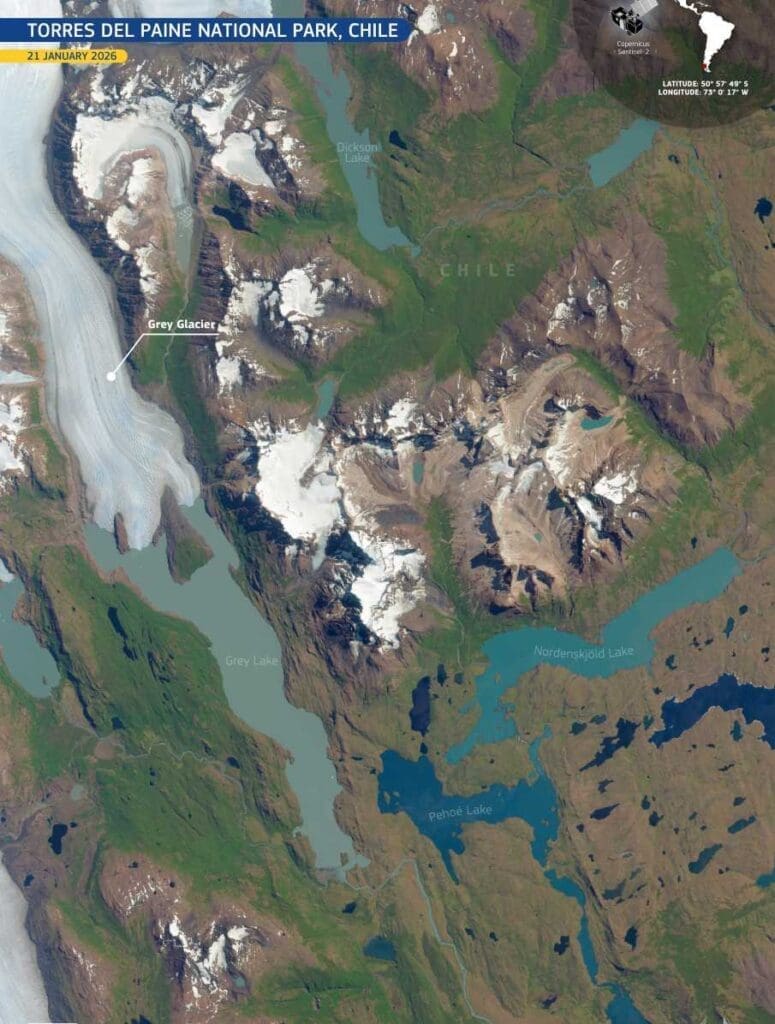
That wider setting is central to the character of the park. Grey Glacier is among its best-known features, flowing from the Southern Patagonian Ice Field into Grey Lake, while other lakes and river systems help define the reserve’s distinct mosaic of water and rock. Even during the austral summer, snow and ice remain visible across higher ground, showing how strongly glacial processes continue to shape this part of Patagonia.
Copernicus satellite data adds more than a striking visual record. Because Sentinel-2 revisits the same areas frequently, the imagery helps scientists and environmental authorities follow glacier dynamics, seasonal snow cover and changes in vegetation across remote mountain regions. In protected areas such as Torres del Paine, these observations support climate research and provide practical information for tracking environmental change and managing fragile ecosystems over time.
Featured image credit: European Union, Copernicus Sentinel-2 imagery