Aquaculture is the cultivation of fish, shellfish and other aquatic organisms in controlled marine or freshwater environments. Often described as the farming of seafood, it resembles agriculture on land but takes place in water and includes species such as fish, crustaceans, molluscs and aquatic plants. As the fastest-growing food production sector in the world, aquaculture now provides more than half of global seafood production and plays an increasingly important role in supplying sustainable food for a growing population.
Vietnam is one of the countries where this sector has expanded rapidly. With thousands of kilometres of coastline and extensive river systems, the country has developed a major aquaculture industry that supplies both domestic markets and international seafood trade. Farmed shrimp, pangasius and a variety of marine species are exported worldwide, making aquaculture a key part of Vietnam’s coastal economy and an important source of livelihoods for many communities.
In northern Vietnam, Quảng Ninh Province has become an important centre for marine aquaculture. The region’s indented coastline, shallow bays and sheltered waters create favourable conditions for floating farms. These protected marine environments are common around the Hạ Long Bay area, where limestone islands and calm seas provide natural protection from strong waves and currents.
Floating aquaculture platforms in Hạ Long Bay
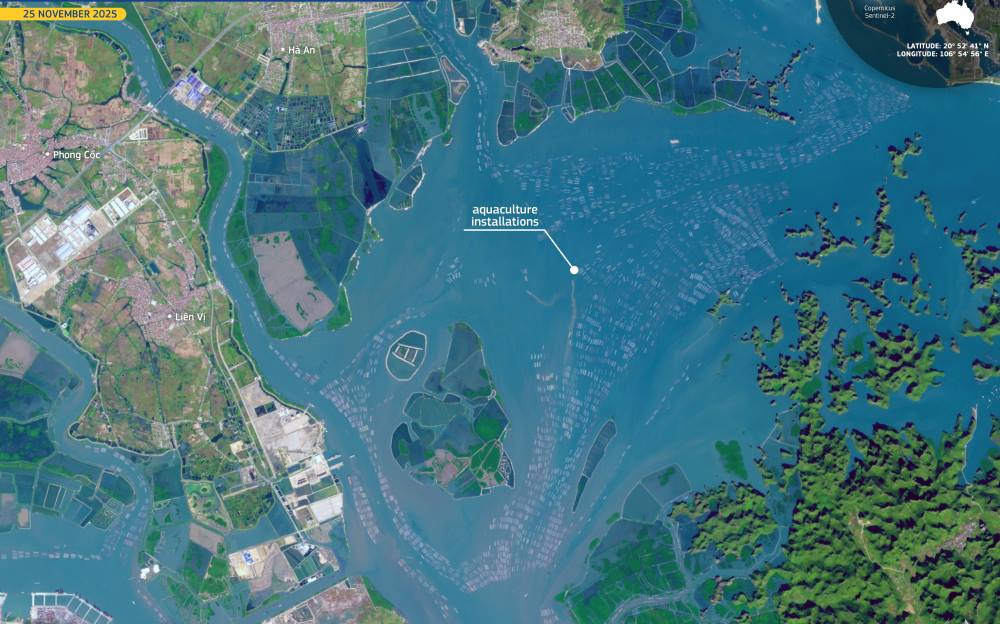
Acquired on 25 November 2025 by one of the Copernicus Sentinel-2 satellites, the image shows extensive aquaculture installations in coastal waters near Phong Cốc in Quảng Ninh Province, west of Hạ Long Bay. The floating platforms form dense networks of light-coloured lines arranged in parallel rows across shallow waters. Such structures typically support cages or longlines used to cultivate marine fish and shellfish.
Marine aquaculture in this part of Vietnam includes species such as grouper, seabass and other finfish raised in floating cages, along with molluscs such as oysters and clams grown on suspended lines or racks. These farming systems allow coastal communities to cultivate seafood in sheltered waters while maintaining water circulation that supports healthy growth.
The importance of aquaculture in Vietnam is also reflected in international industry gatherings. In Ho Chi Minh City, the Aquaculture Vietnam 2026 exhibition and the VietShrimp Asia 2026 fair are scheduled to take place from 18 – 20 March 2026 at the Saigon Exhibition and Convention Center. The events bring together companies, researchers and policymakers from around the world to discuss new technologies, sustainable farming practices and the future of seafood production as the sector continues to expand.
The rapid expansion of aquaculture also raises environmental challenges. Climate change, stronger storms and water quality pressures can affect coastal farms and surrounding ecosystems. These concerns are especially relevant in waters around Hạ Long Bay, which is part of the Hạ Long Bay – Cát Bà Archipelago UNESCO World Heritage Site, where aquaculture operates alongside rich marine habitats.
Satellite observations play an increasingly important role in understanding and managing these coastal environments. Data from the Copernicus Sentinel missions allow scientists and authorities to monitor coastal waters, map aquaculture infrastructure and track changes in marine ecosystems over time. By providing regular observations of coastal areas, Earth observation satellites support better planning, ecosystem conservation and sustainable management of aquaculture.
Featured image credit: European Union, Copernicus Sentinel-2 imagery