Summary:
Reforestation is widely promoted as a way to help limit global warming, but new research suggests its climate impact depends strongly on where new forests are established. In a study published in Communications Earth & Environment, researchers at ETH Zurich found that the geographic placement of reforestation can be more important than the total area restored when the goal is to cool the planet.
Using a fully coupled Earth system model, the team compared three global reforestation scenarios and analysed both the carbon absorbed by forests and their biophysical effects on the climate system. These include changes in sunlight reflection, evapotranspiration and surface properties that influence how energy and moisture move between land and atmosphere. Across the scenarios, the simulations show that reforestation could lower global temperature by 0.13 °C to 0.25 °C by 2100. In two of the scenarios, nearly the same cooling effect was achieved even though the reforested area differed by about 450 million hectares.
The simulations indicate that tropical regions – including the Amazon basin and parts of West and Southeast Africa – offer the strongest cooling potential. In contrast, reforestation in high northern latitudes can reduce the reflection of sunlight from snow-covered ground, partly or fully offsetting the cooling benefit of carbon uptake. The researchers conclude that reforestation can contribute to climate mitigation, but it cannot replace rapid cuts in fossil fuel emissions.

— Press Release —
Not every forest cools the Earth
- Climate researchers at ETH Zurich show where planting trees makes the most sense with a view to achieving the greatest possible cooling effect on the climate.
- Reforestation in tropical regions has the greatest cooling effect. Tree planting in the northern hemisphere, on the other hand, reduces the reflection of sunlight and has no effect or even contributes to global warming.
- The cooling effect on the climate will be a maximum of 0.25°C by 2100. This contribution is important, but it cannot replace the urgently required reduction in greenhouse gas emissions.
Trees are much beloved, and reforestation enjoys broad support in society, in the political sphere and, to some extent, within the scientific community. Widespread campaigns such as the Trillion Tree Campaign, launched by the United Nations Environment Programme (UNEP), promise climate protection through the planting of billions of trees.
Such initiatives aim to increase the number of trees worldwide as quickly as possible to absorb climate-damaging carbon dioxide. How much land is available for reforestation globally remains a highly contested topic of debate to this day. Depending on the individual study, between 150 and 1,000 million hectares could absorb between 130 and 750 gigatonnes of carbon dioxide.
Various reforestation scenarios compared
Previous studies have generally only examined individual, often highly idealised reforestation scenarios or have worked with simplified models. In a recently published article, researchers led by Robert Jnglin Wills, Professor of Climate Dynamics at ETH Zurich, simulated and compared the climate impact of three global reforestation scenarios in a complex Earth system model for the first time.
In order to do this, they considered not only the biochemical effects of reforestation, i.e. the absorption of carbon dioxide through photosynthesis by trees, but also the biophysical effects. These include the changed albedo, i.e. the ability to reflect sunlight, as well as the effects on water evapotranspiration and the altered surface properties of reforested areas, caused for example by the presence of leaves rather than grasses.
In conducting their modelling, the researchers opted for three existing reforestation scenarios, that make different economic and ecological assumptions concerning reforestation possibilities. These included one scenario developed by a team led by Jean-François Bastin at ETH Zurich in 2019, which attracted a great deal of attention while also drawing criticism. Nevertheless, it is still used by many international organisations today when planning reforestation projects.
Maximum reforestation with varying cooling effect
The researchers calculated the biochemical and biophysical temperature effects that reforestation would have by 2100 for the three scenarios – and how these would impact the global climate system. This was based on the assumption that, for all three scenarios, forests would be reforested to their maximum potential between 2015 and 2070 and that the forest area would then remain constant for 30 years. No urban areas, vegetation-free or ice-covered regions were to be reforested, and reforestation on agricultural land would be kept to a minimum so as not to jeopardise global food security.
In carrying out the simulation, the researchers used a climate model that incorporates all the components of the climate system, including the atmosphere, oceans and land. To ensure that the calculated effects were actually attributable to reforestation and not to random weather fluctuations, the researchers ran the model five times on the ETH ‘Euler’ supercomputer, with slightly different starting conditions. The simulations took around four months and generated 300 terabytes of data.
The amount of land required could be halved
The results were astounding: although the reforested area differed by 450 million hectares, two of the scenarios examined achieved almost the same global cooling effect. The difference corresponds to an area roughly the size of all EU countries combined. “The fact that we can achieve the same cooling effect with significantly less land shows that where we plant is more important than how much we plant,” explains Nora Fahrenbach, a doctoral student in Jnglin Wills’ group and lead author of the study.
The reason for these efficiency gains lies in the geographical location and in the contradictory effects of biophysical and biochemical processes at different latitudes. While the reforestation scenario proposed by Jean-François Bastin’s team envisages vast forest areas in northern latitudes, more efficient approaches focus on regions where trees can better exert their cooling effect.
The greatest potential for a cooling effect on the local and global climate is in the tropics, especially in the Amazon basin and in West and South-East Africa. Trees there not only store carbon efficiently (biochemical cooling), but also cool their surroundings locally due to a high evapotranspiration rate (biophysical cooling). To a lesser extent, the same effects can be observed in South-East Asia.
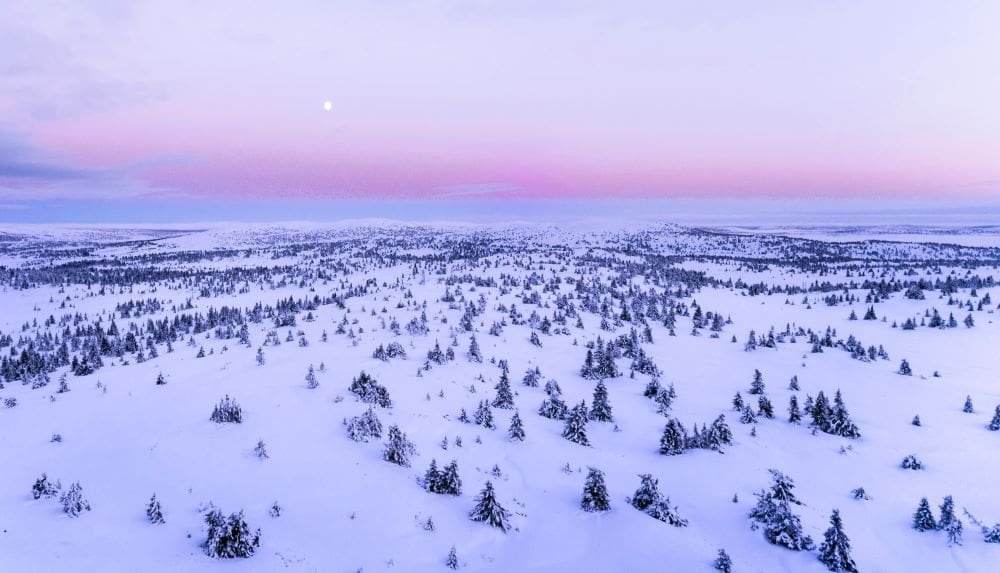
In high northern latitudes, however, such as in Siberia, Canada, Alaska and large parts of North America, large-scale reforestation does not usually have a cooling effect on the climate. These areas are often covered in snow and ice for months on end, which strongly reflect sunlight. When reforestation takes place, the dark tree crowns protruding from the snow cover cause more solar radiation to be absorbed. This albedo effect results in local warming, which, in combination with climate effects from other regions, partially or even completely negates the cooling effect of CO₂ absorption by trees.
“By avoiding reforestation in northern regions and focusing instead on the tropics, reforestation becomes a far more efficient tool for climate protection,” explains Fahrenbach.
Local interventions with global consequences
The researchers also demonstrated that reforestation influences atmospheric and oceanic circulation. This means that a new forest can alter temperatures and precipitation in regions thousands of kilometres away. Surprisingly, these non-local effects varied dramatically between the three scenarios. Whether a region became warmer or cooler depended not only on the trees in that location, but also on where else on Earth additional forests were planted. This clearly shows that reforestation has not only a local impact, but also global consequences.
Fahrenbach admits that she only looked at the effects of the reforestation scenarios on the climate, not on biodiversity, ecosystems and the people living in the forest. In addition, the effects of the various scenarios have thus far only been calculated using one climate model. Ideally, results from different models would be compared, which is, however, time-consuming and cost intensive.
Nevertheless, Fahrenbach emphasises that the findings are not isolated as such: a comparison with existing observational data and other models supports the key findings of the study. “It has long been known that tropical forests cool the climate more effectively than forests in high northern latitudes,” explains the researcher. “With our comparison, however, we are now – for the first time – providing policymakers with a scientific foundation for decision-making, highlighting which areas worldwide offer the greatest potential for effective climate cooling.”
Systematic and with a global perspective
Future reforestation efforts should ideally be coordinated internationally, as Fahrenbach states. This would help to prevent inefficient reforestation projects. However, there is currently no global institution established for this purpose. It is also surprising that international agreements such as the Paris Climate Agreement and the UN REED+ initiative view forests solely as carbon sinks and do not take their biophysical effects on the climate into account. “I like trees too, but when we pursue reforestation, it must be carried out systematically, scientifically and with a global perspective,” says Fahrenbach.
Consequently, she advocates for ‘climate-smart’ reforestation and advises planting trees only where they actually have a positive effect on the climate system – and never in monocultures, which are particularly susceptible to disease and fire.
The climate scientist also emphasises that reforestation cannot stop climate change. In large-scale reforestation scenarios, it would be possible to reduce the global average temperature by a maximum of 0.25 degrees by 2100. Although this contribution is valuable, it is limited in relation to the degree to which the Earth is actually required to be cooled. “There is no way around a drastic and rapid reduction in fossil fuel emissions,” asserts the researcher.
Journal Reference:
Fahrenbach NLS, De Hertog SJ, Jäger F, Lawrence PJ, Jnglin Wills RC, ‘Reforestation scenarios shape global and regional temperature outcomes’, Communications Earth & Environment 7, 204 (2026). DOI: 10.1038/s43247-026-03331-3
Article Source:
Press Release/Material by Samuel Schlaefli | ETH Zurich
Featured image: The opposite of what was intended: if more trees are planted in the taiga than grow there naturally, the cooling albedo effect of the snow decreases and the dark tree crowns promote warming. Credit: invisiblepower | Pexels