Lava from Piton de la Fournaise has reached the Indian Ocean on Réunion Island after flowing for weeks across the volcano’s southeastern flank, marking a rare event where molten rock travelled from eruption site to coastline.
Réunion, a French island east of Madagascar in the western Indian Ocean, is shaped by active volcanism. Piton de la Fournaise dominates its southeastern sector, where most eruptions occur within the Enclos Fouqué caldera. While activity is frequent, flows that extend beyond the upper slopes toward infrastructure and the coast are less common.
The eruption began on 13 February and continued into March, with sustained lava output feeding a southward-moving branch. The Smithsonian Institution’s Global Volcanism Program (GVP), citing the Observatoire Volcanologique du Piton de la Fournaise (OVPF), reported that by 11 March the flow had advanced to within 1.1 km of National Route 2 (RN2) before crossing the road two days later.
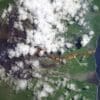
The 16 March satellite image shows a clear spatial structure. A narrow, bright lava channel cuts from the darker volcanic slopes toward the coast, crossing lighter green terrain and older grey lava fields. The flow remains concentrated, forming a continuous line rather than spreading widely, with slight widening where the terrain flattens. The Indian Ocean appears along the right edge of the image, marking the endpoint of the flow.
Satellite view of Piton de la Fournaise lava flow
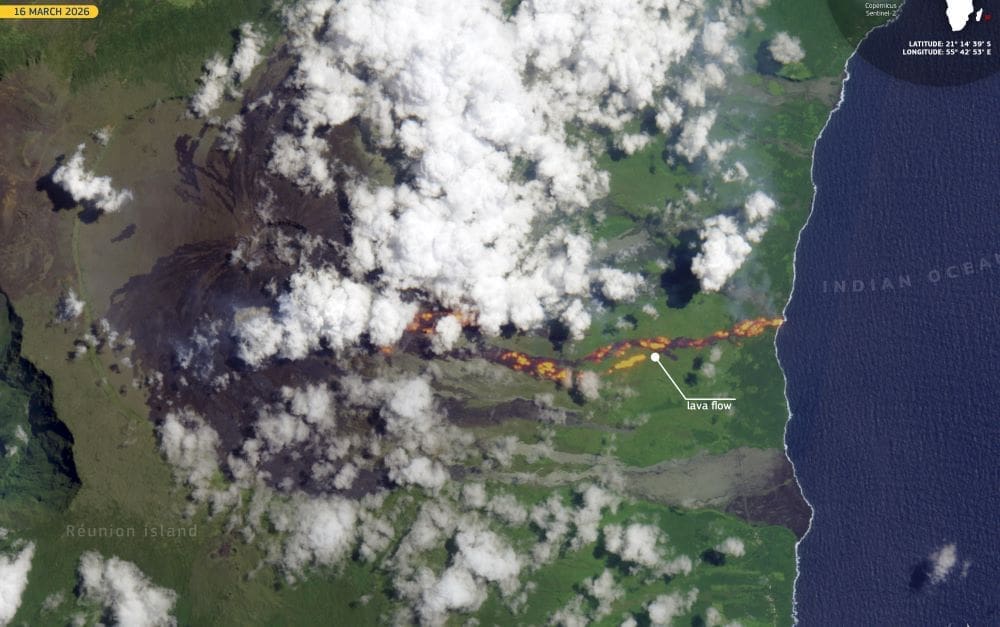
The image captures the full extent of the event in a single frame. The active lava path links the upper volcanic area to the shoreline, crossing both natural terrain and built infrastructure. No large steam plume is visible at the coast, but the continuity of the flow makes the progression clear from eruption site to ocean entry.
By mid-March, the lava had extended about 7 km and reached the Indian Ocean for the first time since 2007. The flow cut the RN2 coastal road, a key transport route connecting communities in the south and east of the island. Authorities restricted access near the site as lava entered the sea, where interactions with seawater can generate unstable ground and hazardous gases.
Such coast-reaching flows are relatively uncommon at Piton de la Fournaise despite its frequent eruptions. In many cases, lava cools or stalls before reaching the shoreline. Copernicus Earth observation data provide a consistent record of such events, helping track the movement of lava, assess impacts on infrastructure and coastline, and monitor changes in active volcanic landscapes over time.
Featured image credit: European Union, Copernicus Sentinel-2 imagery