Around 70% of Earth’s freshwater is stored in the cryosphere, which covers roughly 10% of the planet’s land surface. On 21 March, World Day for Glaciers focuses attention on how quickly this frozen system is changing, as rising temperatures accelerate the loss of ice that feeds rivers and stabilises water supply in many regions.
The UN declared 2025 the International Year of Glaciers’ Preservation and set 21 March as the annual World Day for Glaciers, alongside a Decade of Action for Cryospheric Sciences (2025–2034) to strengthen research and responses to accelerating ice loss. The initiative reflects growing concern that glacier retreat is altering water systems, sediment flows and seasonal runoff patterns at a global scale.
In New Zealand, these changes are visible in the Southern Alps, where steep terrain rises to nearly 4,000 m within about 30 km of the Tasman Sea. This compressed geography concentrates snowfall and ice formation, creating one of the most prominent glacier systems in the mid-latitudes of the Southern Hemisphere.
Aoraki/Mount Cook National Park contains the country’s largest glaciers, with ice covering about 40% of the landscape. The park forms part of Te Wāhipounamu – South West New Zealand, a UNESCO World Heritage site spanning around 2.6 million hectares, or about 10% of the country’s land area. The region sits along the Alpine Fault, where the Indo-Australian and Pacific plates meet, and its terrain has been shaped by repeated glaciations, tectonic uplift and erosion over long timescales.
A glacier in transition
The Tasman Glacier occupies a wide valley carved by these processes and is the largest glacier in New Zealand. Its current form reflects both its geological setting and recent climate-driven retreat. As the glacier has thinned and withdrawn, it has exposed extensive moraine systems and contributed to the expansion of Tasman Lake at its terminus.
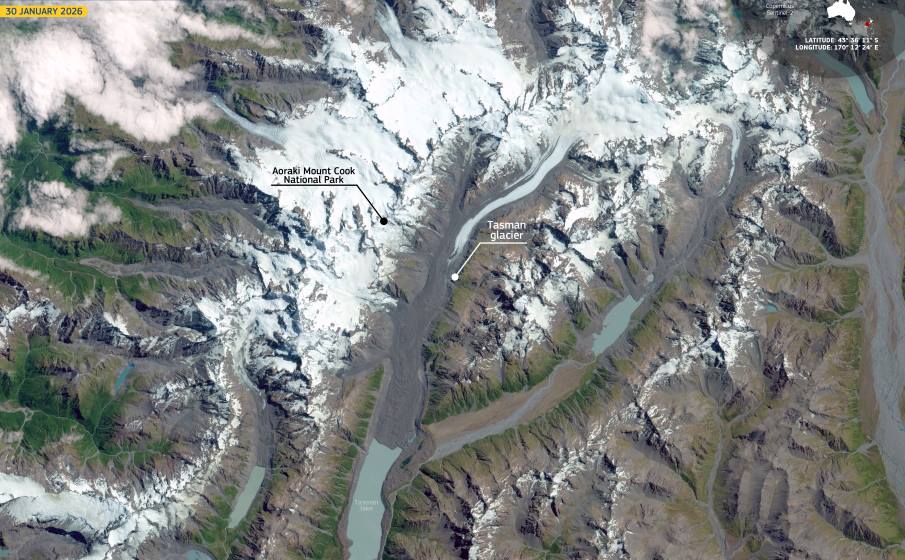
In this image, acquired by one of the Copernicus Sentinel-2 satellites on 30 January 2026, the glacier appears in bright white and pale blue tones, while the dark grey moraines stretching southwards mark its path. Fresh meltwater flows down the valley and empties into Tasman Lake, which appears in turquoise tones.
The contrast between ice, debris and water reveals the glacier’s current state. Moraines trace earlier positions of the ice front, while the size and colour of the lake indicate sustained melting and high sediment transport. These features show a system in transition, where ice loss, meltwater flow and erosion are reshaping the valley floor.
Te Wāhipounamu provides a broader context for these changes. The region preserves a large-scale record of glacial landforms and post-glacial ecosystems, shaped by interactions between climate, tectonics and ice. As temperatures rise, those same processes are continuing under different conditions, with glaciers retreating and altering the structure of alpine catchments.
Copernicus satellite observations allow consistent monitoring of glacier extent, snow cover and sediment-rich water systems over time. On World Day for Glaciers, the Tasman Glacier offers a clear example of how changes in the cryosphere can be observed directly, linking local landscape evolution to global climate trends.
Featured image credit: European Union, Copernicus Sentinel-2 imagery