Every year on 23 March, World Meteorological Day marks the establishment of the World Meteorological Organization (WMO) and draws attention to the systems that monitor the Earth’s atmosphere, oceans and climate. In 2026, the theme ‘Observing Today, Protecting Tomorrow’ reflects how continuous measurements are transformed into forecasts and warnings that support decisions and reduce risk.
Observations are collected continuously through the WMO Integrated Global Observing System (WIGOS), with data coming from land stations, ships, ocean buoys, aircraft and satellites. Around 4,000 Argo floats operate across the global ocean. Together, these systems provide the continuous flow of data used to produce forecasts, monitor climate and issue early warnings.
The atmosphere is one of the clearest examples of why this global network matters. Aerosols – tiny particles suspended in the air – originate from sources such as desert dust, sea spray, industrial pollution and wildfire smoke. They affect visibility and human health. They also influence radiation and cloud formation, with implications for both weather and climate. Once injected high into the atmosphere, smoke from large fires can travel across continents.
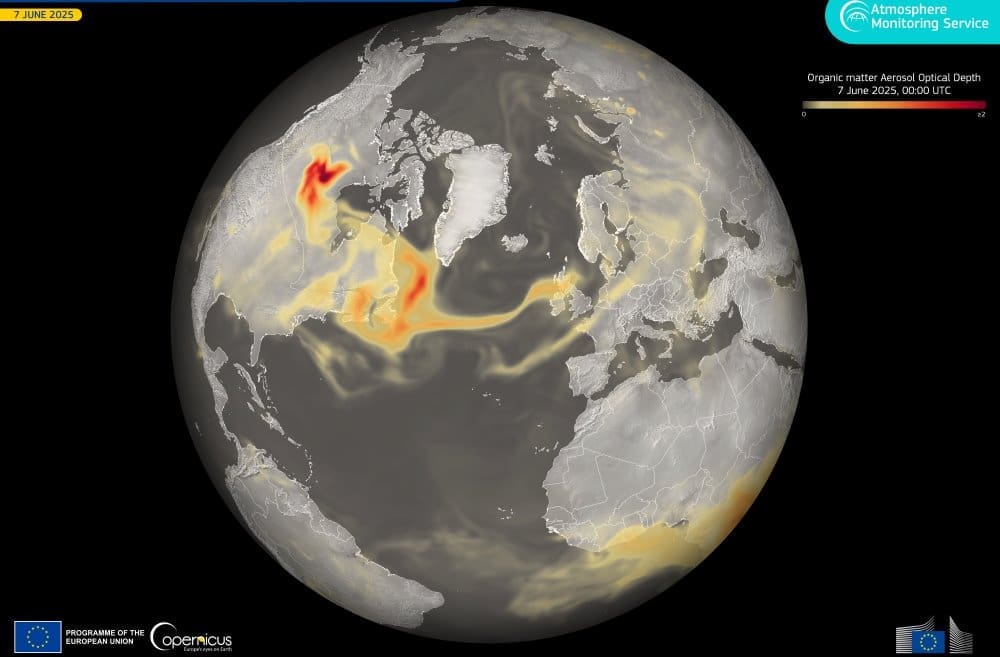
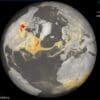
During the Canadian wildfire season in 2025, intense fire activity released large volumes of smoke into the atmosphere. CAMS reported that emissions from that season ranked among the highest in its records since 2003. The scale of the fires allowed smoke to rise and enter atmospheric circulation patterns capable of carrying it far beyond North America.
CAMS data capture that transatlantic transport in action. A broad plume of smoke extends eastward from Canada across the North Atlantic and into Europe on 7 June 2025 at 00:00 UTC, turning a regional fire event into a hemispheric atmospheric phenomenon. The visualisation shows not only where the smoke originated, but how its movement can be tracked across an ocean and used to anticipate where its effects may be felt next.
This type of monitoring is operational. The Copernicus Atmosphere Monitoring Service (CAMS) combines satellite observations, ground-based measurements and numerical models to analyse and forecast atmospheric composition in near real time. During wildfire events, this allows scientists and authorities to assess how smoke may affect air quality across large regions.
World Meteorological Day highlights the systems that make such analysis possible. Observations collected across the globe are shared, processed and transformed into information that supports decision-making. From wildfire smoke crossing the Atlantic to local air quality forecasts, continuous monitoring of the atmosphere remains essential for understanding change and managing its impacts.
Featured image credit: European Union, Copernicus Atmosphere Monitoring Service Data