

Summary:
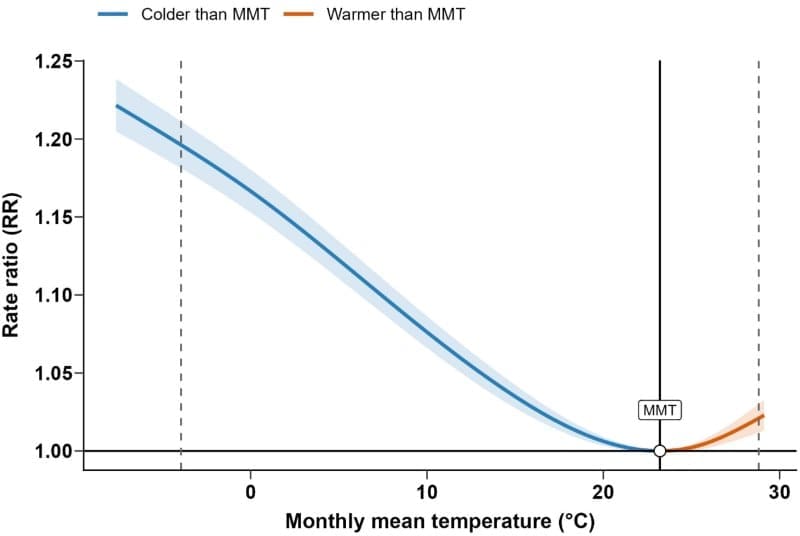
Lower temperatures are associated with a marked rise in cardiovascular deaths across the United States, according to a large nationwide analysis published in the American Journal of Preventive Cardiology and presented at the American College of Cardiology’s Annual Scientific Session (ACC.26). Researchers examined data from 819 locations covering around 80% of the U.S. population aged over 25 between 2000 and 2020, identifying 23 °C as the temperature linked to the lowest mortality risk. Death rates increased as temperatures moved both below and above this level, forming a lopsided U-shaped pattern.
The increase was substantially greater in colder conditions. The study estimates that cold weather contributed to about 40,000 excess cardiovascular deaths per year, equivalent to 6.3% of all such deaths, compared with roughly 2,000 annually linked to heat. Physiological responses to cold, including blood vessel constriction and inflammatory processes, are considered key mechanisms.
The findings indicate that public health strategies should address cold exposure alongside heat when preparing for climate-related risks, particularly as the number of people with chronic conditions continues to rise.
— Press Release —
When temperatures drop, heart-related deaths rise
According to a study being presented at the American College of Cardiology’s Annual Scientific Session (ACC.26), hotter temperatures were also associated with increases in cardiovascular deaths, but at a more modest rate.
Previous studies have linked temperature extremes with increased cardiovascular mortality, but most research has focused on other countries or on limited portions of the United States. For example, a past study published in JACC found that cold weather exposure was associated with an increased risk of heart attacks. This new study provides the most comprehensive analysis of temperature-related trends to date across a broad swath of the U.S. population.
“This is the first time we have actual numbers for most of the United States, and we found the burden of excess deaths associated with cold is quite substantial,” said Pedro Rafael Vieira De Oliveira Salerno, MD, resident physician at NYC Health + Hospitals/Elmhurst, Icahn School of Medicine at Mt. Sinai in New York, and the study’s lead author.
Researchers analyzed monthly temperatures and total cardiovascular deaths in 819 U.S. locations that collectively include about 80% of the U.S. population over 25 years of age. During the period from 2000-2020, they found that the temperature associated with the lowest rate of cardiovascular death was 23° C (about 74° F), and rates gradually increased as temperatures deviated both below and above that level.
According to the results, cardiovascular death rates followed a lopsided u-shaped curve: both extreme cold and extreme heat were associated with increased mortality, but the rise was steeper and larger on the colder side of the spectrum. The researchers estimate that cold weather accounted for about 40,000 excess cardiovascular deaths each year during the study period (about 6.3% of all cardiovascular deaths), amounting to a total of 800,000 deaths over two decades. By contrast, hot weather accounted for about 2,000 excess deaths each year (about 0.33% of all cardiovascular deaths) or 40,000 deaths over two decades.
Exposure to cold weather triggers a cascade of physiological changes including inflammatory processes and the constriction of blood vessels, which can ultimately lead to a greater risk of adverse cardiovascular events. People who are older or have certain chronic diseases are more vulnerable to these impacts.
“As rates of chronic conditions like diabetes, heart failure and chronic kidney disease rise in the United States, we can expect to see a rise in the number of people who are more vulnerable to the effects of extreme temperatures,” Salerno said.
Based on the results, Salerno said that communities should not overlook the dangers of extreme cold as they plan for climate change.
“We tend to focus on heat-related impacts of climate change, but climate change also includes extreme cold. We need to not only have heat-related mitigation measures, but also cold-related mitigation measures,” he said.
The study findings can also provide a useful point of reference for health organizations that may face spikes in health care needs during cold snaps.
“It’s important for public health planning and also for institutions to anticipate more emergency medical service calls and in-hospital mortality during cold periods. Our systems need to be prepared for that influx of patients,” Salerno said.
Salerno said that the study is limited by its reliance on monthly, rather than daily, temperature data. In addition, he said that health outcomes were assessed at the population level rather than among individuals. The researchers plan a follow-on study to track associations between temperature and EMS activations related to cardiovascular events.
This study was simultaneously published online in the American Journal of Preventive Cardiology at the time of presentation.
***
Salerno will present the study, ‘County-Level Temperature-Attributable Cardiovascular Disease Mortality in the U.S.’, on Monday, March 30, at 9:30 a.m. / 14:30 UTC at the Engage Stage for the Young Investigators Award Competition.
ACC.26 will take place March 28-30, 2026, in New Orleans, LA, USA, bringing together cardiologists and cardiovascular specialists from around the world to share the newest discoveries in treatment and prevention.
Journal Reference:
Pedro Rafael Vieira de Oliveira Salerno, Ricardo J. Estrada-Mendizabal, Weichuan Dong, Avery Hum, Zhuo Chen, Colin Capenter, Mohamed Bassiony, Sanjay Rajagopalan, Sadeer Al-Kindi, Salil V Deo, ‘Cardiovascular disease mortality attributable to monthly non-optimal temperature in the united states: a county-level analysis’, American Journal of Preventive Cardiology online ver., 101514 (2026). DOI: 10.1016/j.ajpc.2026.101514
Article Source:
Press Release/Material by American College of Cardiology (ACC)
Featured image credit: Freepik