Spring thaw in southern Finland marks a transition in the annual ice season, as coastal waters and inland lakes shift from winter cover to a mix of open water, thinning ice and drifting fragments. The Gulf of Finland is one of the Baltic’s key transition zones at this time of year, where freezing and breakup are shaped by shallow coasts, dense archipelagos and changing winds. Ice formation in the Baltic commonly begins along sheltered coasts, including the inner Gulf of Finland, while late-season ice reports indicate that by late March 2026 rotten fast ice was still present along parts of its coasts.
The transition affects both marine and coastal systems. Southern Finland lies at the meeting point of the Archipelago Sea, the Gulf of Finland and some of the country’s most densely populated coastal areas, where ports, fairways and island communities depend on winter sea conditions. Even as average Baltic ice cover has declined in recent decades, individual winters can still produce extensive ice, and recent reporting in Finland indicates that strong ice seasons remain part of regional variability.
By late March, the condition of the ice becomes more significant than its overall extent. During breakup, the surface weakens, becomes porous and loses the solid structure associated with midwinter fast ice. What remains is often uneven and unstable, with drifting fragments, thinning coastal cover and widening areas of open water. In southern Finland, this creates a fast-changing boundary between sea, shore and archipelago, where winter conditions can still be visible even as the thaw advances.
Spring thaw patterns in southern Finland
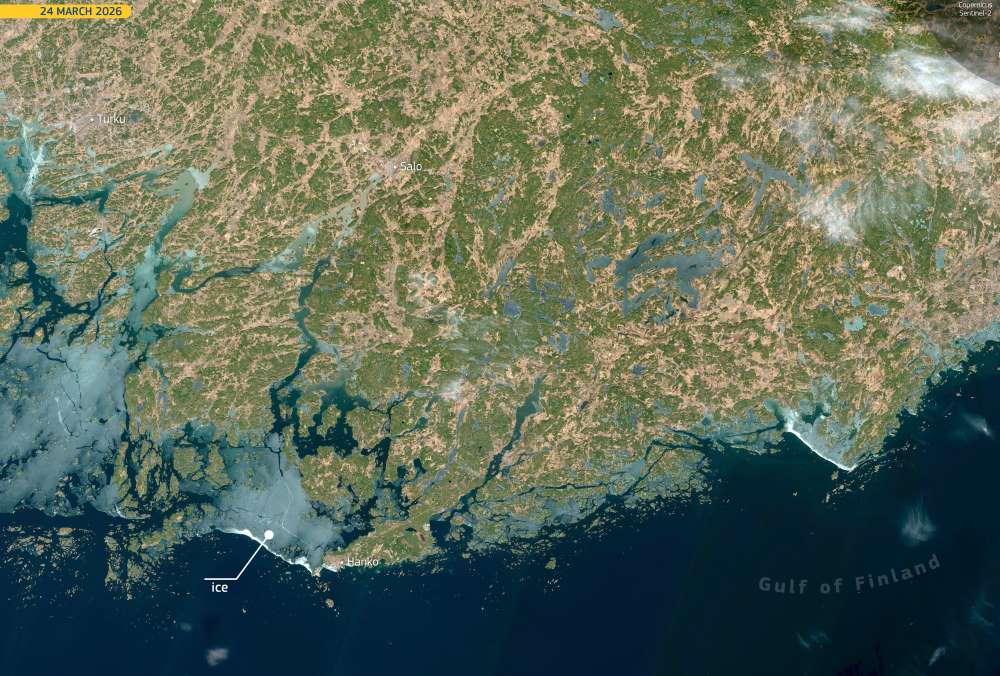
This Copernicus Sentinel-2 image, acquired on 24 March 2026, shows that transition across southern Finland, including Turku, Salo, Hanko and the western Gulf of Finland. The sea surface is divided between open water and broad pale areas of deteriorating ice, with the labelled ice zone near Hanko marking one of the clearest remaining coastal concentrations. Between the islands southwest of Turku, the archipelago forms a complex pattern of sheltered channels, fragmented floes and thinning ice cover. Inland, many lakes remain partially frozen, appearing as pale blue surfaces, while the surrounding land is largely snow-free, revealing forests and agricultural areas.
The distribution reflects local geography. Sheltered coastal waters and island-filled inlets retain ice longer than exposed marine areas, where wind, currents and wave action accelerate breakup. As a result, the most persistent ice remains close to the coast and within the archipelago, while more exposed parts of the Gulf of Finland show larger areas of open water. The landscape becomes highly variable, with ice and water coexisting over short distances.
Copernicus Sentinel-2 observations provide detailed insight into this phase of the seasonal cycle, allowing scientists to monitor ice breakup, track changes in inland waters and follow the progression of spring thaw across southern Finland and the Gulf of Finland.
Featured image credit: European Union, Copernicus Sentinel-2 imagery