Summary:
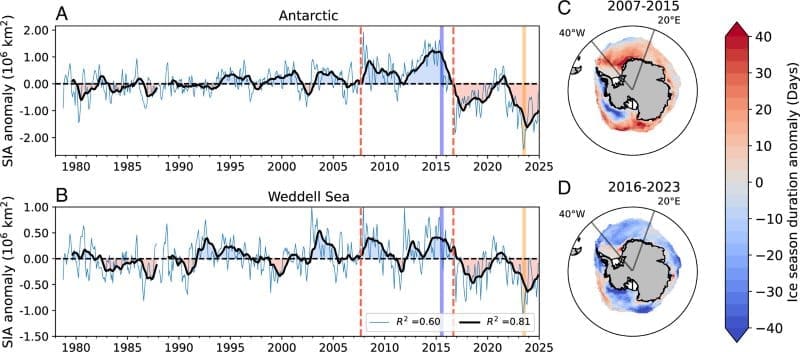
For decades, Antarctic sea ice showed an unexpected pattern, expanding until 2015 before entering a period of rapid decline. Research published in the Proceedings of the National Academy of Sciences links these shifts to changes in how heat is stored and released beneath the ocean surface. Drawing on nearly two decades of under-ice Argo float data, the study shows that increased precipitation freshened surface waters, strengthening stratification and limiting the upward movement of warmer deep water. This process supported sea ice growth despite broader warming trends.
After 2015, stronger winds increased upwelling, weakening stratification and allowing accumulated heat to reach the surface. The release of subsurface warmth contributed to the sustained reduction in sea ice extent observed since 2016. While this mechanism explains much of the variability in the Weddell Sea and parts of East Antarctica, the Pacific sector shows different patterns that remain under investigation. The findings point to a balance between freshwater input and wind-driven circulation as a key driver of Antarctic sea ice changes.
— Press Release —
Study explains Antarctic sea ice growth and sudden decline
A new Stanford University study has helped solve a mystery about dramatic swings in sea ice extent around Antarctica.
Despite rising global and regional temperatures, Antarctic sea ice expanded from the 1970s through 2015. Then, in 2016, sea ice extent declined abruptly to record lows and has not recovered.
Based on data gathered by floating, robotic probes, the new study links this unprecedented sea ice loss to the rapid release of accumulated ocean heat. That heat had built up prior to 2015 as increased precipitation formed a less salty, lower-density lid on the ocean’s surface, effectively trapping warmer, deeper water. An increase in stormy weather around Antarctica in recent decades, likely tied to climate change, led to more upwelling, eventually bringing on the low-ice era.
“We’ve traced the recent extremes in sea ice extent to the combination of enhanced precipitation and upwelling due to winds,” said Earle Wilson, an assistant professor of Earth system science in the Stanford Doerr School of Sustainability and lead author of the study published in Proceedings of the National Academy of Sciences. “We identified these two competing effects, both of which were increasing in concert with each other, but by different amounts over the years. For a while, precipitation was winning until upwelling took over.”
The findings significantly add to the complex picture of conditions at the bottom of the world, where the Southern Ocean drives global ocean circulation and absorbs much of the heat trapped by emissions from human activity. The results also dovetail with other recent research by Wilson’s group attributing the perplexing decades-long cooling trend in the Southern Ocean to underestimated rainfall and meltwater.
“The Southern Ocean is a central cog in the global climate system, and sea ice mediates much of what happens there,” said Wilson. “To establish confidence in our regional climate projections, including for processes such as Antarctic ice sheet melting and sea level rise, we need to understand the mechanisms that drive Antarctic sea ice variability.”
Valuable under-ice data
For the study, Wilson and his coauthors took advantage of a rich, yet seldom-accessed dataset for Antarctic sea ice research.
Over the past quarter-century, collection of subsurface data has advanced greatly thanks to the deployment of thousands of autonomous floats that comprise the global Argo array. While the floats operate mostly in open water outside the Antarctic sea ice zone, some floats also travel below the seasonal ice, cruising along, taking readings, and resurfacing come summertime to transmit their gathered data. The Stanford researchers compiled and analyzed 20 years of this overlooked under-ice data.
“It was very exciting to be able to use a combination of data and idealized modeling to explain both the observed expansion and retreat phases of sea ice,” said study coauthor Lexi Arlen, a PhD student in Earth system science in the Polar Ocean Dynamics Group led by Wilson.
“It has been enlightening to finally have enough broadly distributed under-ice data to discern year-to-year ocean trends around Antarctica,” said Wilson. “Our paper is one of the first to fully leverage these data to explain Antarctic sea ice trends over the past two decades.”
Partitioned waters
A key insight from the research team’s data analysis is that upwelling of warm water surprisingly started several years before the sea ice reversal of the mid-2010s. “These data told us another process must have delayed the release of subsurface warm water and thus sea ice decline, which led us to examine salinity and freshwater trends,” said Wilson.
Increases in precipitation, including snow and rainfall, over the Southern Ocean are known to make surface waters less salty and less dense than deeper waters, stratifying the water column into separate salinity and density regimes. In recent years, this stratification became stronger, making it harder for the waters to mix vertically and even out their temperatures.
The deeper layer in the Southern Ocean runs about two to three degrees warmer than the colder surface water, which is exposed to the frigid atmosphere and registers right around freezing. The trapping of that relatively warmer water allowed sea ice to expand, even against background climatic warming, until prevailing winds caused enough upwelling to force sea ice retreat.
Complicating this explanation, however, is that the Argo floats did not detect the same set of conditions on the Pacific-facing side west of the Antarctic Peninsula, wrapping around to the Ross Sea, as were detected on the Atlantic side. Yet sea ice expanded and contracted on the Pacific side as well.
“We saw opposite trends in the Pacific sector, with the ocean interior getting cooler rather than warmer after the sea ice declined,” said Wilson. “This remains an unanswered part of the puzzle.”
The researchers plan to study and model other mechanisms that could be having a stronger impact on the Pacific side, which also likely play roles throughout the region. Examples include changes in sea ice drift and increases in turbulent ocean mixing due to more frequent storms.
“The ocean has a long memory and can drive multiyear changes in ways weather can’t,” said Wilson. “We plan to continue monitoring the ocean data and work toward developing a theory that will help us anticipate changes in Antarctic sea ice extent in decades to come.”
Journal Reference:
E.A. Wilson,L. Arlen, & E.C. Campbell, ‘Recent extremes in Antarctic sea ice extent modulated by ocean heat ventilation’, Proceedings of the National Academy of Sciences U.S.A. 123 (14) e2530832123 (2026). DOI: 10.1073/pnas.2530832123
Article Source:
Press Release/Material by Adam Hadhazy | Stanford University
Featured image credit: Paul Carroll | Unsplash