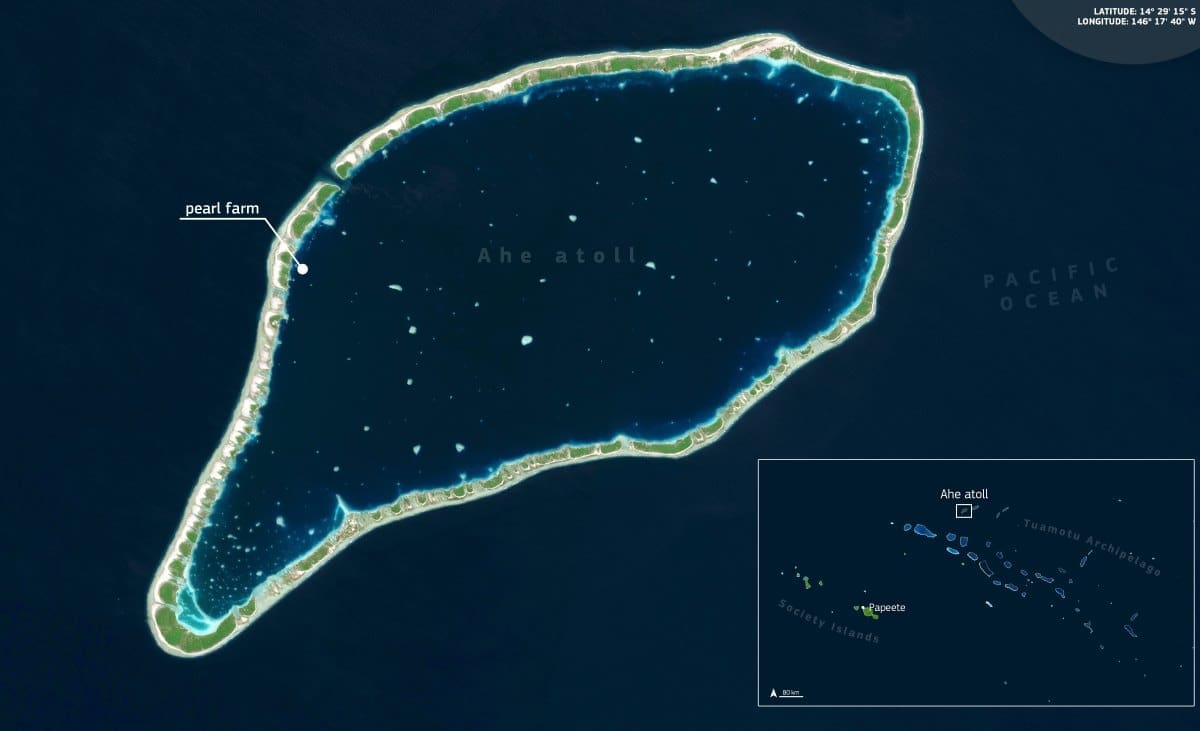
Ahe Atoll, an associated commune of Manihi in the Tuamotu Archipelago – a chain of coral atolls in French Polynesia – lies 484 km from Tahiti and has 490 residents concentrated around the village of Tenukupara. Its 12 km² of land surround a 138 km² lagoon linked to the Pacific through the Tiareroa pass, a ratio that helps explain why daily life and economic activity are organised around the water.
Across the Tuamotu Archipelago, these lagoons support local economies, particularly through pearl oyster aquaculture. Ahe is part of a group of atolls where black pearl farming has developed as a primary activity, using sheltered lagoon conditions to cultivate the black-lipped oyster (Pinctada margaritifera).
Lagoon patterns and surface structures
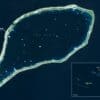
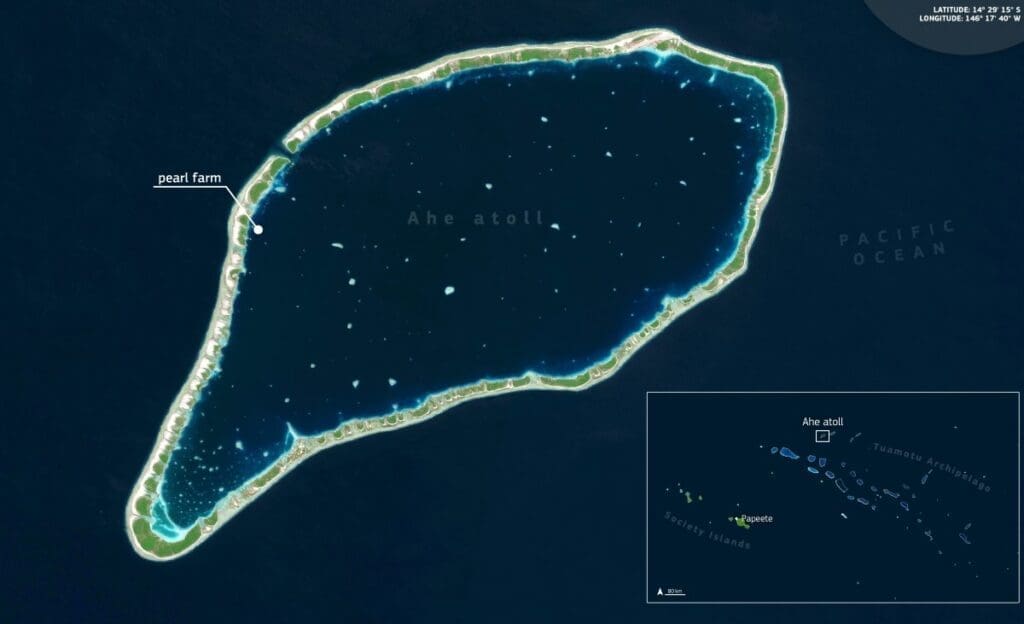
This Copernicus Sentinel-2 image, acquired on 16 August 2025, shows Ahe Atoll as an elongated ring of narrow islets enclosing a deep blue lagoon. Bright turquoise tones trace the shallow reef flats along the inner edge, contrasting with the darker waters of the lagoon and the surrounding Pacific Ocean. Numerous light patches are scattered across the lagoon, forming distinct patterns against the darker background, consistent with aquaculture activity. The motu along the rim appear thin and discontinuous, with pale sandy surfaces edged by narrow strips of vegetation. In the southern part of the lagoon, lighter blue gradients indicate shallower areas near the reef and lagoon floor.
Lagoon dynamics, pearl farming and environmental constraints
Ahe has been the focus of scientific studies examining how semi-enclosed lagoon systems function under natural forcing and human use. Observations and numerical modelling show that water circulation is driven by tidal exchange through the pass and by wind forcing across the lagoon, controlling water renewal and nutrient distribution.
The atoll is also part of a wider pearl industry central to French Polynesia’s economy. In 2022, exports of pearl products reached 6.2 billion F.CFP, with raw cultured pearls accounting for most of the value. Production is organised through lagoon concessions regulated by the Government of French Polynesia. In 2010, Ahe had 57 cultured pearl farmers working across 1,055 hectares of marine concessions, with roughly 8% of the lagoon used for commercial pearl oyster cultivation.
Nutrient cycling and plankton productivity within the lagoon support oyster growth, while limited water exchange makes the system sensitive to changes in circulation and farming intensity, requiring a balance between aquaculture and environmental conditions.
Copernicus Sentinel data provides consistent observations of reef structures, lagoon patterns, and surface conditions, supporting the monitoring of small island environments where natural processes and human activity are closely connected.
Featured image credit: European Union, Copernicus Sentinel-2 imagery