A detailed analysis of 20 years of weather data from the MAGIC Telescopes site at La Palma’s Roque de los Muchachos Observatory revealed that the temperature rose 1.1ºC, a rate more than double the increase predicted by climate models for this region.
The study, led by researchers from the Universitat Autònoma de Barcelona (UAB), indicates that warming in this northern hemisphere site is progressing faster than expected, with implications for regional climate stability.
“The station was built with the intention to have some guidance for telescope operations, not to characterise local weather professionally, let alone the effects of climate change on the measured parameters,” explained Markus Gaug, one of the study’s lead researchers. Despite this, Gaug emphasized that “the fact that they were relatively low-cost devices has been an advantage, since they had to be changed and recalibrated every two years or so, which has favoured the reliability of the data and greatly limited the effects of long-term sensor drifts, which are difficult to detect.”
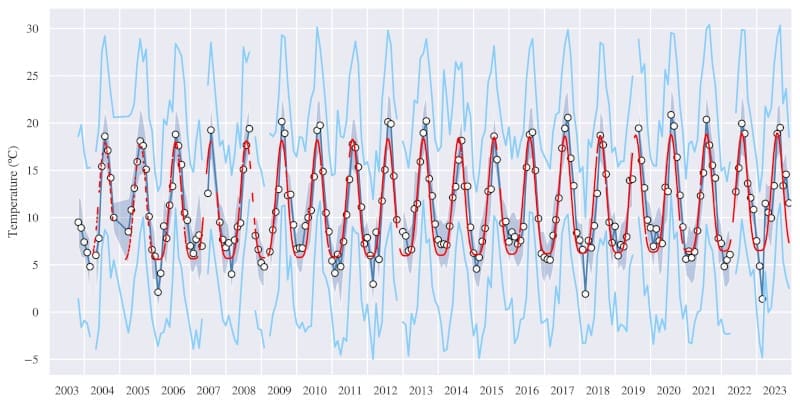
The analysis also identified unique climate shifts, including an increase in relative humidity of 4% per decade. This trend stands out among global observatories, many of which report declining humidity. Researchers hypothesize that this may be due to increased seawater evaporation around La Palma. Similar trends were observed at Hawaii’s Mauna Kea observatory, but not at continental observatories.
The Roque de los Muchachos Observatory’s position above a stable thermal inversion layer in the subtropical Canary Islands atmosphere has made it a prime spot for astronomical observation. Fortunately, despite the temperature rise, “there is no evidence that the changes detected in the meteorological conditions could affect the operation of the telescopes or increase the time they will have to remain inactive due to inclement weather in the coming years,” said co-author Lluís Font.
However, Font added that “these results are further evidence of the worrying pace of global warming,” cautioning that accelerating changes may alter local climate behavior unexpectedly. Gaug also warned that “after a certain temperature increase, the linearity of the climate system ends and that can lead us to the ‘tipping points’ where the climate changes its behaviour drastically.”
Published in the Monthly Notices of the Royal Astronomical Society, the study reflects an international collaboration, including contributions from the Institute for High Energy Physics (IFAE) and several European universities in Italy and Germany.
Journal Reference:
Markus Gaug, Alessandro Longo, Stefano Bianchi, Lluís Font, Sofia Almirante, Harald Kornmayer, Michele Doro, Alexander Hahn, Oscar Blanch, Wolfango Plastino, Daniela Dorner, ‘Detailed analysis of local climate at the CTAO-North site on La Palma from 20 yr of MAGIC weather station data’, Monthly Notices of the Royal Astronomical Society 534 (3) 2344–2377 (2024). DOI: 10.1093/mnras/stae2214
Article Source:
Press Release/Material by Universitat Autònoma de Barcelona
Featured image: Roque de los Muchachos Observatory Credit: Instituto de Aastrofisica de Canaris (IAC)