Summary:
Websites created for United Nations (UN) climate conferences are generating far more carbon emissions than typical webpages, according to a new study published in PLOS Climate. Researchers from the University of Edinburgh analysed the environmental impact of host country websites for the Conference of the Parties (COP) from 1995 to 2025, using archival data from the Internet Archive’s Wayback Machine.
Their analysis shows that average emissions from COP sites have increased by more than 13,000% since the first summit (COP1, 1995), with many recent pages emitting around seven times more carbon per view than the global average of 0.36g of CO₂e. The study found that during COP3 in 1997, website traffic produced just 0.14kg of CO₂e – roughly what a tree absorbs in two days – while homepage visits to COP29 in 2024 released 116.85kg, equivalent to a year’s absorption by up to ten mature trees.
The researchers attribute this rise to increasingly complex web designs and multimedia content. They recommend integrating sustainable web design principles into future host country agreements and official COP guidelines to reduce the digital footprint of the UN’s climate platforms.
Websites produced for COP conferences emit up to seven times more carbon than average internet pages, new research suggests.
Ahead of this year’s United Nations climate summit, COP30, researchers have revealed a sharp increase in the carbon emissions generated by the conference’s websites over time.
Analysis indicates that between 1995 – when the first Conference of the Parties (COP) was held – and 2024, average emissions from COP conference websites have risen by more than 13,000%.
While the increase is partly a consequence of huge growth in computing power and internet use – the internet now accounts for up to three per cent of all emissions – the carbon footprint of COP sites is still significantly higher than the average webpage, the team says.
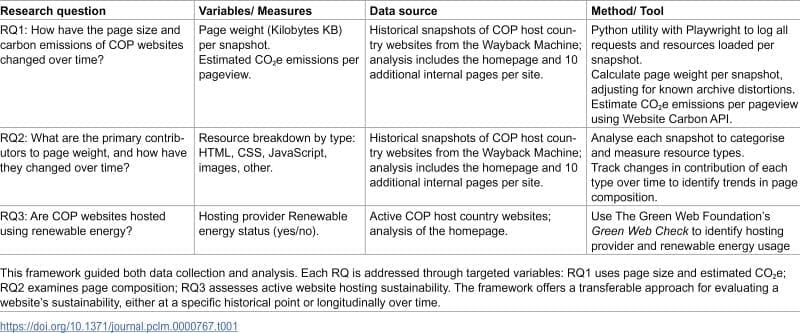
Researchers from the University of Edinburgh analysed web archive data to assess changes in the carbon footprint of COP websites over a 30-year period.
Their findings indicate that emissions remained relatively low until COP14 in 2008, with sites emitting the equivalent of 0.02g carbon per page view.
However, from COP15 onwards, emissions have risen sharply, with pages on average emitting the equivalent of more than 2.4g of carbon per visit, with some emitting substantially more. The average website emits the equivalent of 0.36g of carbon per page view, the team says.
The rise corresponded with COP pages increasingly using content that requires greater computing power, such as multimedia files, experts say.
As well as revealing an increase in the environmental impact of COP websites themselves, the team’s findings also indicate that emissions caused by internet traffic to the pages have risen exponentially.
Website views during COP3 in 1997 – the first year with available data – emitted the equivalent of 0.14kg, roughly the amount of carbon that a mature tree can absorb in two days.

In contrast, it would take up to 10 mature trees a full year to absorb the levels of carbon emitted as a result of COP29 homepage visits alone – 116.85kg – an increase of more than 83,000%.
Researchers say it is too early to calculate carbon emissions from the COP30 website, but highlight that it is not hosted on verified renewable energy infrastructure.
Based on their analysis, the researchers make a number of practical recommendations for reducing the digital footprint of websites. These include placing strict limits on page sizes, optimising site layouts and hosting websites on servers powered by renewable energy.
The analysis is the first example of web archives, such as the Internet Archive, being used to track websites’ environmental impact over time, the team says.
The innovative approach – using bespoke computer code that has been made freely available – could be used to assess the historical environmental impact of other internet pages, they add.
The findings are published in the journal PLOS Climate.
Professor Melissa Terras, of the Institute for Design Informatics at Edinburgh College of Art, said: “The digital footprint of websites, and how they have grown over time, deserves further scrutiny. In this innovative use of web archives as a data source to measure how websites have expanded, we chose first to look at the COP conferences themselves, given they are the focus of so much discussion on climate change. Our research shows that the carbon cost of digital presence is often overlooked by even those who care about, and are meant to protect, the environment. We hope that our recommendations, and our tool, can help institutions identify and tackle this issue.”
PhD student David Mahoney, of the Institute for Design Informatics at Edinburgh College of Art, said: “While AI rightly captures much of today’s attention, websites remain the longest-standing and most widespread form of human–computer interaction, and one of the largest contributors to the internet’s environmental impact. Our work shows how reusing web archives can expose this growing blind spot, even among organisations at the heart of climate discussions, and help identify practical ways to cut digital emissions.”
Professor Frauke Zeller, of the Institute for Design Informatics at Edinburgh College of Art, said: “We are excited to showcase this innovative research and how it creates impact on a wider academic, societal and international scale. The Institute for Design Informatics is a unique place to develop innovative data analysis tools in an interdisciplinary collaboration between Arts/Humanities and Informatics research, which aim to make a difference not just in academic contexts but also in society.”
Journal Reference:
Mahoney D, Terras M, Lee J, Zeller F, ‘The growing environmental impact of COP websites: An analysis of UNFCCC COP host country websites (1995–2025)’, PLOS Climate 4 (11): e0000767 (2025). DOI: 10.1371/journal.pclm.0000767
Article Source:
Press Release/Material by University of Edinburgh
Featured image credit: Freepik