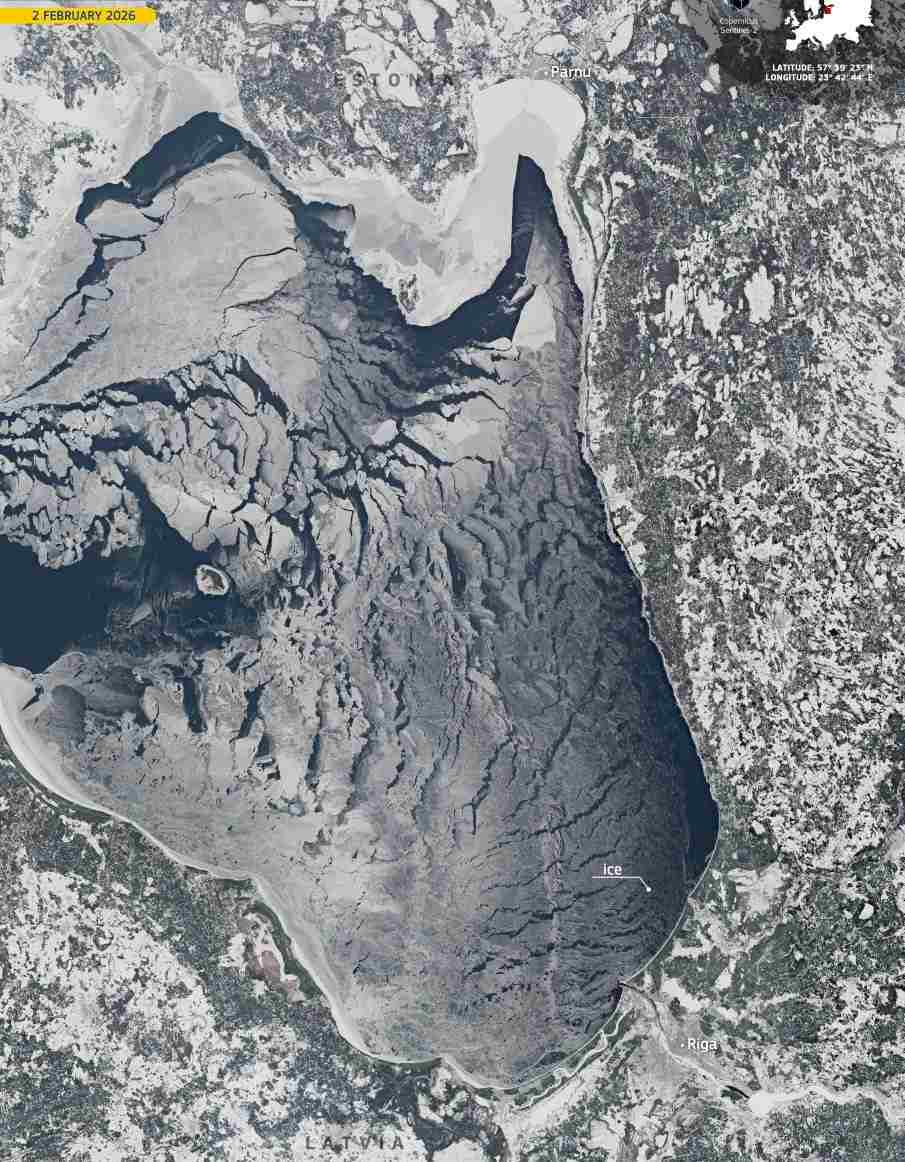
Gulf of Riga ice cover spread widely across the shallow Baltic basin in early February 2026, after days of sustained sub-zero temperatures tightened their grip on Latvia and Estonia. The prolonged cold affected ports, shipping lanes and coastal communities, as sea ice expanded across one of the region’s most weather-sensitive marine areas.
The Gulf of Riga is a semi-enclosed sub-basin of the Baltic Sea between Latvia and Estonia. It is partially separated from the open Baltic by the Estonian island of Saaremaa, with its main connection through the Irbe Strait. Limited water exchange, modest depth and relatively low salinity make the gulf especially responsive to atmospheric shifts. In severe winters, most or all of its surface can freeze.
This image, acquired by one of the Copernicus Sentinel-2 satellites on 2 February 2026, shows the Gulf of Riga largely ice-covered following sustained sub-zero air temperatures across the Baltic region. Sea ice appears in pale grey and white tones, intersected by dark linear fractures which indicate mechanical stress within the ice sheet. Snow-covered land surrounding the gulf appears bright white.

On the same morning the satellite passed overhead, Latvia recorded the coldest 2 February temperature in its measurement history, with −31.7 °C observed in Staļģene. The record for the entire month of February is −43.2 °C, recorded on 8 February 1956 in Daugavpils, which remains the absolute minimum temperature in Latvia since meteorological observations began. In Estonia, weeks of freezing weather enabled the opening of an official ice road across the frozen sea and required icebreakers to assist dozens of vessels along the coast and in the Gulf of Finland. The Gulf of Riga, positioned between the two countries, reflected these broader regional conditions.
The persistence of the cold air mass was linked to large-scale atmospheric circulation patterns over Europe. Meteorologists pointed to a disrupted polar vortex and the development of high-pressure blocking systems that allowed Arctic air to move southward and remain over the Baltic region for an extended period. Such configurations can suppress milder Atlantic air intrusions, reinforcing prolonged frost and favouring the formation and consolidation of sea ice in shallow coastal basins such as the Gulf of Riga.
Winter ice in the gulf is not unusual. Historical records show that during particularly harsh seasons the bay can freeze almost entirely. The thickest measured ice reached 90 cm in the winter of 1941–42. As temperatures rise, the ice typically begins to weaken in March and April, sometimes breaking into floes that drift with winds and currents.
Data from Copernicus Sentinel-2 satellites support monitoring sea ice extent and distribution, helping maritime authorities plan safe shipping routes and deploy icebreakers efficiently during winter months. High-resolution optical imagery allows specialists to track fractures, pressure ridges and the evolution of open water leads, which are critical for navigation in shallow and enclosed waters such as the Gulf of Riga.
Featured image credit: European Union, Copernicus Sentinel-2 imagery