World Water Day on 22 March turns attention this year to the relationship between water, women and gender equality. The United Nations says the global water crisis is not experienced equally, with women and girls often carrying the burden where safe drinking water and sanitation are not available close to home. They are more likely to spend time collecting water, managing household supplies and caring for people made ill by unsafe conditions, while still being excluded from many of the decisions that shape water systems and investment.
That global picture gives added meaning to places where freshwater remains clean, closely monitored and publicly valued. In Sweden, Lake Vättern stands out as one of the country’s most important inland waters, not only because of its size but because of the unusual quality of its ecosystem. The lake is the second largest in Sweden and one of the largest in Europe, extending about 135 km from north to south and around 31 km at its widest point. The lake extends across Östergötland, Västergötland, Närke and Småland, with a shoreline of about 516 km.
Vättern is known for cold, exceptionally clear and nutrient-poor water. Its great depth and southern location create conditions that support an uncommon mix of northern and southern species. The lake hosts around 30 fish species, while water clarity can reach between roughly 13 and 17 m depending on conditions. According to the Lake Vättern Society of Water Conservation, phosphorus levels remain low and the overall condition of the lake is still strong, with water clarity described as being at a level comparable to that recorded 100 to 120 years ago.
That status is not taken for granted. Lake Vättern has been subject to continuous sampling since the 1960s through coordinated national environmental monitoring. The programme is used to assess the state of the lake, support environmental objectives, follow the requirements of the European Union Water Framework Directive and detect emerging problems over time. The data also contribute to environmental assessments and research, with accredited sampling and laboratory methods used so results can be compared across years and locations.
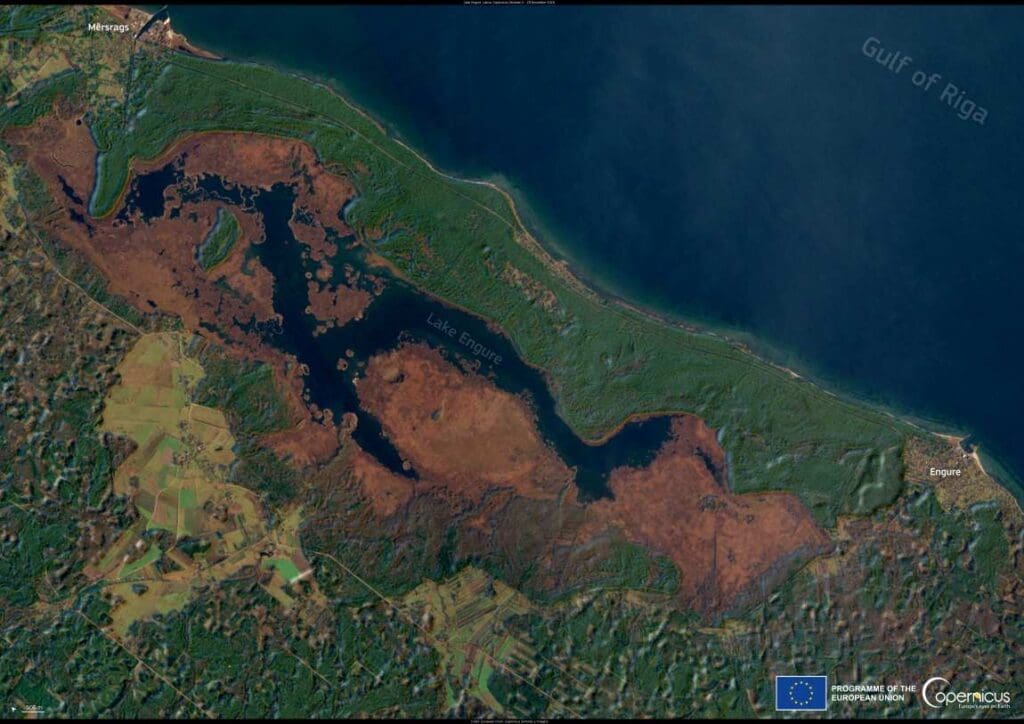
Satellite view of Lake Vättern

In the Copernicus Sentinel-2 image acquired on 6 March 2026, Lake Vättern appears as a long dark body cutting through southern Sweden. The surrounding forests show up in bright red in the false-colour rendering, while farmland is visible in paler pink and brown tones. Areas of frozen water stand out in light blue, showing that winter conditions were still present around parts of the lake in early March. The image makes the contrast between land use, vegetation and water especially clear, and it also shows how the lake sits within a landscape shaped by both natural systems and human activity.
That setting helps explain why Vättern matters well beyond its shoreline. The lake supports fishing, recreation and outdoor life, and the communities around it are closely tied to its condition. On the western shore, the town of Hjo promotes bathing, paddling, boating and sauna activities linked directly to the lake. Vättern is also part of the setting for Vätternrundan, the large recreational cycling event that circles the lake over a route of about 300 km. The combination of ecological value and daily human use makes the lake a visible example of how water quality affects both environment and society.
Despite its current condition, Lake Vättern faces pressures from climate change, invasive species and environmental pollutants. Monitoring and management are therefore essential to maintain water quality over time. This need for sustained oversight reflects a broader point raised on World Water Day, where attention is not only on access to water, but also on how water resources are governed and protected.
Lake Vättern offers a very different reality from regions where safe water remains out of reach, but it still belongs to the same global story. Clean freshwater depends on long-term observation, effective governance and public commitment before visible decline begins. Copernicus satellite data add another layer to that work by helping track shoreline change, land use, seasonal conditions and pressures that can affect water systems over time.
On World Water Day, the view over Vättern is therefore not only a striking landscape image, but also a reminder that protecting water is a continuous task.
Featured image credit: European Union, Copernicus Sentinel-2 imagery