Summary:
Gray whales using San Francisco Bay are experiencing notable mortality linked to vessel traffic and changing feeding patterns, as documented in a study in Frontiers in Marine Science. Researchers analysed sightings and strandings from 2018 to 2025, identifying 114 individual whales through photo-identification based on surveys and community submissions. Only four individuals were recorded in multiple years, while 21 were later matched to carcasses, indicating a minimum mortality rate of 18% in the area.
The results indicate that the Bay is not a stable extension of known feeding grounds but a temporary habitat used by whales affected by declining prey availability in Arctic regions. Many deaths were linked to blunt or sharp force trauma consistent with vessel strikes, especially near the Golden Gate Strait where maritime traffic converges. Some whales also showed signs of malnutrition, reflecting broader ecological pressure tied to shifting ocean conditions.
The study shows that whales entering this high-traffic environment face persistent risks, supporting the case for targeted mitigation measures such as vessel speed limits and route adjustments to reduce collisions.
— Press Release —
18% of gray whales that enter San Francisco Bay die there, scientists find
Gray whales migrate from Arctic waters full of food to the lagoons of Baja Mexico – but as the climate crisis gathers pace, they have been sighted foraging in unexpected places. Recently, some have begun to explore the dangerously busy waters of San Francisco Bay. Scientists at the Marine Mammal Center and the California Academy of Sciences investigating an unexpectedly high death toll among gray whales have found that almost 20% of individuals seen entering the Bay died there, in large part due to boat strikes.
“Gray whales have a low profile to the water when they surface, and this makes them difficult to see in conditions like fog which are common to San Francisco Bay,” explained Josephine Slaathaug of Sonoma State University, lead author of the article in Frontiers in Marine Science. “Additionally, San Francisco Bay is a highly trafficked waterway, and the Golden Gate Strait serves as a bottleneck through which all traffic and whales must enter and exit.”
Off the map
Because it’s considered unusual for gray whales to eat during their migrations to and from tropical lagoons, they are heavily dependent on the prey in their Arctic feeding grounds. But the impact of the climate crisis on their preferred prey means that gray whales are increasingly vulnerable. According to the National Oceanic and Atmospheric Administration, their population has dropped by more than 50% since 2016. Very few calves are being spotted.
Formerly, gray whales’ migration pathways didn’t include San Francisco Bay, but since 2018, scientists have spotted gray whales appearing there – and dying there. The scientists set out to try to determine what was happening to these ‘Bay Grays’, and if they were regular visitors.
They developed a catalogue of visiting whales using opportunistic surveys and citizen science photographs from 2018-2023, supplemented by systematic surveys from 2023-2025. This was compared to necropsy records. However, whales were identified using unique markings on their skin, which decays quickly, so strict identification criteria mean that some catalogued whales may have been among the unidentified necropsied whales.
The surveys identified 114 individual whales spotted in the bay between 2018 and 2025. It seems that most whales don’t return to the bay: only four were seen in multiple years. More research is needed, but this could mean San Francisco Bay serves as a sort of emergency pitstop for particularly hungry whales, as very thin whales have been seen elsewhere stopping to forage in habitats they don’t usually use.
A dangerous combination
However, it seems that many visiting whales don’t survive to return to the Bay. Between 2018 and 2025, 70 gray whales were found dead in the local area. 30 of these were hit by boats, while many of the other whales for which a cause of death could be identified died of malnutrition. Out of 45 potentially identifiable dead whales, the scientists matched 21 to their catalogue.
“At least 18% of the individuals identified in San Francisco Bay later died in the area,” said Bekah Lane of the Center for Coastal Studies, co-author. “Our broader analysis of local strandings both inside and outside San Francisco Bay found that over 40% of these whales died of trauma from vessels.”
More research is urgently needed to identify the areas whales have started using and determine how best to protect them: in 2025, 36 whales entered the bay, sometimes more than 10 at a time. Dedicated surveys and more necropsies could establish whether the low incidence of resighted whales is due to the high mortality rate, and whether that is primarily linked to starvation or vessel strike – or whether the two are connected: starving whales may be less able to avoid boats. Education programs for commercial vessel operators or changing ferry routes could help.
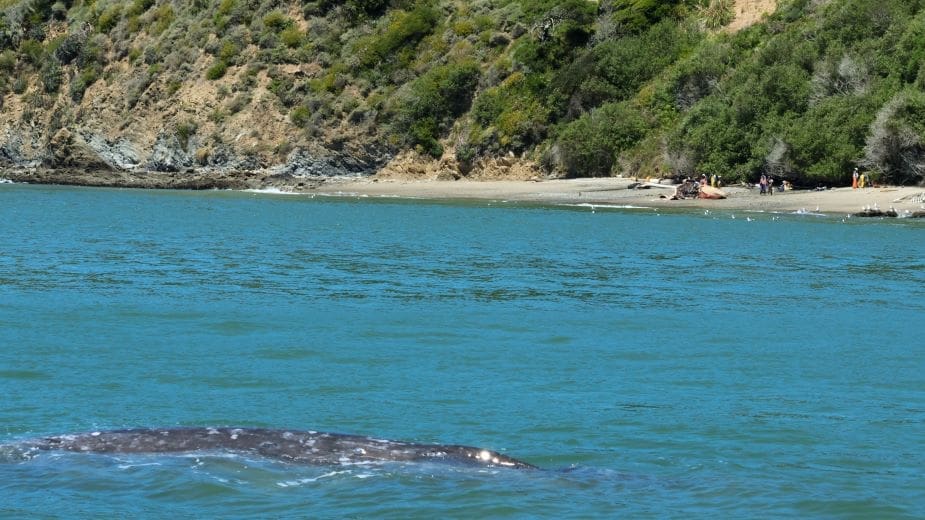
“In San Francisco Bay, the biggest threat to these whales is vessel traffic,” said Lane. “Continued monitoring will help illuminate their distribution patterns and behaviors while within the Bay, which can impact risk. Route changes and speed restrictions have been found to significantly reduce vessel strike mortality to large whales, and an assessment of risk can help identify the most effective strategies to protect these animals.”
“This study is our best analysis of the data we collected, but it’s important to consider that we do not have the full picture of each whale’s movements on a daily timescale,” said Slaathaug. “These results are an important piece of the larger puzzle of what is going on in the overall population as they attempt to adapt to climate change in real time.”
Journal Reference:
Slaathaug JM, Lane RS, Keener W, Pérez A, Flannery M, Webber MA, Grimes A, Wilkin AM, O’Hern JE, Duignan PJ, Calambokidis J and Crocker DE, ‘Gray whales (Eschrichtius robustus) in San Francisco Bay experience high mortality and have limited affiliation to known foraging groups’, Frontiers in Marine Science 13: 1775666 (2026). DOI: 10.3389/fmars.2026.1775666
Article Source:
Press Release/Material by Angharad Brewer Gillham | Frontiers
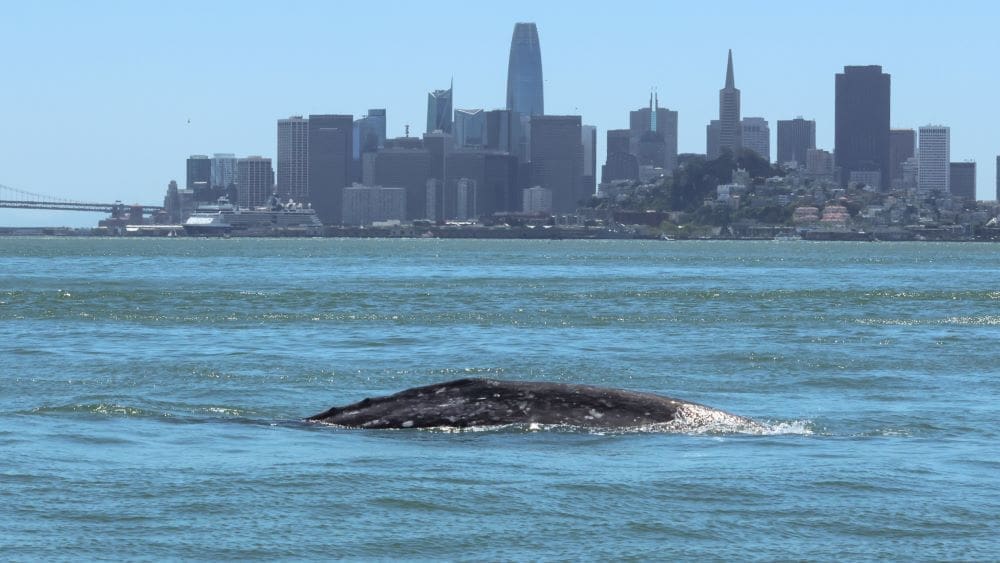
Featured image: TMMC-1-91, also known as ‘Ladybug’, swimming in central San Francisco Bay – pictured with the skyline of the city. This individual later died. (The Marine Mammal Center NOAA-NMFS Permit #26532) Credit: Josephine Slaathaug | © The Marine Mammal Center