
An international team of scientists has issued a clarion call for urgent action to address the interconnected crises of climate change, ecological destruction, and socio-economic inequality. Their findings, published today in the Proceedings of the National Academy of Sciences NEXUS, highlight the need for a global cultural shift towards sustainability and justice.
Led by researchers from the University of Hawai‘i at Mānoa, the study brings together experts from diverse fields including earth and ocean sciences, politics, law, public health, renewable energy, geography, communications, and ethnic studies. According to Chip Fletcher, the lead author and interim Dean of the UH Mānoa School of Ocean and Earth Science and Technology, the crises facing humanity are not isolated but intertwined, posing a grave threat to both the environment and human well-being.
The authors argue that centuries of imperialism, extractive capitalism, and population growth have pushed Earth’s ecosystems beyond their limits, leading to a broadening pattern of social inequality. However, they reject a pessimistic outlook and instead advocate for swift and substantial actions to address these challenges.
One major obstacle identified by the authors is the global economic model focused on wealth accumulation and profit, which they argue is incompatible with true sustainability. Urgent measures such as rapid decarbonization, elimination of environmentally harmful subsidies, and restrictions on trade that generates pollution or unsustainable consumption are proposed as essential steps to mitigate the crises.
Moreover, the authors highlight the disproportionate impact of these crises on the most vulnerable populations, who bear the least responsibility for them. The widening gap between the rich and the poor, coupled with increasing consumption patterns, exacerbates ecological destruction and social inequality.
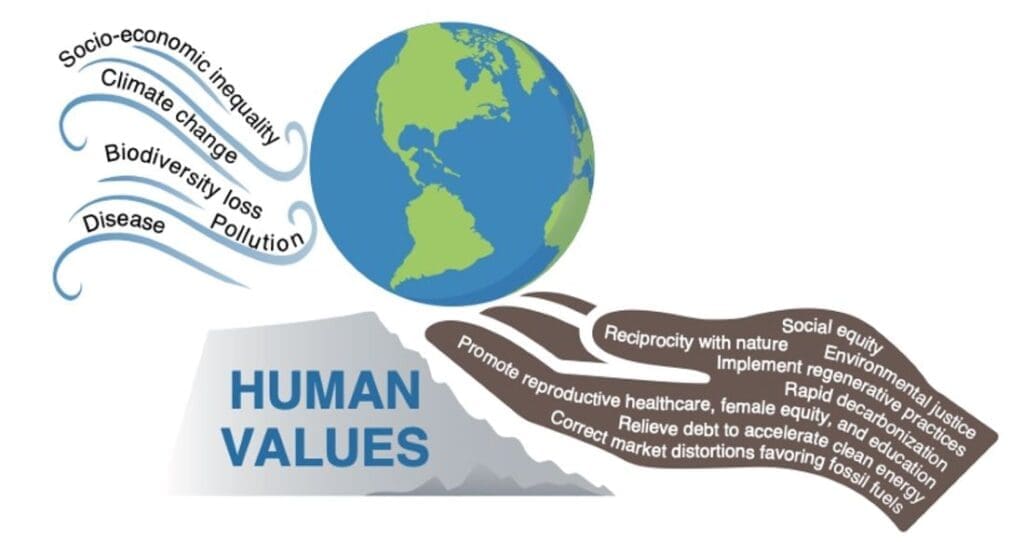
Krista Hiser, a professor of English at Kapiolani Community College at the University of Hawai‘i, emphasizes the need for a global cultural shift that prioritizes kinship with nature and communal well-being. This shift, underpinned by the recognition of Earth’s finite resources and the interconnectedness of its inhabitants, is seen as essential for achieving true sustainability.
Phoebe Barnard, an affiliate professor at the University of Washington, underscores the imperative of collective action to steer towards a future where human progress does not come at the expense of ecological integrity and social equity.
In conclusion, the authors call for a comprehensive approach involving education, robust policy, economic incentives, cross-sector partnerships, community empowerment, corporate accountability, technological innovation, leadership, and cultural narratives. They stress the importance of treating these issues as interconnected challenges and advocate for a systemic response based on kinship with nature, recognizing Earth as humanity’s lifeboat in the cosmic sea of space.
(More information: Charles Fletcher et al, Earth at risk: An urgent call to end the age of destruction and forge a just and sustainable future, PNAS Nexus (2024), DOI: 10.1093/pnasnexus/pgae106. University of Hawai’i at Manoa – Press Release; Featured image credits: Freepik)