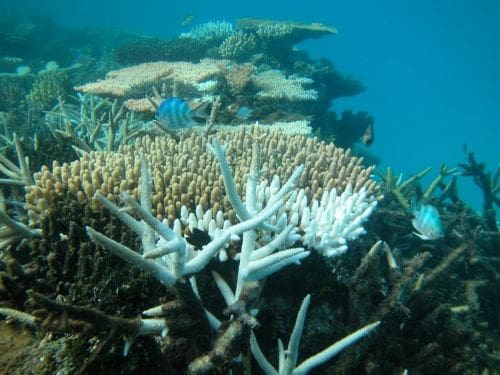
The Great Barrier Reef is under significant pressure, with warming sea temperatures and mass coral bleaching events threatening to destroy the remarkable ecology, biodiversity and beauty of the world’s largest coral reef, according to new research published today.
Led by University of Melbourne Dr Benjamin Henley, ‘Highest ocean heat in four centuries places Great Barrier Reef in danger’, published in Nature, provides new evidence of the impact rising sea surface temperatures have had, and will continue to have, on Australia’s ecological jewel.
The research reconstructs 400 years of summer sea surface temperatures in the Coral Sea. The results chronicle the extreme nature of recent ocean heat events that have led to mass coral bleaching on the Reef.
Recently, UNESCO’s World Heritage Committee handed down its final decision on the state of the Great Barrier Reef, declining to list the Reef as in danger. However, the scientists have pushed back and say the Great Barrier Reef is in danger.
To analyse 400 years of temperatures, Dr Henley and his team reconstructed sea surface temperature data from 1618 to 1995 using coral skeleton samples from within and surrounding the Coral Sea and coupled this dataset with recorded sea surface temperature data from 1900 to 2024.
They also analysed climate model simulations of sea surface temperatures run with and without climate change, finding human-caused climate change is to blame for the rising temperatures in the region.
The recent mass bleaching events coincide with five of the six hottest years in the 400 years measured in the study. In the years 2024, 2017, and 2020, the Coral Sea experienced the warmest temperatures recorded in 400 years, with 2024 being the warmest on record by a large margin. The recent heat events in 2016, 2004, and 2022, were the next warmest three years on record.
“When I plotted the 2024 data point, I had to triple check my calculations. It was off the charts, far above the previous record high in 2017,” Dr Henley said. “I could almost not believe it. It is a tragic, but near-inevitable consequence, that mass coral bleaching has occurred yet again this year”.
He emphasized: “It’s the inevitability of the impacts on the reef in the coming years that really gets to me. In the absence of rapid, coordinated and ambitious global action to combat climate change, we will likely witness the demise of one of Earth’s most spectacular natural wonders.”
Professor Helen McGregor, from Environmental Futures, and a co-author of the study, said urgent action was needed to prevent devastation of one of the world’s most important ecosystems.
“There is no ‘if, but or maybe’, the ocean temperatures during these bleaching events, including the event happening right now, are unprecedented in the past four centuries,” Professor McGregor said.
He continued: “The Great Barrier Reef is facing catastrophe if anthropogenic climate change is not immediately addressed. The very corals that have lived for hundreds of years and that gave us the data for our study are themselves under serious threat.”
Dr Henley undertook most of the study as a post-doctoral researcher at UOW, where he is now an Honorary Fellow. “Our climate model analysis confirms that human influence on the climate system is responsible for the rapid warming in recent decades,” he said.
“Without urgent intervention, our iconic Great Barrier Reef is at risk of near-annual beaching from these high ocean temperatures. The Reef’s ecological integrity and outstanding universal value are at stake,” he added.
“We have many of the key solutions to turn climate change around. What we need is a step change in the level of coordinated national and international action to transition to net zero. We hope that our study equips policymakers with more evidence to pursue deeper cuts in greenhouse gas emissions internationally.”
Researchers from Securing Antarctic’s Environmental Future, the University of Wollongong, the University of Melbourne, the University of Queensland, the Australian Institute of Marine Science, Tulane University (USA), and Columbia University (USA) contributed to the paper.
Journal Reference:
Henley, B.J., McGregor, H.V., King, A.D. et al. ‘Highest ocean heat in four centuries places Great Barrier Reef in danger’. Nature 632, 320–326 (2024); DOI: 10.1038/s41586-024-07672-x
Article Source:
Press Release/Material by University of Melbourne
Featured image credit: Nico Smit | Unsplash