Brasília, Brazil (AFP) – More than a thousand Brazilian municipalities were on alert Thursday due to very low humidity — in some cases comparable to that of the Sahara desert — as the country is gripped by a historic drought that has fueled major wildfires.
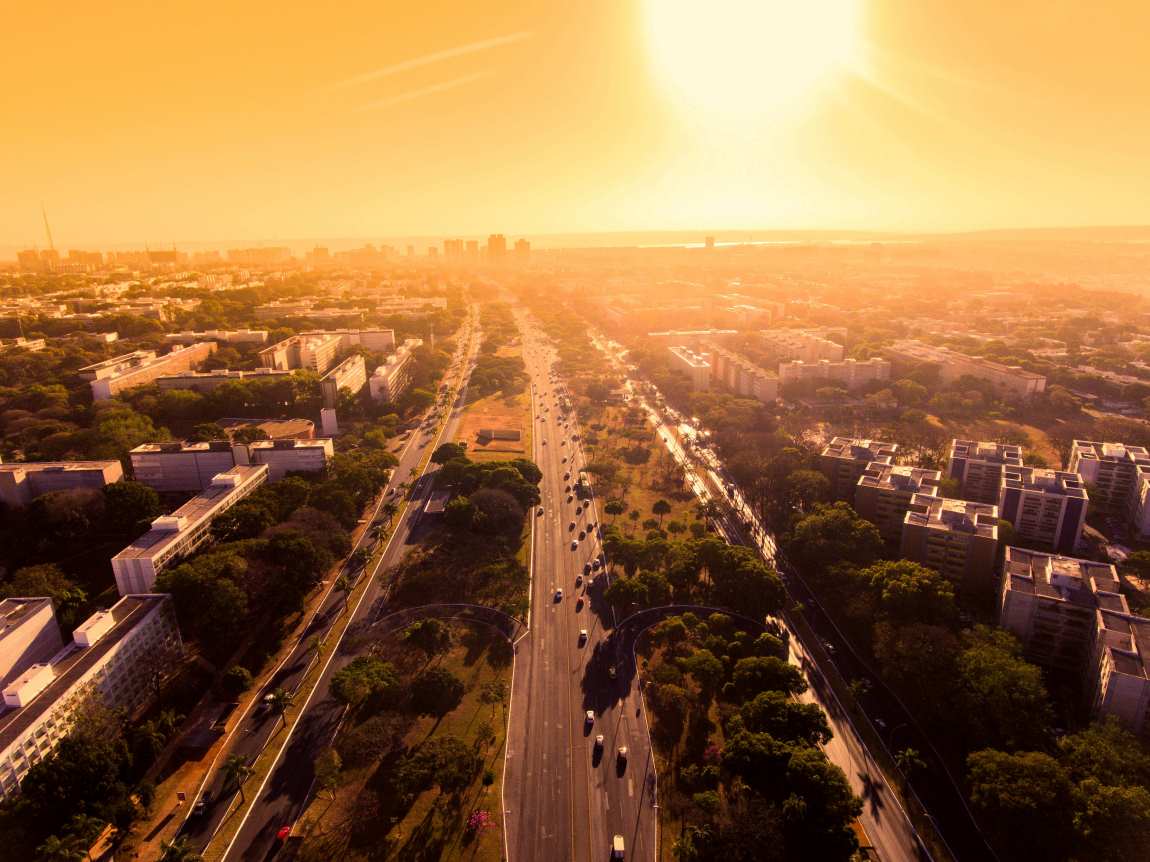
Flames reached a protected forest on the outskirts of the capital Brasilia, which was enveloped in smoke for the second time in two weeks, and where it has not rained in 130 days.
The National Institute of Meteorology (Inmet) said in a report that Brasilia, as well as the southeast with its highly populated states of Sao Paulo and Minas Gerais, were among the worst affected by a “relative humidity of less than 12 percent.”
This was a “very dangerous” situation due to the “great risk of forest fires,” the government agency said.
Such low humidity also impacts residents’ health and can cause pulmonary disease or headaches.
In several dozen municipalities, the humidity level has fallen below the 10 percent threshold, even reaching seven percent, a level “as low” as that seen in the Sahara, said Ana Paula Cunha, a researcher at the National Center for Natural Disaster Monitoring (Cemaden).
She said Brazil was experiencing its worst drought “in at least 70 years” due to low rainfall since the end of last year.
The country has for months been battling large-scale fires, especially in the Amazon, the world’s largest tropical rainforest and the central west Pantanal, the world’s largest tropical wetlands.
Recently, fires have also hit the state of Sao Paulo.
The combination of high temperatures, strong winds and low humidity creates a “very favorable context for new fires,” Brazil’s Environment Minister Marina Silva said in a recent interview with AFP.
Only two of Brazil’s 27 states “are not seriously affected by severe water shortages,” she said.
At a Senate hearing on Wednesday, she warned that the Pantanal could disappear “by the end of the century” if drought persists and such climate events “become more severe and frequent.”
Brasilia is accustomed to harsh, desert-like weather and low humidity during its dry season, however the intensity of fires and smoke blowing in from blazes elsewhere in the country are unusual.
Huge clouds of smoke were visible over the 9,000-hectare Brasilia National Forest on Wednesday.
Authorities blame human action for most of the recent fires in the country.
“There are many fires, more than human personnel,” firefighter Diego Rodriguez told AFP.
rsr/lg/tmo/fb/des
© Agence France-Presse
Featured image credit: Daniel Costa | Unsplash