A recent study has revealed a significant rise in industrial activities across the Arctic, with more than 800,000 square kilometers of land impacted by human activity as of 2013.
Analyzing satellite data from 1992 to 2013 on artificial light at night, researchers found that 85% of the illuminated areas were due to industrial activities, not urban development.
This research, led by the University of Zurich in collaboration with NASA and the University of Wisconsin-Madison, highlights the growing environmental pressures on one of the most fragile ecosystems on Earth.
The Arctic is warming almost four times faster than the global average, with temperatures rising by approximately 3°C since 1979. This unprecedented rate of warming has opened up vast areas of land to industrial and urban development.
Historically, the region experienced minimal human disturbance, but the changing climate has shifted accessibility, encouraging economic activities, including oil, gas extraction, and mining.
“More than 800,000 km2 were affected by light pollution, corresponding to 5.1% of the 16.4 million km2 analyzed, with an annual increase of 4.8%,” said Gabriela Schaepman-Strub, from the Department of Evolutionary Biology and Environmental Studies at the University of Zurich, who led the research.
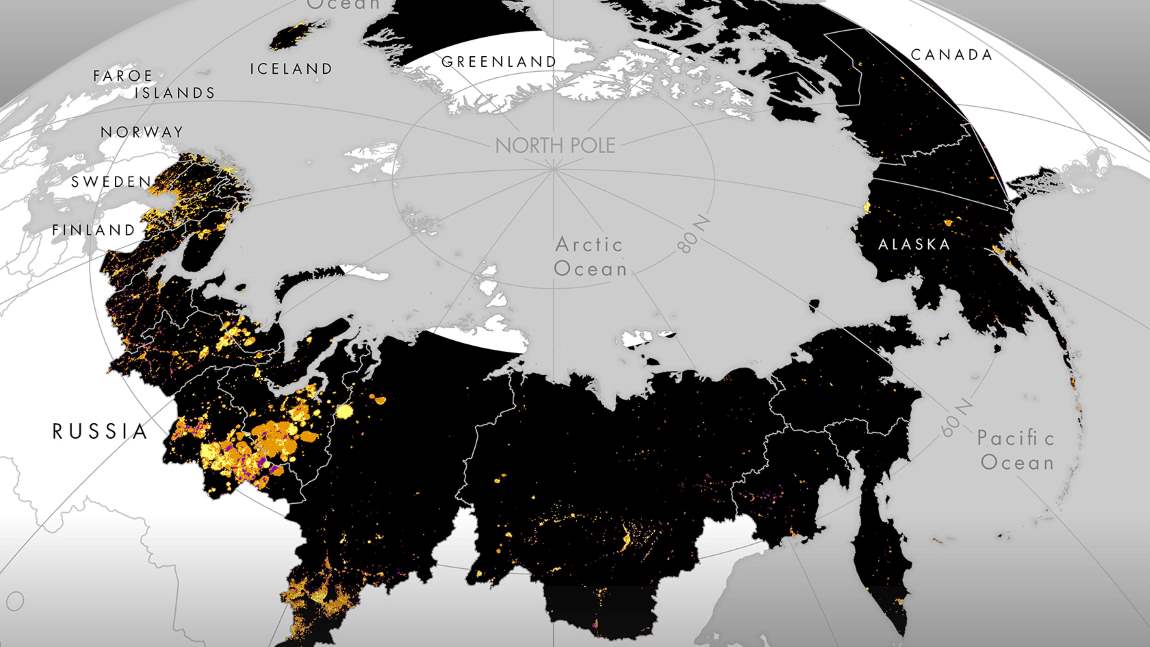
The European Arctic and the oil and gas extraction regions of Alaska, USA, and Russia were hotspots of human activity, with up to one-third of the land area illuminated. In contrast, the Canadian Arctic remained largely untouched by artificial light at night.
Of particular concern is the growing intensity of industrial development. According to Cengiz Akandil, the study’s first author, only 15% of the illuminated areas were associated with human settlements. “Most of the artificial light is due to industrial activities rather than urban development. And this major source of light pollution is increasing in both area and intensity every year,” he noted.
The environmental consequences of this rapid development are profound.
The researchers warn that human activity in the Arctic could exacerbate the impacts of climate change on fragile ecosystems, such as the tundra and permafrost landscapes. Even minor disturbances, such as vehicle tracks, can have long-lasting effects. Artificial light also disrupts local wildlife, including Arctic reindeer, whose ability to adapt to the extreme light conditions of winter is impaired.
As industrial expansion continues, researchers emphasize the urgent need for sustainable development strategies that balance economic growth with environmental preservation.
“Our analyses on the spatial variability and hotspots of industrial development are critical to support monitoring and planning of industrial development in the Arctic. This new information may support Indigenous Peoples, governments and stakeholders to align their decision-making with the Sustainable Development Goals in the Arctic,” concludes Schaepman-Strub.
This study provides a vital foundation for understanding the extent and impact of human activity in the Arctic, as the region faces unprecedented pressures from both climate change and industrialization.
Journal Reference:
Cengiz Akandil, Elena Plekhanova, Nils Rietze, Jacqueline Oehri, Miguel O. Román, Zhuosen Wang, Volker C. Radeloff, and Gabriela Schaepman-Strub, ‘Artificial light at night reveals hotspots and rapid development of industrial activity in the Arctic’, Proceedings of the National Academy of Sciences (PNAS) 121 (44) e2322269121 (2024). DOI: 10.1073/pnas.2322269121
Article Source:
Press Release/Material by University of Zurich
Featured image: Pan-Arctic light-emitting human activity map showing unlit areas (black) versus lit areas (orange) with significantly increasing (yellow) or decreasing light-emitting human activity (purple) from 1992 to 2013. Credit: Cengiz Akandil | University of Zurich/Natural Earth