Changing precipitation patterns in the Neotropics, a region recognized for its exceptional biodiversity, pose a significant threat to nearly two-thirds of the area’s bird species by the year 2100 if climate change continues unchecked.
This alarming finding comes from research conducted by a team led by the University of Illinois Urbana-Champaign and George Mason University, highlighting the urgent need for conservation efforts.
The Neotropics are home to approximately 30% of the world’s bird species, making the projected losses not only concerning for avian populations but also indicative of broader ecological impacts.
Jeff Brawn, co-lead author of the study published in Global Change Biology, underscores the broader implications of these findings: “Compared to a more optimistic future precipitation scenario, we predict the ‘business-as-usual’ scenario will be potentially catastrophic for resident forest birds in the Neotropics. But really, we’re just using birds as an illustration in this study,” he stated.
Brawn noted that similar threats are anticipated for mammals, reptiles, amphibians, arthropods, fungi, and plants, along with significant repercussions for agriculture.
Previously, Brawn and his colleagues examined the effects of extended dry seasons on 20 bird species in Panama. Their research revealed significantly lower population growth rates among several species, raising questions about the potential impacts on the roughly 3,000 resident forest-dwelling bird species across the Neotropics.
To further understand these dynamics, Brawn collaborated with David Luther, an associate professor in the College of Science at George Mason University, and a team that included UCLA’s Rong Fu.
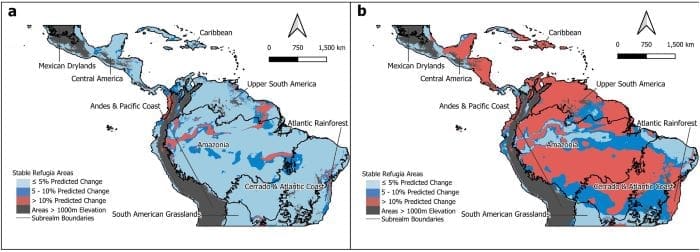
Together, they modeled future precipitation scenarios for the Neotropics under two contrasting climate trajectories: the SSP-8.5 scenario, which reflects a pessimistic view with no carbon mitigation efforts, and the SSP-2.6 scenario, representing a rapid transition to a low-carbon economy.
The researchers focused on how these scenarios might affect the length of dry seasons throughout the region. “Precipitation changes could have a huge impact on these systems, especially with regard to biodiversity, but temperature has dominated the climate change landscape until recently,” Luther explained.
Their findings indicate that under the SSP-8.5 scenario, dry seasons are expected to lengthen by at least 5% across three-quarters of Neotropical lowland forests, endangering nearly 2,000 species of resident birds. In contrast, the SSP-2.6 scenario predicts that only 10% of lowland forests will experience increased dryness, impacting just 90 bird species.
The implications of these longer dry seasons extend beyond bird populations. The changing climate may fundamentally alter tropical ecosystems.
Brawn warns: “Think of a closed canopy rainforest. If it gets too dry, there’s going to be a threshold where it’ll open up and become a savannah. A lot of the forest birds won’t do well in savannahs, but the savannah birds will do better.” He emphasizes that the long-term effects of these transformations remain uncertain.
Mapping predicted changes in dry season length, the researchers identified areas likely to be most affected under both scenarios. Luther emphasizes the importance of recognizing regions that may remain stable: “If we’re going to plan future conservation efforts, we should put extra effort into those areas because they’re less likely to dry out.” This strategic focus will be crucial for prioritizing existing protected areas and potentially establishing new ones.
While the study highlights the more favorable conditions under SSP-2.6, Brawn notes that the reality may be more dire due to ongoing deforestation.
“If anything, we’re painting a rosy picture in this paper because we’re not accounting for deforestation at all. If there are fewer trees, it’s hotter and drier,” he said. The loss of tropical forests continues at an alarming rate, compounding the challenges posed by climate change.
Luther remains hopeful, stating: “The good news is these are all things we can solve, if we choose to. We can do the right thing.”
The study received support from various institutions, including the USDA National Institute of Food and Agriculture and the National Science Foundation.
As the clock ticks toward 2100, the findings serve as a clarion call for policymakers and conservationists alike to take urgent action to mitigate climate change and protect the rich biodiversity of the Neotropics.
Journal Reference:
Jeffrey D. Brawn, David Luther, Mingxin Qu, Sarah M. Farinelli, W. Justin Cooper, Rong Fu, ‘Prospects for Neotropical Forest Birds and Their Habitats Under Contrasting Emissions Scenarios’, Global Change Biology 30 (10) e17544 (2024). DOI: 10.1111/gcb.17544
Article Source:
Press Release/Material by University of Illinois College of Agricultural, Consumer and Environmental Sciences
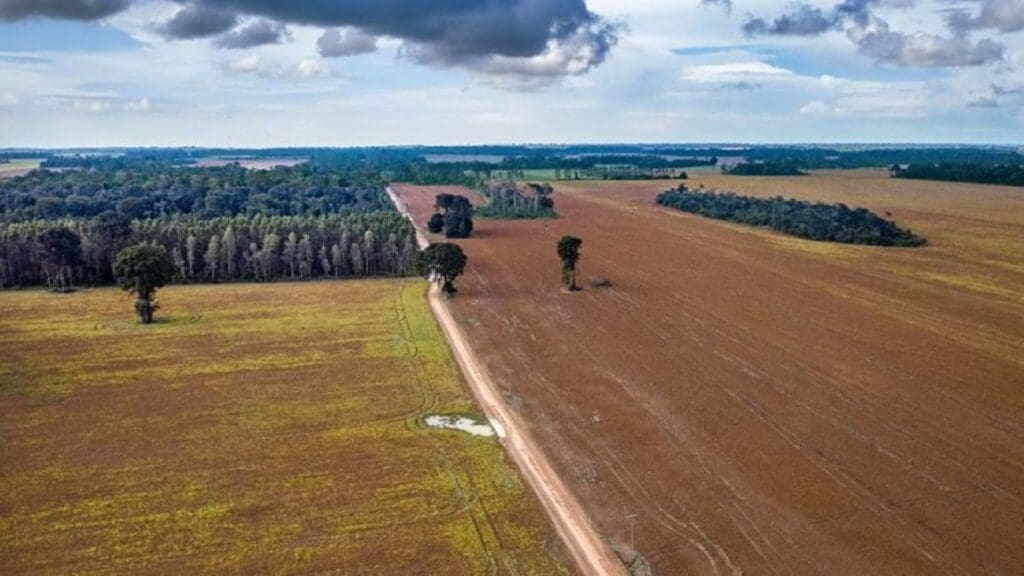
Featured image: Researchers at the University of Illinois Urbana-Champaign and George Mason University project major biodiversity loss in bird groups across the Neotropical region under unmitigated climate change. In contrast, strong, immediate climate actions could reverse that outcome. Credit: John Whitelaw